Working Partners
IPS and CAPFs must work together for the nation’s security and integrity
Yashovardhan Jha Azad
The recent legislative clarification on the command and leadership structure of the Central Armed Police Forces (CAPFs) should have settled a long-running debate. Yet, the discussion continues, often framed as an ‘IPS victory’ or as a measure imposed upon CAPF officers contrary to the spirit of judicial pronouncements. Such characterisations miss the larger issue. The question was never about institutional prestige. It was, and remains, about what best serves India’s internal security architecture.
The decision to retain IPS leadership in the CAPFs is neither a concession to one service nor a denial of the legitimate aspirations of another. It reflects a considered assessment of India’s security needs, the historical purpose for which the CAPFs were created, and the integrated framework through which internal security has been managed since Independence. The debate must therefore move beyond sectional interests and focus on national interest.
The Historical Foundations
The origins of India’s central police forces predate Independence. The force that would eventually become the Central Reserve Police Force (CRPF) traces its lineage to the Crown Representative’s Police established in 1939. The leadership model adopted from the beginning was one in which officers of the Imperial Police—predecessors of today’s Indian Police Service (IPS)—commanded these forces.
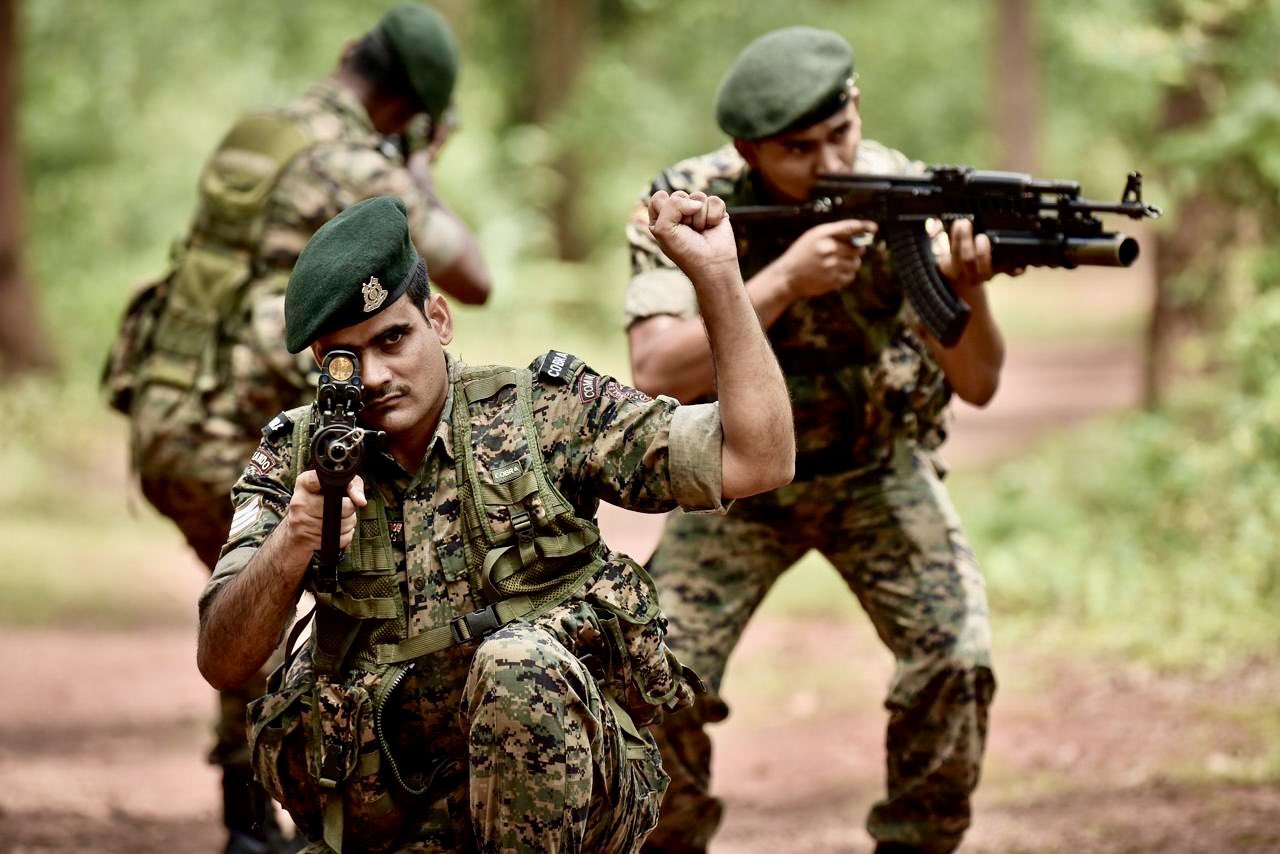
COMBAT DRILL CRPF soldiers during their raising day parade in July 2025
This was not accidental. The central forces were conceived as instruments of national authority that would operate across provinces and later across states. Their role required coordination with local administrations, district authorities, intelligence agencies, and police organisations. The officer corps that possessed such exposure and experience was the Imperial Police and, subsequently, the IPS.
After Independence, India inherited not merely institutions but also serious security challenges—Partition violence, princely state integration, insurgencies, communal disturbances, and border conflicts. The CAPFs expanded steadily to meet these challenges. Throughout this period, IPS officers continued to provide leadership because they brought a unique combination of field policing, administrative authority, and inter-governmental coordination. The rationale that existed in 1947 remains equally relevant in 2026.

The CAPFs and the Leadership Debate
Today, the CAPFs constitute one of the largest internal security structures in the world. The CRPF, Border Security Force (BSF), Central Industrial Security Force (CISF), Indo-Tibetan Border Police (ITBP), Sashastra Seema Bal (SSB), Assam Rifles, and National Security Guard (NSG) together comprise over a million personnel and more than 13,000 Group A officers. For years, CAPF officers raised legitimate concerns regarding career progression, Non-Functional Financial Upgradation (NFFU), cadre management, promotional opportunities, and service conditions. These grievances eventually reached the courts.
The Supreme Court examined several of these issues and recognised the need to address disparities affecting CAPF officers. The Court’s observations principally related to service conditions, cadre status, and career progression. Importantly, however, the Court did not direct the removal of IPS officers from leadership positions in the CAPFs. Nor did it hold that command of these forces must become the exclusive preserve of their own cadres. The subsequent legislative and administrative measures sought to reconcile two objectives: improving career prospects for CAPF officers while preserving an integrated leadership structure.
Unfortunately, sections of the debate thereafter shifted from demands for parity to demands for exclusivity. The distinction is important. Seeking fair career opportunities is legitimate. Seeking complete occupational monopoly over leadership positions raises an altogether different question.

TOP & ABOVE 48th IPS Induction Training Course at Sardar
Vallabhbhai Patel National Police Academy, Hyderabad; and DG
CRPF, G.P.
Singh, IPS with CRPF officers
Who Should Lead?
At the heart of the controversy lies a deceptively simple question: who should lead India’s central police forces? The answer cannot be determined merely by seniority within an organisation. It must be determined by the nature of the mission.
The CAPFs are not military formations operating independently of civilian structures. They are deployed primarily as adjuncts to civil authority. Whether in counter-insurgency, election duties, riot control, anti-Naxal operations, border management, or protection of critical infrastructure, they function within a broader ecosystem involving state police forces, district administrations, intelligence agencies, and central ministries.
The IPS occupies a unique position within this ecosystem. It was Sardar Vallabhbhai Patel who insisted on preserving the All India Services as the steel frame of the nation. The IPS became a crucial link connecting the Union and the states in matters of internal security. An IPS officer begins his career commanding men at a young age in districts. He deals with law and order crises, communal disturbances, criminal investigations, political unrest, elections, disasters, and intelligence operations.
As careers progress, IPS officers command armed police battalions, head district police forces, supervise intelligence wings, lead crime branches, and manage large-scale public order situations. Many subsequently serve in central agencies, ministries, and CAPFs themselves. This creates a rare institutional perspective spanning local, state, and national levels.
That perspective becomes invaluable when CAPFs are deployed in aid of civil power. Unlike the army, CAPFs depend heavily on local intelligence, state police cooperation, prosecution systems, and district administration support. IPS officers, by virtue of their training and career trajectories, are uniquely positioned to provide that integration.
Why the Rank and File Often Prefer Integrated Leadership
Much of the public debate does not present the voices of the rank and file. Yet the reality on ground is that jawans and subordinate officers are principally concerned with operational effectiveness, welfare, clarity of command, and mission success. They operate in environments where state police, intelligence agencies, district magistrates, and CAPFs must function as a single team. An integrated leadership structure helps achieve precisely that.
The rank and file often judge leaders not by their parent service but by their ability to secure resources, coordinate agencies, resolve operational bottlenecks, and protect personnel. In this regard, IPS officers bring networks and institutional familiarity built over decades of service across multiple levels of government.
This does not diminish the competence or commitment of CAPF officers. It merely recognises that the requirements of senior leadership differ from those of tactical command.
Selection, Training and Leadership
The IPS is recruited through one of the toughest competitive examinations in the world. In 2025, nearly six lakh candidates have appeared for the Civil Services examination. Fewer than a thousand were selected for all services combined, and roughly 150 vacancies were there for the IPS.
The subsequent training process is equally demanding. IPS probationers undergo rigorous physical conditioning, weapon training, law, criminology, forensic science, intelligence studies, public administration, leadership development, and field attachments.
CAPF officers too, undergo rigorous training and have repeatedly demonstrated outstanding courage in difficult operational environments. Units such as COBRA have earned national respect through exceptional performance against Left-Wing Extremism (LWE). But courage alone does not define senior leadership.
At higher levels, leadership involves strategic planning, inter-ministerial coordination, policy formulation, diplomatic engagement, resource allocation, intelligence integration, and management of complex crises involving multiple stakeholders.
The issue therefore is not whether CAPF officers are brave enough or competent enough. It is whether the institutional experience required for national-level coordination is more naturally available within the IPS framework.
Evidence from India’s Security Successes
India’s major internal security successes provide useful lessons. The defeat of terrorism in Punjab owed much to the leadership of officers such as K.P.S. Gill and Julio Ribeiro. The campaign succeeded because of coordination between intelligence agencies, police forces, political leadership, and central forces.
The celebrated Greyhounds model in Andhra Pradesh was conceived and led by IPS officers working closely with highly trained state police personnel. Their success transformed the national response to Maoism.
The recent spectacular success against LWE illustrates the value of integrated command. CAPFs played a critical role. So did specialised state formations such as Greyhounds, Jaguars, District Reserve Guards, and intelligence networks. Success emerged not from isolated efforts but from coordinated action.
In Jammu and Kashmir, too, the challenge was addressed through a combination of state police, central forces, intelligence agencies, and military formations operating within a unified framework. The contribution of the CAPFs was immense, but so was the role of leadership capable of synchronising diverse institutions.
These examples demonstrate an important principle: security victories are rarely achieved by a single organisation. They are achieved by systems. IPS leadership has historically functioned as one of the principal integrators of that system.
Reform Without Fragmentation
The real question is not ‘IPS versus CAPF.’ It is architecture versus disaggregation. India faces hybrid threats: terrorism, radicalisation, organised crime, cyber-enabled violence, narco-trafficking, border infiltration, and internal unrest. Such threats demand integration rather than compartmentalisation.
The nation requires stronger CAPFs, not isolated CAPFs. It requires empowered cadres, not competing silos. And it requires leadership structures capable of connecting local realities with national priorities.
Looking Beyond Group Interests
Every service naturally seeks greater opportunities for its members. There is nothing unusual about that. But national security policy cannot be determined by cadre aspirations alone. The test must always be simple: what arrangement best serves India?
For more than seven decades, the present framework has enabled India to confront insurgencies, terrorism, separatism, communal violence, organised crime, and border security challenges. The system is not perfect and should certainly evolve. Yet there is a profound difference between improving a system and dismantling the principles on which it rests.
Conclusion
India’s internal security architecture is a vast and intricate network. The CAPFs are among its strongest nodes—disciplined, courageous, and battle-tested. State police forces and the Intelligence agencies provide the crucial links in this set up. The IPS leadership enjoins these components into a coherent whole, while the political executive gives the direction.
The debate, therefore, should not be about institutional triumphs or defeats. It should be about preserving the unity of command and purpose that India’s security environment demands. Strengthen CAPF careers by all means and expand opportunities. But in doing so, let us not weaken the structure that has enabled coordination across the world’s most complex democracy. The IPS-led model, refined and reformed where necessary, continues to provide exactly that.
The challenge before us is not to choose between the IPS and the CAPFs. It is to ensure that both remain partners in a common mission—the security, stability and unity of India.
(Yashovardhan Jha Azad is a retd IPS officer, who has served as the Central Information Commissioner, Secretary Security GOI and Special Director IB)

VIDEO







