The Indian Army is currently undergoing significant reforms and changes to modernise and enhance its capabilities. This multi-pronged program aims to enhance the army's operational preparedness, optimise its structure, and leverage modern technologies. This ambitious plan, outlined by General Manoj Pande, seeks to address evolving security threats and challenges through five key pillars.
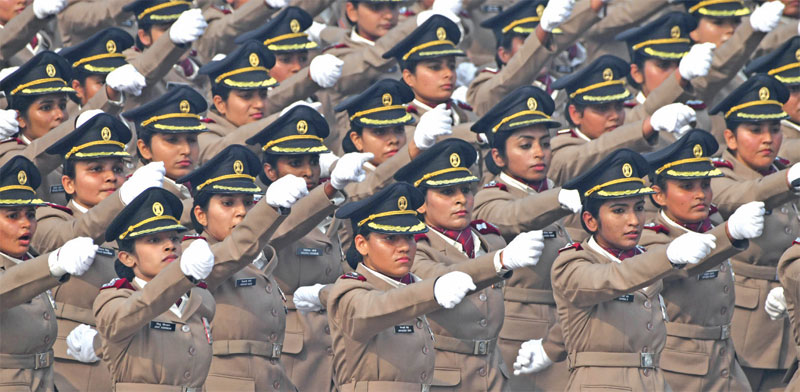
Women personnel of Armed Forces Medical Services at Army Day Parade
Modernisation and Technology Infusion
In 2024, the Indian Army is also looking at indigenous development as a significant area of focus, with initiatives like the Aatmanirbhar Bharat initiative and collaborations with the Defence Research and Development Organisation (DRDO) for defence innovation projects. The Indian Army is observing 2024 as the ‘Year of Technology Absorption.’ The focus here is on acquiring indigenous weapons and systems, upgrading communication infrastructure, and integrating cutting-edge technologies like drones and artificial intelligence (AI). General Pande highlighted the necessity of ‘capability type repair programmes’ and collaboration with academic institutions to accelerate technological adoption. This modernisation drive aims to equip the army with the tools needed to effectively counter modern threats.
General Pande highlighted the Indian Army’s recent advancements in technology, including the induction of improved vehicles, drones and counter-drone systems. He emphasised the adoption of a new operational approach for managing these technologies across infantry, artillery and armoured battalion levels. While dismissing the notion of forming a dedicated force for technology handling, one of the key areas of focus is the modernisation of the army’s tank fleet. In 2024, the Indian Army announced a project worth INR 57,000 crore to replace 1,800 ageing Russian T-72 tanks with advanced AI battle machines. This project aims to produce 1,770 Future Ready Combat Vehicles (FRCVs) starting in 2030. These FRCVs will feature advanced technologies like AI, drone integration and active protection systems. The decision to upgrade the tank fleet was made in response to reports on tank vulnerabilities. Senior officers attribute the heavy losses of Russian tanks in Ukraine to poor tactics, highlighting the need for combined arms operations. The new FRCVs are being planned with enhanced survivability, especially against aerial threats, and connectivity.
In addition to the FRCVs, the army plans to induct the first batch of 118 indigenous Arjun Mark-1A tanks. These tanks come equipped with various upgrades to boost firepower, mobility, endurance and protection.
The Indian Army is actively enhancing its capabilities in cyberspace through training initiatives and technological advancements. Project SAMBHAV, short for Secure Army Mobile Bharat Version, which introduces a secure mobile ecosystem powered by advanced 5G technology, plays a significant role in this endeavour.
Project SAMBHAV is an initiative by the Indian Army to create a secure mobile ecosystem powered by advanced 5G technology. The system ensures high data security through multi-layered encryption and is network-agnostic, allowing it to operate seamlessly across different networks.








 VIDEO
VIDEO