

In a Gilded Cage
India-US trade framework and alignments portend unravelling of its strategic autonomy
 By Jawahar Bhagwat
The global geopolitical situation of February 2026 is defined by a paradox: as India moves closer to the United States (US) through a series of interlocking frameworks, the very ‘strategic autonomy’ that New Delhi has guarded for decades is being gradually dismantled. From the threat of punitive tariffs to the technological enclosures of ‘Pax Silica,’ the relationship has shifted from a partnership of mutual interest to a master class in coercion euphemistically called American economic statecraft.
Trade Framework and Tariff Sword
The foundation of this new alignment is a coercive trade framework that treats market access as a tool of political discipline. Since August 2025, the shadow of tariffs has hung over the Indian economy. President Donald Trump characterised these as a response to India’s support for Russian energy. However, in the background was also India’s refusal to accept President Trump’s role in ending the India-Pakistan hostilities of May 2025, which may have affected his ambitions for the Nobel Peace Prize.
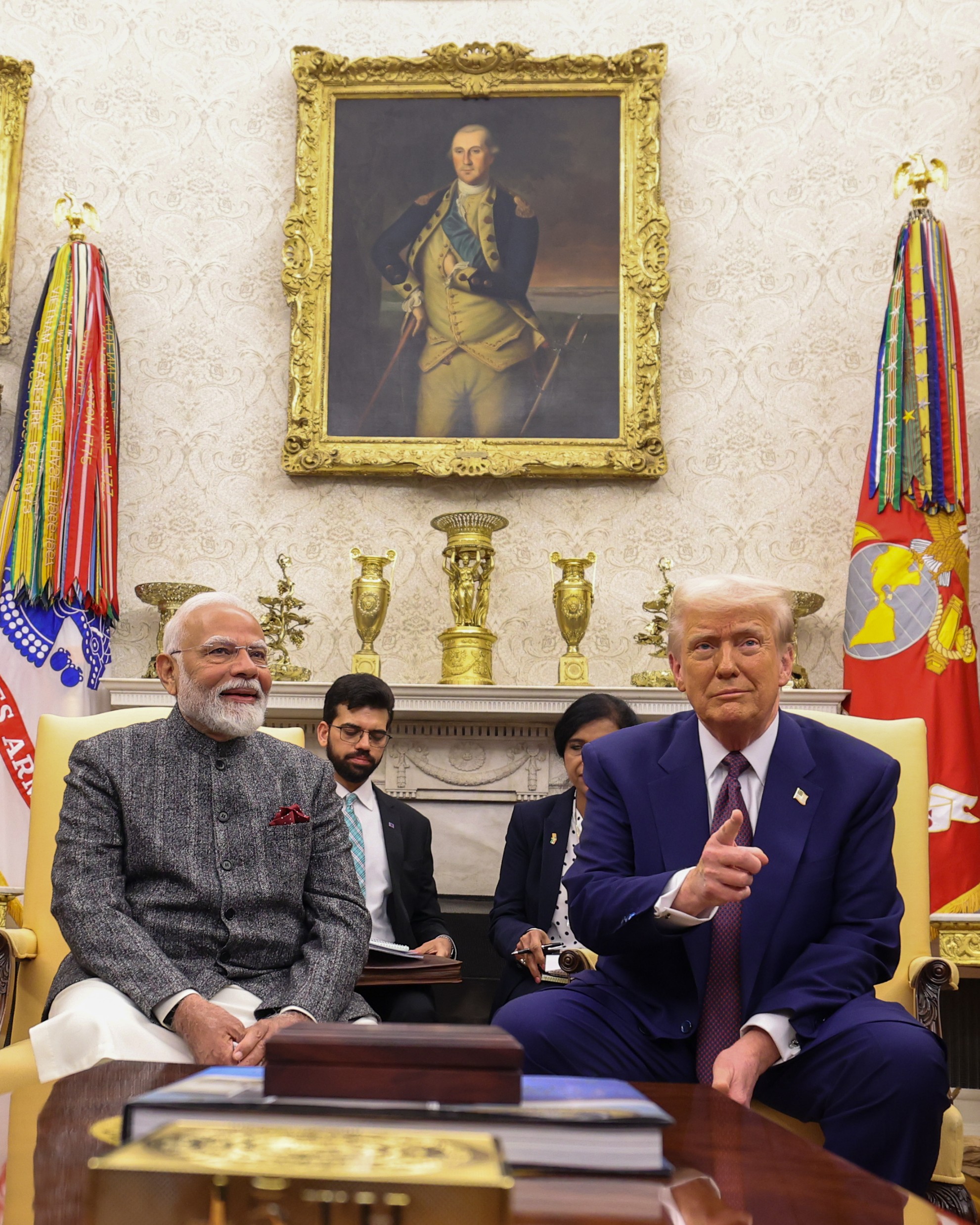
President Trump has effectively weaponised the US market, allowing the administration to bypass World Trade Organisation (WTO) norms and use trade as a blunt instrument. For India, this creates a state of perpetual economic insecurity, where trade deals are not settled law but ‘active negotiations’ subject to the whims of the White House.
On 20 February 2026, the US Supreme Court delivered a landmark ruling that President Trump exceeded his authority under the International Emergency Economic Powers Act (IEEPA). The Court held that while the law allows the president to ‘regulate’ commerce during national emergencies, it does not grant the unilateral power to ‘lay and collect’ tariffs—a power explicitly reserved for Congress under Article I of the Constitution.
While this ruling effectively nullifies billions of dollars in emergency tariffs and opens the door for massive importer refunds, the reprieve for India may be short-lived. Within hours, the administration pivoted towards Section 122 of the Trade Act of 1974, which permits temporary import surcharges to address balance-of-payments deficits. Unlike Trump’s earlier actions, tariffs under this provision can only be raised to 15 per cent, and only for 150 days, unless Congress extends the duties. This ensures that trade remains a weapon of negotiation, regardless of the judicial setback, as Washington continues to use market access to demand geopolitical alignment.
However, the narrative of India being a ‘trade predator’ is mathematically flawed. If Indian trade negotiators know their job and present the full picture, the reality is starkly different from the ‘America First’ rhetoric. According to data from the Global Trade Research Initiative (GTRI), once services and defence equipment are factored in, the US enjoys a USD 35-40 billion surplus with India. By ignoring the massive outflows from India for American software, consulting, and multi-billion dollar arms deals, Washington manufactures a grievance that justifies its protectionist stance. Moreover, India’s commitment to buy USD 500 billion of goods from the US would mean a compromise of India’s energy security, agricultural sector, digital sovereignty and defence preparedness due to the purchase of expensive equipment subject to controls, of dubious value and unsuited to modern warfare.
Beyond immediate trade math, India faces the risk of tethering its future to a ‘Great Power’ in retreat. As Paul Kennedy argued in The Rise and Fall of the Great Powers, ‘imperial overstretch’ occurs when a nation’s strategic commitments exceed its economic capacity—a phenomenon now visible in Washington’s desperate use of coercive tariffs. Furthermore, historian Alfred McCoy warns again in his recent book Cold War on Five Continents: A Global History of Empire and Espionage that as empires/ countries decline (Spain, Dutch, France, Great Britain, Tsarist Russia and the Soviet Union), they often pivot such as the US to defence overreach and spending beyond means to maintain control. McCoy predicts that US global hegemony may end by 2030, followed by a period of Chinese leadership before the environmental crisis reshapes the world order entirely. By aligning too closely with a fraying Pax Americana, India risks being dragged into the volatility of a hegemon’s twilight, sacrificing long-term autonomy for the protection of a fading shield.
The Digital Enclosure
Where tariff threats provide the pressure, the Pax Silica Declaration provides the structure for long-term dependence. Signed under the guise of building ‘resilient supply chains’ for critical minerals and Artificial Intelligence (AI), Pax Silica is an attempt to decouple India from Chinese manufacturing while simultaneously tying it to American standards.
As analyst Isha Oswal has observed, outsourcing these core capabilities carries security risks. Furthermore, there is the environmental cost of these centres. This arrangement facilitates the ‘export’ of Indian data for conversion into AI algorithms that boost the valuations of Big Tech abroad. In an era where even Europe is erecting digital walls, India remains the last frontier for ‘free data.’ This facilitated drainage of data represents an extreme form of neocolonial exploitation, robbing India of its Digital Industrial Policy tools.
The joint statement on AI cooperation, an addendum to the declaration, commits India to a regulatory environment that is ‘friendly’ to innovation. In practice, this means India is being pressured to abandon data sovereignty and robust privacy protections that might hinder American tech giants. By aligning with Pax Silica, India risks becoming a provider of raw data and a consumer of American ‘compute,’ surrendering its digital future to ensure its hardware supply chain remains ‘secure’ from Beijing.
Chabahar Port
This economic statecraft extends to India’s geographical ambitions to develop alternative shipping routes. The US imposition of periodic sanctions on the Chabahar Port project in Iran has effectively compromised India’s efforts to develop an alternative trading route to Central Asia and Russia. By blocking this corridor, Washington ensures that India remains dependent on US-approved maritime routes and limits New Delhi’s ability to develop a partnership with Eurasia. The message is clear: India’s connectivity projects are only permissible if they do not bypass the American-led financial and physical architecture.
India-US-Europe Defence Mirage
To mitigate this US centricity, India has sought a counterbalance through the India-Europe Defence Agreement. However, this pursuit is increasingly viewed as a mirage. To date, Europe has failed to transfer any sensitive technology to India. The crux of the issue is that a significant portion of European defence intellectual property is either borrowed from or co-developed with the US. This involvement allows Washington to use ‘economic statecraft’ to prevent the export of critical components or ‘black box’ technologies.
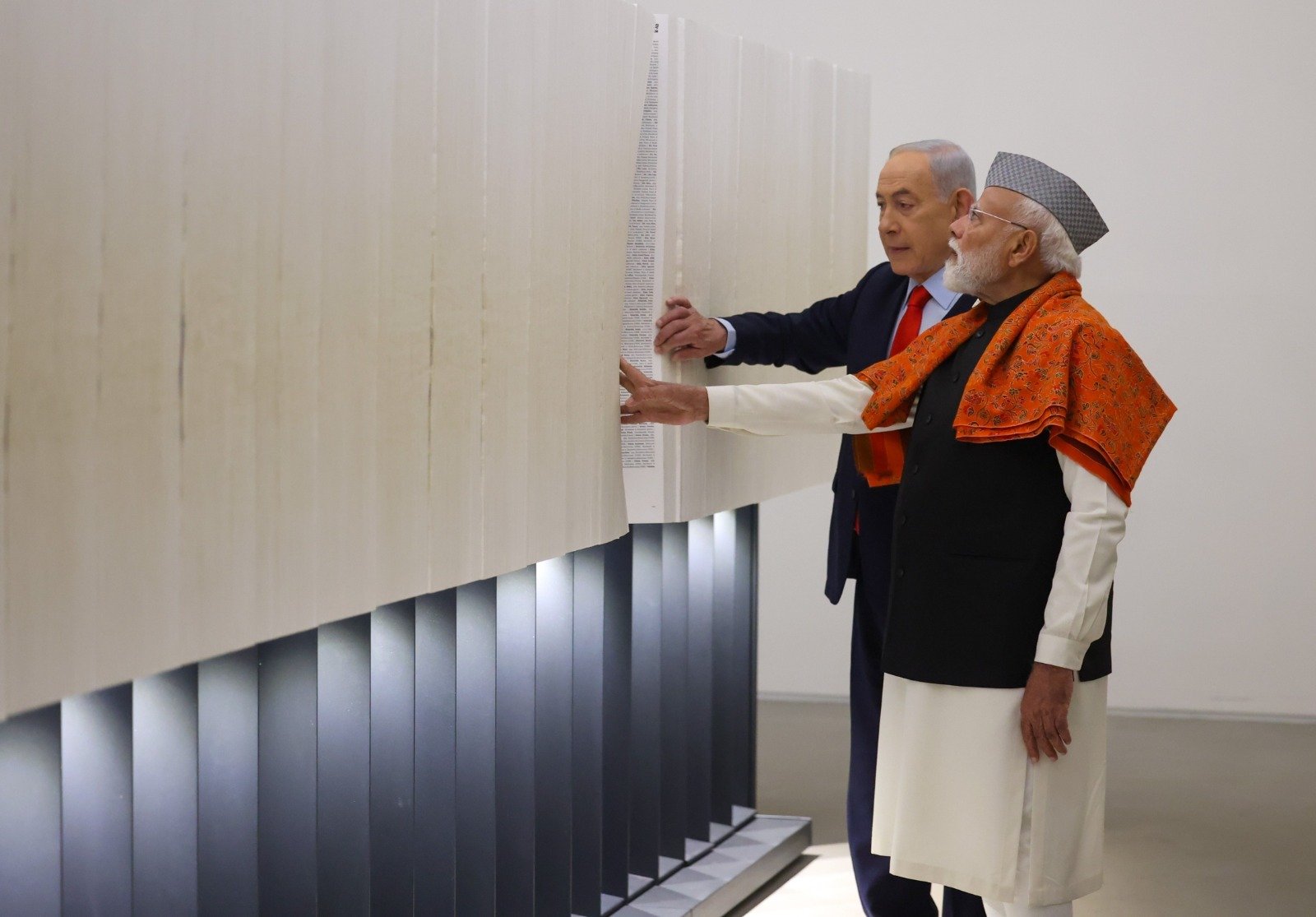
TOp & ABOVE Modi at Yad Vashem the World Holocaust Remembrance Centre in Israel 26 Feb 2026; force-2
Even when dealing with Brussels or Paris, New Delhi finds that the path to high-end military capability is still gated by Washington’s veto. India is permitted to buy the hardware, but source codes or the ‘sensitive’ core remain under foreign lock and key, ensuring India cannot achieve true self-reliance in defence manufacturing. India’s signing of a deal with GE for Tejas engines, despite numerous delays, indicates that even this project is likely to be subject to American coercion. The only projects that have achieved some level of indigenisation are those with Russia in the fields of space, missiles, and submarines.
Conclusion
The ‘unravelling’ of India’s strategic autonomy is not the result of a single defeat, but a series of tactical retreats. By yielding on an interim trade framework with the world’s biggest debtor nation, AI regulation via Pax Silica, accepting the strangulation of the Chabahar route, and participating in free trade deals with declining powers to stave off tariffs and in search of trading diversity, India is entering a framework where its policy choices are increasingly made in Washington and serving neo-colonial interests. Despite a real trade deficit in services and arms favouring the US, India remains inexplicably on the defensive.
For India, the challenge of 2026 is to move beyond ‘neti-neti’ diplomacy and leverage its USD 40 billion ‘hidden’ trade deficit to reassert its right to an independent foreign and economic policy. If it fails to learn the lessons of industrial and technological (including digital) sovereignty from China, India risks trading its hard-won autonomy for the ephemeral comfort of a ‘Pax Silica’ cage. It remains to be observed whether India can reassert its interests or if it will remain a junior partner in a ‘Pax Silica’ world, where technology and trade are the new frontiers of neocolonisation.
Well-known international relations theorist today, John Mearsheimer, stated in a recent article on the India-US negotiations, “’That outcome (greater economic intercourse with the US) is a potential danger, because as we have seen in recent years, the US does not hesitate to brandish that leverage against allies and rivals alike.’ India needs to clearly identify national interests in negotiations; develop alternative partnerships and invest in its own technological capacities. This is the only way India can retain even a limited role as an independent centre of power in a multipolar world.
(A former captain of INS Chakra, INS Shishumar and INS Shalki, the writer is a strategic affairs analyst and author of books Evolution of India’s Polar Policies and Russian Policies for the Development of the Northern Sea Route)



 VIDEO
VIDEO