The Indo-Pacific, a recent geopolitical construct, is the centre of attention globally. Even though the expanse of the region is debated, roughly, it is understood to be an interconnected space between the Indian and the Pacific oceans. The region has gained significance because of the fierce US-China rivalry.
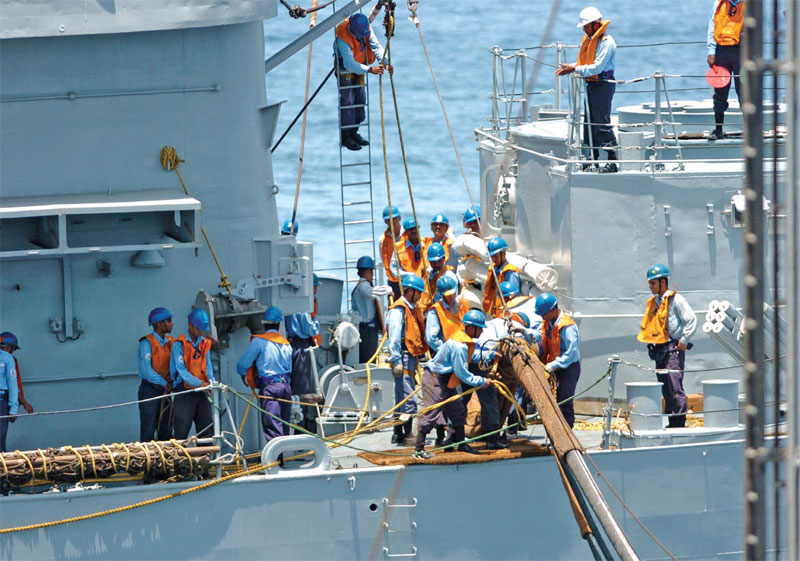
Indian and UK Navy personnel during exercise Konkan
However, even without the competing interests of the present times, the region has always been immensely important for global trade; with some of the most powerful militaries of the world operating here. Countries around world are conscious of the threat that looms in the region. Thus, most countries have been working on fostering peace and stability in the region.
The United Kingdom’s tilt towards the Indo-Pacific is well-known and goes well past the current coinage. Post-colonialism, India has been a key factor in its geostrategic interest in the region. In furtherance of that, on 16 March 2021, the UK released the Integrated Review of Security, Defence, Development and Foreign Policy, which was followed by its Defence Command Paper on 22 March 2021. The Integrated Review, titled, ‘Global Britain in a Competitive Age’ highlights UK’s ‘Indo-Pacific tilt’, with China’s rising power and assertiveness being a cause for concern.
As the Indo-Pacific becomes an important region, the significance of India, being a regional power and its navy being a formidable force in the Indian Ocean Region (IOR), comes into the picture. India and UK share a modern relationship woven with diplomatic, trade and military ties. In India’s ministry of external affairs’ own words, “India and the United Kingdom share a modern partnership bound by strong historical ties.”
From the Past to the Present
British came to India in search of spices for the purpose of trade. The Britishers, with the aim of concentrating all resources in their hand, started to interfere in local politics in different provinces of India. The East India Company soon established trading posts all over the eastern and western coasts of India. In turn, Calcutta, Madras and Bombay became three major trading towns.
After the first Indian uprising of 1857, the Company was dissolved in 1858 and the British Crown took direct control of India. After the British left, and India ceased to be a colony, the two countries established bilateral relations at a number of levels, including trade, investments, defence, education and culture. In 2004, the bilateral ties were elevated to ‘Strategic Partnership’. Then Prime Ministers Dr Manmohan Singh and Tony Blair adopted a Joint Declaration titled ‘India-UK: Towards a New and Dynamic Partnership’ in London. This entailed annual summits and regular meetings between foreign ministers. The visit of Prime Minister David Cameron to India in July 2010 further elevated the relations to ‘Enhanced Partnership for the Future’.
Cut to May 2021, Prime Ministers Boris Johnson along with Narendra Modi elevated the ties to the level of Comprehensive Partnership while also announcing enhanced defence cooperation. The two prime ministers, in a virtual summit, unveiled a ‘2030 Roadmap’. The leaders reaffirmed the benefits of closer cooperation in a free and open Indo-Pacific, recognising their shared interest in regional prosperity and stability.
The two countries are also working to conclude a Logistics Memorandum of Understanding that will enhance the joint ability to tackle shared challenges. The roadmap includes commitments to expand UK-India health partnership to enhance global security and pandemic resilience; to tackle climate change, deepen economic relationship between the UK and India through an enhanced trade partnership while also aiming for a free trade agreement which would double the UK-India trade over the next decade.





 VIDEO
VIDEO