

All Guests Are Not Welcome
India needs to implement a strong domestic law for refugee protection
 Nandita Haksar
For the United Nations (UN) system, the rule of law is a principle of governance in which all persons, institutions and entities, public and private, including the State itself, are accountable to laws that are publicly promulgated, equally enforced and independently adjudicated, and which are consistent with international human rights norms and standards.
Refugees have always been pawns in international politics but now they have taken centre-stage in international political stage with the distinction between refugee and migrants been blurred allowing governments all over the world to use them as scapegoats for everything from unemployment to climate change.
However, India had till recently been welcoming to refugees.
India has a reputation for tolerance and respect for diverse nationalities, religions and cultures. This is the image of India from the time India championed Third World unity or the spirit of Bandung as it was known in the Nehru years.
Even if in India the memory of the Bandung spirit is all but obliterated, people all over Asia and Africa still think of India as a haven for tolerance of diversity and when their countries are engulfed in deadly civil wars and conflicts they think of going to India in the hope of getting refuge, a safe harbour till they can return.
These deadly wars, conflicts and violence are the result of Western interventions and vested interests in grabbing natural resources. The bombing and violence in Iraq, Syria, the partition of Sudan, and the civil war in the Democratic Republic of Congo has pushed people to leave their countries and many of them have taken refuge in India.
Most of these refugees have been through multiple personal tragedies, from seeing their loved ones killed or their family members kidnapped, the terrible trauma of leaving home and arriving at a new country with nothing except a few clothes and some cash which gets over in a few months as they navigate their way in their new environment.
That is how India hosts refugees from countries as far as Somalia, Ethiopia, Yemen, Sudan, Iran, Iraq, Syria and from countries nearer home like Afghanistan, Myanmar and Sri Lanka. So far, they have found ways and means to survive because they have largely been welcomed as tenants by Indians, schools have opened their doors and hospitals have been available.
But the growing climate of intolerance in our country has caught these refugees in its clutches. The target has been mostly Muslim refugees, beginning with the Rohingyas of Myanmar to more recent arrests and detentions of African refugees from Sudan and Somalia; and from Yemen.
The police have hunted down African refugees in Delhi, India’s capital and dumped them at the Lampur Seva Sadan. The men are torn away from their wives and small children and kept in indefinite detention without access to lawyers or help. When journalists have asked the police why they are being arrested, the police say it is routine arrests of foreigners who do not have visas.
When the refugees recognised under the mandate of the United Nations High Commission for Refugees (UNHCR) show their identity cards, the police throw the card at their faces and say the cards are not recognised by the Indian law. This is happening very frequently, and the refugee community is facing unbearable stress and anxiety.
Recently, a Supreme Court judge, Justice Surya Kant, said in open court while hearing a petition filed by a refugee from Africa that the UNHCR has merely opened a showroom and are issuing cards. Unfortunately, the judges not only refused to give protection to the refugee, but they also made a series of remarks which reflected the widespread ignorance of the law on refugee rights.
It is true that that India is not a signatory to the UN Convention on Refugees of 1951 and India does not have a domestic law for the recognition and protection of refugees. However, over the years, various high courts and the Supreme Court have recognised a category of foreigners called refugees (as distinguished from migrants and other foreigners such as students, patients, businessmen or tourists) and have protected refugees from deportations.
Moreover, India is a member of the executive committee of the UNHCR. Every year it has attended the meetings and commended the work of the UNHCR and promised to cooperate with the UN organisation.
Take for example the statement by India at the General Debate of the 76th Annual Session of UNHCR Executive Committee (ExCom) on 6-10 October 2025 delivered by K. S. Mohammed Hussain, Counsellor & Legal Adviser, Permanent Mission of India, Geneva.
He said, “As a host to refugees, we also commend other States currently hosting displaced persons in their territories. It is important for the world to recognise and understand the humanitarian responsibility that the host States, including India, continue to shoulder to ensure the well-being of refugees and displaced persons. We urge the international community to enhance its support to such States engaged in providing humanitarian assistance to refugees.’
“Mr Chair, India would like to commend the contribution being made by the Office of UNHCR in dealing with global refugee issues. The affirmation of the Global Compact on Refugees as a voluntary, apolitical, non-prescriptive and cooperative action-oriented framework premised on national ownership was a milestone step in the right direction.’
“We encourage UNHCR to continue to help build, strengthen and use national capacities for protection and humanitarian action and increasingly work with local responders for ensuring localisation of solutions and ownership of the process.’
“Mr Chair, we take this opportunity to renew India’s commitment to UNCHR’s mandate to address refugee situations and look forward to productive outcomes through constructive engagement during this 76th Session of the Executive Committee.” The full speech is available at https://pmindiaun.gov.in/statements/MzYxMA.
This stand goes directly against the remarks made by the Supreme Court in several cases about the role of UNHR and refugee protection.
Last year, the government passed the Immigration and Foreigners Act, 2025. This Act does not apply to refugees, especially those recognised as refugees under the mandate of the UNHCR. The government of India has directed the NHRC to draft a domestic law for the protection of refugees. NHRC has even brought out a pamphlet on refugee protection in 2024.
NHRC has had several rounds of talks with different stakeholders, including the UNHCR as a process of drafting the refugee protection law. Refugee protection law would take its justification from the Constitution of India which guarantees the right to life and liberty under Article 21 to every person, regardless of whether they are a citizen of India or not; and Article 14 which guarantees equal right before the law is also available to non-citizens.
It is perhaps just for this reason that the NHRC does not adhere to international human rights standards by upholding India’s obligations under international law that it has so far been denied accreditation. The Global Alliance of National Human Rights Institutions (GANHRI) deferred, and subsequently recommended downgrading the India NHRC’s ‘A’ status to ‘B’ in 2023-2025 due to concerns over lack of independence, non-transparent appointments, police involvement in investigations, and poor civil society cooperation. This could limit India’s ability to participate in important UN debates.
It is true that both Europe and Americas have taken anti-refugee and migrant stands and there have been large scale deportations. I had written about these developments three years ago in FORCE (February 2023.)
Since the US has withdrawn funding to UN organisations and to NGOs, many of whom looked after refugee interests in India, the UNHCR too has started withdrawing from many of its functions. The NGOs which were affiliated or worked in close collaboration with the UNHCR do not offer the services which they once provided such as medical, educational or legal.
Thus, the refugees are left without any protection at all. In a rising atmosphere of hatred and suspicion where refugees are being called ‘terrorists’ there have been vicious attacks of refugees. For instance, when refugees were protesting peacefully outside the UNHCR community centre in Vikaspuri, someone came and threw pesticide on them injuring a six-month-old baby of a Syrian refugee. Another time, a Myanmarese refugee child was stabbed several times and left in a park with his intestines falling out. A passerby admitted the boy to a hospital, which demanded Rs 4 lakh from the refugee’s parents who had barely enough to eat. An Iraqi refugee was beaten because he requested a drunken neighbour to tone down his radio.
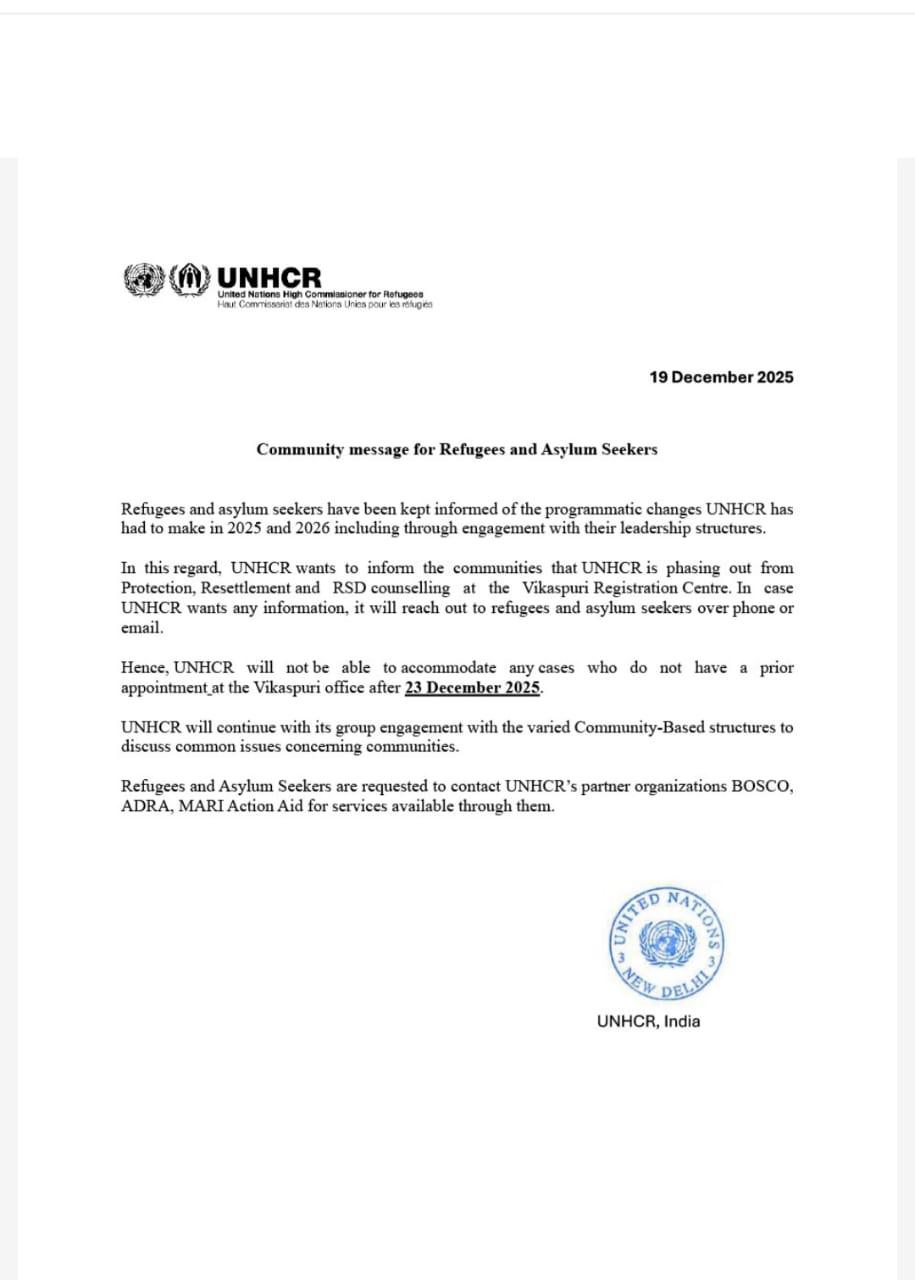
And now UNHCR has sent a notice virtually withdrawing from refugee protection and resettlement. They cannot protect a refugee from illegal arrests. And with the West having closed its doors on refugees, UNHCR cannot help them get resettlement in western countries, except for a few.
Often people react by saying that why should they care about refugees. The answer is simple: because they are fellow human beings. But this violence on people who cannot protect themselves only shows the level of dehumanisation of our society and of the abuse of power that the police can exercise without check and it does not stop at refugees; it will extend to citizens.
Just a few years ago, in 2019 the home ministry had issued Standard Operating Procedures (SOPs) for refugees to the police. These have for some reason been kept confidential. However, in a petition filed by an African refugee before the NHRC, the prayer is that the NHRC issue these guidelines to all police for detention of refugees who have the UNHCR card in a notification No. 2502fl34/20fl1-F.lV
The guidelines show that the home ministry was taking steps towards refugee determination but unless the police are trained in the procedures, they cannot be expected to conduct these procedures. In the absence of training, the police get wrong ideas of their powers and are susceptible to bribes. The entire legal system is being corrupted because there is no domestic law for refugee protection.
Political parties have not taken interest except for three leftist members of Parliament (MPs) who did raise their voices against the brutality of arrests of African refugees; and many years ago, Congress minister Shashi Tharoor did put forward a Private Members Bill on refugee protection but did nothing to follow up. Tharoor is well conversant with refugee protection and could possibly intervene effectively.
Refugee protection is a core value of Indian ethos and is something to be proud of, rather than aping the West in its brutalities and double standards.





 VIDEO
VIDEO