Main concern of the Fighter/Bomber aircraft pilot re-entering own territory after a mission has been the friendly fire it might encounter while flying over the Tactical Battle Area (TBA). Historically, many aircraft have been lost in this manner during various campaigns. Usually, ground-based forces fear adversaries’ air forces more than they respect their own. These days, ground forces have been equipped with all kind of weapons to protect themselves against potential air attacks.
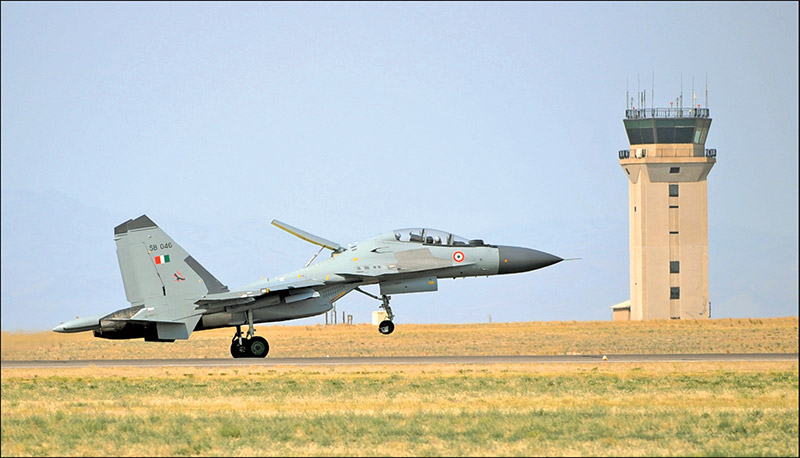
An Indian Air Force SU-30MKI touches down at Mountain Home Air Force base, United States
Presence of missiles of various kind and Air Defence (AD) guns in the TBA not effectively integrated into the broader national AD network have the potential to mistakenly fire at own aircraft. The National AD network is usually responsible for the air defence of the entire airspace, Vulnerable Areas (VAs) and Vulnerable Points (VPs) spread across the country. It is responsible for identification of all the flying objects in the airspace to segregate friend form the foe. The number of flying objects is likely to increase manifold with the Unmanned Aerial Systems (UAS) taking to sky. UAS or RPAs (Remotely Piloted Aircraft) as they are more familiarly called by the Directorate General of Civil Aviation (DGCA) would usher in many uncertainties in the command and control of the flying objects.
All flying aircraft, military or civil are required to be identified while flying over own airspace. Usually, civil aircraft fly on predetermined routes according to a predetermined schedule. It is easy to identify them procedurally or through technological solutions. That is not the case with military aircraft which are required to fly as per mission requirements dictated by operational considerations. An incoming aircraft from across the border could be a friendly aircraft returning after a mission or it could be an adversary’s strike mission heading towards important targets. Under such circumstances, technological solutions are more reliable. Procedural solutions are also used to complement the technology.
Technological solutions have evolved over a period of time. Primary surveillance radars with both transmitter and receiver at ground station and with no corresponding equipment on board the aircraft were able to pick up flying objects at long distances, but they could not be used to discriminate between friend and foe. Secondary surveillance radar systems with transmitter and receiver on board of the aircraft as well became handy for identification. The ground tans-receiver or interrogator would send interrogation signals and flying aircraft trans-receiver or transponder would send reply signals which along with the primary radar echo would result in the identification of the aircraft.








 VIDEO
VIDEO