

Guest Column | A Game Changer
On 26 February 2019, India used its air power to attack the terror camp in Balakot in what could be termed as a classic example of the Indian Air Force’s (IAF’s) strike prowess. The Mirage pilots demonstrated skills of meticulous planning, tactical acumen and flawless execution with utmost professionalism. The nation felt euphoric as the country delivered a befitting response to the perpetuators of the Pulwama tragedy. Hitherto, air power had never been used across borders in an undeclared war situation. The value of any weapon system lies in how it is used to deliver the overall political message. In executing the strike, in the manner we did, India conveyed that it cannot be pushed beyond a point no matter how high the risk or how loud the noise at the ground level maybe. Those involved in the decision making and execution deserve a compliment.
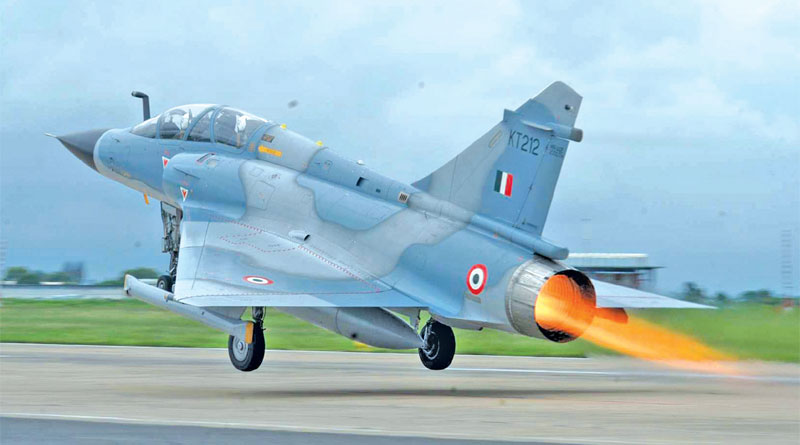
IAF’s Mirage 2000 taking off
There has been a lot of conjecture as to why air power was seen as an unmitigated asset for use in our war on terror. Had it acquired an aura of fear, guilt or culpability owing to the perception that air power was inherently escalatory and could trigger an unprecedented and probable nuclear response making it unworthy. Or was it owing to international and strategic ramifications of violating the sovereignty of another nation, or was it the risk to aircraft and aircrew, or the inadequacy of targets for an aerial weapon given the collateral risk to innocent civilians, or was it insufficient / inadequate actionable intelligence, or was it purely lack of political will, in the backdrop of all the above or a combination of such factors. Be that as it may, the nation’s security apparatus had finally shown gumption and contemplated the use of air power. Probably, the leadership was compelled by the sheer audacity of the February 14 terror attack that martyred 44 Central Reserve Police Force (CRPF) jawans, and driven to convey the anguish, resolve and combativeness for over decades of humiliation by Pakistan initiated terror strikes, and realised that only air power could carry the requisite bellicosity in such an exigency.
The use of 12 Mirage aircraft to target the infrastructure of the terror camp seemed an appropriate and proportionate option to convey our dissension. Our offensive air power capability is extremely capable, effective and reliable, given the mix of stand-off Smart Weapons (both air-to-ground and air-to-air), Electronic Warfare suites, Air Defense network, AWACS, Aerial Refuelers, onboard computers and communication systems. Strike planning would have factored each of these elements in the required fit for the task. While the intricate details would be known only to those in the IAF responsible for its execution, it is not difficult to imagine that the increased stand-off potential of smart weapons and communications with our radar system network, would have made it feasible to attack the target with lesser miles to ingress into enemy territory, thereby reducing risk to aircrew. Air power’s geographic flexibility (regardless of terrain) would have allowed tactical routeing and use of decoys masking the exact point of attack. Air defence cover would have provided the requisite umbrella to ward off any interception in the contested air space. Precision-guidance weapons would have accorded a high hit probability alongside minimising collateral damage and accurate intelligence would have been the planning start point. Air power works best between clearly distinguishable adversaries, in empty and uncluttered terrain, against identifiable targets. The mission would not have found a better target than the Balakot terror training camp on a hill top by the Kunhar river in the Khyber Pakhtunkhwa province. It was away from populated areas, with clearly discernible buildings and fitted extremely well in this lexicon. With the element of surprise, success was in the underbelly from the very start.
Subscribe To Force
Fuel Fearless Journalism with Your Yearly Subscription
SUBSCRIBE NOW
We don’t tell you how to do your job…
But we put the environment in which you do your job in perspective, so that when you step out you do so with the complete picture.






 VIDEO
VIDEO