

Fight for the Fighters
Atul Chandra
The Indian Air Force (IAF) and Indian Navy (IN) appear to be closing the gap between anticipation and reality with regard to acquisition of high-end fighter aircraft to meet their long-pending requirements. The main fighter types for both services at present are made of Russian built fighter aircraft with the air force operating Sukhoi SU-30 MKIs, MiG-29 UPGs and IN operating the MiG-29K astheir sole carrier borne fighters.
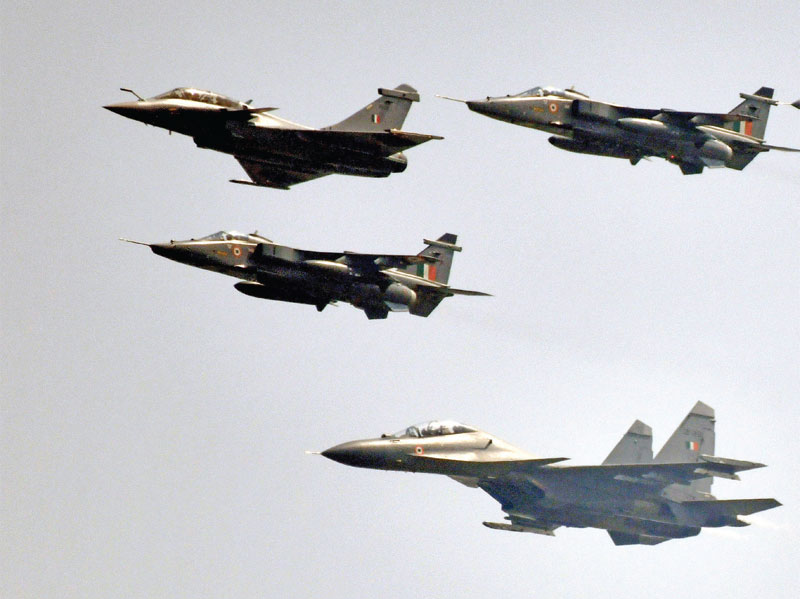
Both these fighter types have been uniquely customised to meet Indian requirements and feature a unique mix of Russian, European and Indian systems. However, both services require newer fighters to effectively operate in a modern battle space filled with unmanned systems, high-end air defence systems, decoys and countermeasures.
Faced with Chinese superiority in terms of men, material and infrastructure on its conflicted Eastern borders, air power is now of supreme importance due to its ability to deliver high volumes of precision fire power on targets of importance. One need only study the lessons of the 1999 Kargil War to revisit the importance of air power. Hence, induction of newer fighter aircraft now acquires an even greater importance.
Yesterday Once More
The September 2016 Inter-Governmental Agreement (IGA) between India and France led to a contract for procurement of 36 Rafale F3-R aircraft in fly-away condition. The Euros 7.8 billion contract included purchase of 36 Rafales, along with an initial lot of weapons, Performance Based Logistics (PBL) maintenance support for five years, simulators, training and associated equipment. This was followed by the ministry of defence’s (MoD) release of a request for information (RFI) in April 2018 for procurement of new fighter aircraft.
The procurement sought to acquire 86 single-seat and 28 twin-seat fighters, with up to 18 aircraft (1 Squadron) to be acquired in flyaway condition. The remaining 96 aircraft were to have been produced in India by a Strategic Partner/Indian Production Agency (SP/IPA). Each aircraft would be expected to generate an average flying effort of 150 hours per year as per the RFI which also asked for a Performance Based Logistics Package (PBL) with an aircraft availability rate of 75 per cent.
The April 2018 RFI called for the first fly-away aircraft to be delivered within three years of contract signature and delivery of the last fly-away aircraft to be completed by the fifth year. This would mean that the IAF will receive a squadron worth of aircraft over a two-year period. “Delivery of aircraft produced by the SP/ IPA should commence by T0+5 years and complete by T0+12 year. (T0 would be the date of signing of the contract),” the RFI had stated. As can be seen from these time lines, if a new fighter contract is concluded by 2023, then the IAF will receive a squadron worth of aircraft between 2025-2027 and would receive the first Indian built aircraft by 2038 and deliveries would be concluded by 2038.
There is news now emerging from various media outlets that the MoD is looking at ways to speed up the IAF fighter acquisition process. There are now increased indications that the ‘Buy Global, Make in India’ model would be preferred over the ill-fated ‘Strategic Partnership’ model. There are also indications that the fighter procurement will be broken up into a smaller quantity—54 aircraft now to be acquired, with 18 as fly-away and 36 to be built in India. This approach does not seem to take into account the prohibitive costs of paying the foreign OEM to establish a new production line with attendant supply chain in India, train the Indian workforce on the production line, as also the high ‘Transfer of Technology’ fees. Recouping this amount from an initial production run of 36 aircraft is unlikely to prove feasible and would require a follow-on order for additional aircraft to be placed sooner, rather than later.
Subscribe To Force
Fuel Fearless Journalism with Your Yearly Subscription
SUBSCRIBE NOW
We don’t tell you how to do your job…
But we put the environment in which you do your job in perspective, so that when you step out you do so with the complete picture.



 VIDEO
VIDEO