India faces insurmountable internal security challenges such as terrorism, Left-Wing Extremism, insurgency, and ethnic turmoil. Our constitutional structure is federal, wherein federalism defines the division of powers between Union and state governments. Police and public order falls under a state’s domain, thus primary responsibility to deal with internal security challenges lies with state governments.
Yet, it is often seen that the police is not able to maintain routine law and order which forces states to requisition Central Armed Police Forces (CAPFs) to deal with internal security challenges. Article 355 makes it incumbent upon the Union to continuously evaluate external and internal security situation and protect states against external aggression and internal disturbances.
As such, there is a need to carry out an in-depth analysis of national security challenges and evaluate response mechanism regularly. So, what are the major internal security challenges? The Committee of Estimates, ministry of home affairs (MHA) 28th report for the year 2017-18 and MHA’s annual report 2022-23, categorises internal security challenges as under:
Surprisingly, these internal security challenges have remained constant, which means that no in-depth analysis of dynamic internal security challenges has been done in a structured manner. Without analysis, there cannot be a structured response to deal with such dynamic challenges. Piecemeal response may not serve the purpose. Over the years, new challenges have emerged such as:
The new challenges have been on government’s radar in passing, as was revealed from the response of the then home secretary before the Committee of Estimates. He said, “I would like to make you aware that the main threat to internal security is also on land border, and on the coast land as well as also due to our internal insurgency”. It was a generalised response without a response strategy. There is a need to analyse major internal security challenges. Let’s now understand in details.
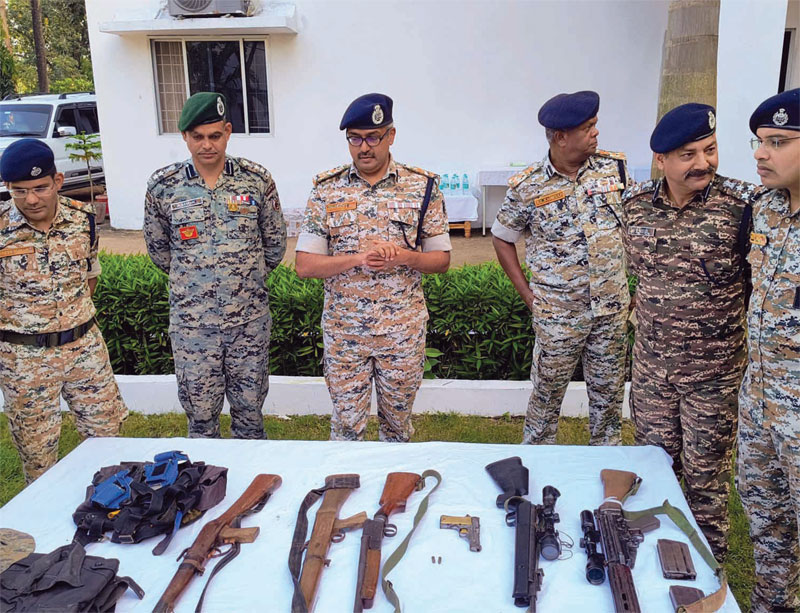
Bastar police with weapons recovered after an encounter with alleged Maoists in November 2024
Terrorism in the Hinterland
Cross-border-sponsored terrorism in the form of infiltration of terrorists, arms and ammunition and indigenous terrorism in collaboration with cross-border elements is found in the hinterland. This type of terrorism includes terrorist groups operating in Jammu and Kashmir in coordination with Inter-Services Intelligence (ISI), and Northeast-based dormant terrorist groups which are regrouping and establishing camps close to the border under ‘strike and fall-back strategy’ to disturb the NE.
Left-Wing Extremism
Left-Wing Extremism (LWE) poses a major challenge to internal security. The factors which forced tribals to join Naxalism include their dissatisfaction with the Forest (Conservation) Act of 1980, lack of development projects, misgovernance and large-scale mining operations which displaced them. However, the geographical spread of LWE has been shrinking considerably. In 2022, the LWE violence incidents were reported from 176 police stations in 45 districts spread across eight states. Now, the arc of violence is restricted to 25 districts accounting for 90 per cent violence. The Union government has fixed March 2026 as the deadline for eradication of LWE, despite the fact that it remains a major threat in states of Chhattisgarh, Jharkhand, Odisha and some parts of Andhra Pradesh and Madhya Pradesh.








 VIDEO
VIDEO