As India grapples against a rising China, it seeks to build on its engagement with friendly countries. Only recently, in October, India along with the US signed a new Quadrilateral Security Dialogue agreement with the Middle East. India, the US, Australia, and Japan were the ones to get into such a mini-lateral arrangement in 2007, only recently in October 2021 did India and the US enter a similar agreement with the two Middle Eastern countries--Israel and the United Arab Emirates (UAE).
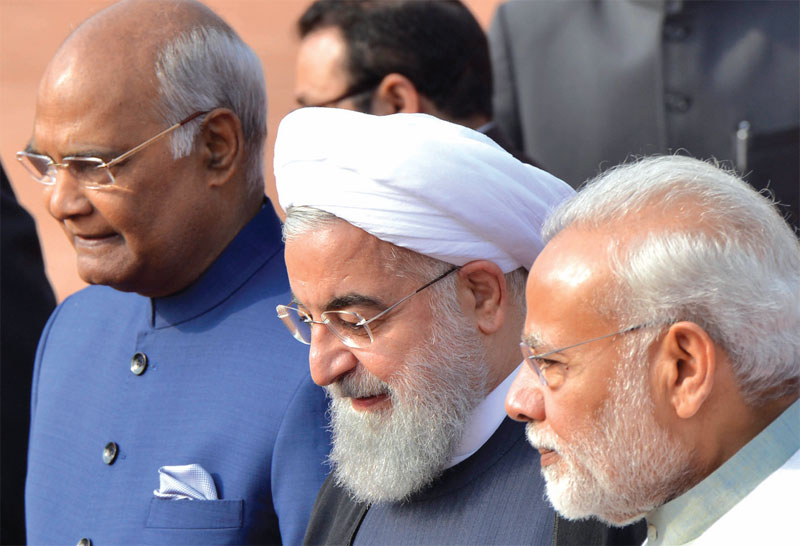
Iranian President Hassan Rouhani with Prime Minister Modi and President Kovind
On October 20, India’s S. Jaishankar and Israel’s Yair Lapid joined the meeting together from Israel during Jaishankar’s visit to the country while the U.S. Secretary of State Antony Blinken and UAE Foreign Minister Sheikh Abdullah bin Zayed Al Nahyan joined the meeting virtually. The grouping could take place due to the Abraham Accords signed between Israel, the UAE, Bahrain, Morocco, and Sudan in September 2020. Intended to normalise relations between these countries, the Abraham Accords created a new window of opportunity for India to widen its security nexus. While India’s policy towards Israel has seen a sea change under the BJP-led NDA government, shifting from its traditional pro-Arab and pro-Palestine approach, India’s relations with the major Middle Eastern countries such as UAE, Iran and Saudi Arabia are being balanced. As the US gave way to India to form strategic alliance with its allies—Israel, the UAE, Bahrain, Morocco, and Sudan, some even coined the moniker ‘Indo-Abrahamic Accords’.
While the current scenario has opened new dimensions for India in the region, the latter has always balanced its way with the countries despite the existing schisms in the region. For so long, India’s foreign policy mandated that the country keep a safe distance from the political ongoings in West Asia. This included the US’s role in the region. Now as India warms up to Israel and the US, a seemingly different window of opportunity presents itself.
Regarding India’s policy change in the West Asia, Doctoral Candidate, Centre for West Asian/ Middle Eastern Studies, Jamia Millia Islamia University, Afroz Khan says, “India is moving from its traditional approach based on bilateral engagement with individual countries to a much bigger multilateral regional policy. Earlier India was hesitant in joining any regional coalition with partners in the region out of fear of alienating its other partners in the region.”
He further adds, “It no longer sees the US as a de-stabilizer in the region. In fact, now, it considers the US a factor to strengthen India’s position in the region. This is a major shift in India’s policy in the region.”
For India, West Asian countries are important for their contribution to the country’s economy. Being the third-largest importer of oil, India had been for so long dependent on Middle Eastern countries for its energy requirements. It was only recently that India went in for diversification of oil imports to gradually cut their dependence on the Middle East after OPEC+ decided last week to largely continue production cuts in April, Reuters reported. “Most of the OPEC+ producers, led by world’s top exporter Saudi Arabia, last week decided to extend most output curbs into April,” according to the report. The country’s top refiner Indian Oil Corporation renewed its oil import contract with Russia. According to the Indian officials, India had not cancelled any shipment of crude oil from the Middle East in 2020, when oil demand collapsed due to COVID-19.


 VIDEO
VIDEO