

Win Some, Lose Some
Defence Policy Making
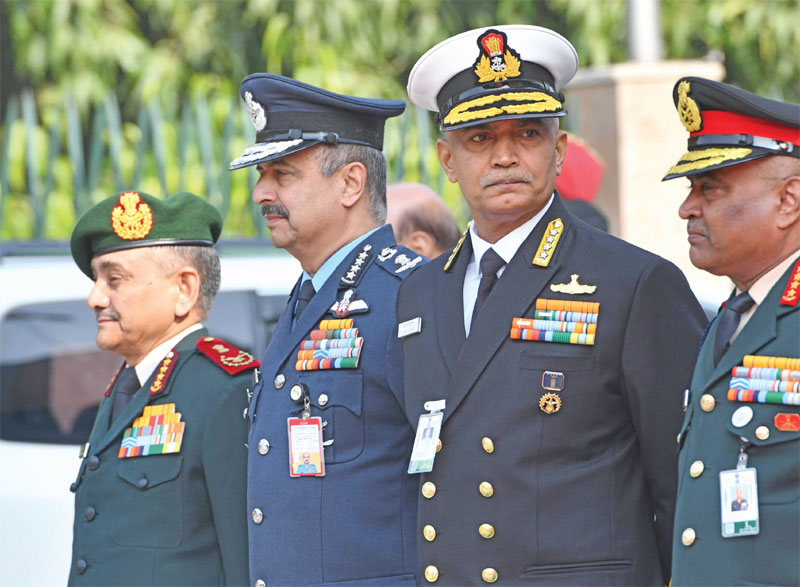
CDS and More: The newly created position of the Chief of Defence Staff (CDS) had been lying vacant since the first CDS General Bipin Rawat (Retd) died in a helicopter crash in December 2021. Unable to find a suitable replacement, the government amended the service rules of the army, navy and air force in June 2022, allowing retired service chiefs and three-star officers to be eligible for consideration for the country’s top military post.
According to the amendment: “...The Central Government may, if considered necessary, in public interest… appoint as CDS, an officer who is serving as Lieutenant General or General or an officer who has retired in the rank of Lieutenant General or General but has not attained the age of 62 years on the date of his appointment.”
Thereafter the government appointed Lt Gen. Anil Chauhan (Retd) as the second CDS on September 28. He had retired from service as the Eastern Army Commander in May 2021. Interestingly, like his predecessor, General Chauhan was also commissioned into the 11 Gorkha Rifles. And in an uncanny coincidence, like General Rawat (Retd), he also hails from the Pauri Garhwal district of Uttarakhand, which incidentally is the native place of the national security adviser Ajit Doval too.
In another key appointment, the then vice chief of the army staff Lt Gen. Manoj C Pande was elevated as the Chief of the Army Staff on April 30. General Pande took over from General M.M. Naravane Retd). In the rank of Lt Gen., General Pande had served as the Commander-in-Chief of the Andaman & Nicobar Command and GOC-in-C of the Eastern Command.
India and World
Xi Rules: Chinese President Xi Jinping was re-elected as the general secretary of the Communist Party in October for a historic third term, the first leader after Mao Zedong to get a third term. Xi, who first assumed power in 2012, was elected by a new seven-member Standing Committee.
While Russian President Vladimir Putin and North Korean leader Kim Jong Un were the first to congratulate Xi on his re-election, Prime Minister Narendra Modi did not congratulate the Chinese leader.
At the concluding session of the Congress, Xi said, “We must be ready to withstand high winds, choppy waters and even dangerous storms. Confronted with drastic changes in the international landscape, especially external attempts to blackmail, contain, (and) blockade… China, we have put our national interests first.” This was regarded as a reference to the growing negativity against China in the US and West.
However, from India’s perspective, more critical was his exhortation to the People’s Liberation Army (PLA). While laying emphasis on the “reunification with Taiwan,” Xi, as part of theory-building, instructed the PLA to be prepared for “regional wars.” According to him, “We (PLA) need to be able to stage military operations readily, create a secure environment, deter and control risks and conflicts, and win regional wars.”
Border Talks: On January 12, the 14th round India-China Corps Commander level meeting was held at Chushul-Moldo border meeting point on the Chinese side. Representatives from the defence and foreign affairs establishments of the two sides were present at the meeting. Even though the two sides had a ‘frank and in-depth exchange of views for the resolution of the relevant issues along the LAC in the western sector’, nothing much came out of it.
The 15th round was held at the same location, but this time on the Indian side on March 11. The two sides agreed to maintain dialogue via military and diplomatic channels to reach a mutually acceptable resolution of the remaining issues at the earliest.
Thereafter, the 16th round of talks were held on July 17. Following this, the Indian and Chinese troops started disengagement from Patrolling Point 15 in the Gogra-Hot springs area of eastern Ladakh in a ‘coordinated and planned way’.
On October 14, during the 25th meeting of the Working Mechanism for Consultation & Coordination on India-China Border Affairs (WMCC), India and China agreed to hold another round of talks between senior military commanders to take up remaining issues along the Line of Actual Control and ‘create conditions for the restoration of normalcy’ in ties.
‘The two sides agreed to continue discussions through diplomatic and military channels to resolve the remaining issues along the LAC at the earliest so as to create conditions for restoration of normalcy in bilateral relations,’ read the statement issued by the external affairs ministry.
However, on December 1, quoting sources in the security establishment, the Telegraph reported that the Chinese Army has bolstered its presence in the ‘occupied’ territory of Depsang in eastern Ladakh and has pitched over 200 tents over the past one month, besides building additional bunkers and military camps.
At Depsang, a 972sqkm plateau 16,000ft above sea level, the People’s Liberation Army is estimated to be entrenched 18km inside India-claimed line.
Russia’s Special Operations in Ukraine: Though there were warnings and counter-warnings for several weeks, nobody believed that Russia would invade Ukraine on February 24. Not only it did that, but even 10 months hence, it remains unrelenting. While Ukrainian President Volodymyr Zelensky claim that up to 13,000 Ukrainian soldiers have been killed so far, no credible figures are available for the Russian troops.
With massive propaganda by both sides—the US-led western world (with Nato as the front) and Russia—credible facts have been a casualty, adding to a total fog of war. The only fact is that the war, which Russia calls special operations, is being fought on the Ukrainian territory between the US-led Nato and Russia. While the US and the Nato countries are supplying weapons and other equipment to Ukraine, Russia, heavily sanctioned by the West, is being helped by China and Iran.
Subscribe To Force
Fuel Fearless Journalism with Your Yearly Subscription
SUBSCRIBE NOW
We don’t tell you how to do your job…
But we put the environment in which you do your job in perspective, so that when you step out you do so with the complete picture.






 VIDEO
VIDEO