

What’s in a Name
Despite being used interchangeably, NCW and MDO are technology apart
Junaid Suhais
Military doctrine has a long history of arriving as vocabulary before it arrives as capability. Officers reach for the most advanced language available to describe what their forces have just done, often before the institution behind them has built the architecture that language actually requires, and the gap between the word and the system rarely announces itself until someone tests the claim against the evidence.
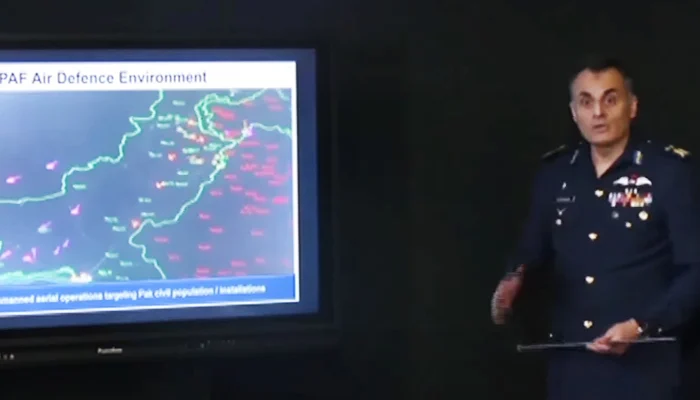
Operation Sindoor supplied that test in a single, dense sentence. Closing Operation Bunyan-un-Marsoos, Pakistan’s director general of Inter-Services Public Relations, Lieutenant General Ahmed Sharif Chaudhry, described it as a textbook demonstration of integrated tri-services jointness, enabled by real-time situational awareness, network-centric warfare (NCW) capabilities, and seamless multi-domain operations (MDO). Two doctrines, stacked into one clause, as though they were the same idea wearing different uniforms.
They are not, and the confusion is not confined to Rawalpindi.
New Delhi has reached for the identical vocabulary to describe what its own forces did during the same four-day exchange. The language has converged across the border faster than the publicly demonstrated architecture. What follows separates the two doctrines, then applies a single test to both sides’ claims against what Operation Sindoor actually produced.
What the Words Actually Mean
NCW was coined in a single article. In January 1998, Vice Admiral Arthur K. Cebrowski and John Garstka argued in the US Naval Institute’s Proceedings that American forces stood at the edge of a shift from platform-centric war, in which a ship or a tank’s individual capability decided outcomes, to NCW, in which the decisive factor became how well sensors, commanders and shooters were connected. The theory rested on three linked propositions: a robustly networked force improves information sharing, better information sharing improves shared situational awareness, and shared awareness enables self-synchronisation, the ability of a well-informed force to organise complex operations from the bottom up rather than waiting on a step-by-step chain of command.
The tenets held up better than the institution did. A decade on, a retrospective assessment found that the US defence establishment had substantially eschewed Cebrowski’s own principles in practice even as policy paid them lip service. The Pentagon’s own transformation office had anticipated the more uncomfortable version of that finding years earlier, warning that decentralised, technology-enabled coordination was not a capability only large militaries could build, and a Congressional Research Service assessment prepared for lawmakers noted that al Qaeda’s dispersed, self-organising cells already displayed the flexibility and adaptability NCW theory prized, achieving with commercial communications tools what a much larger defence budget struggled to institutionalise. Cheap connectivity turned out to be available to anyone. What was scarce was the institutional discipline to use it.
There is also a paradox sitting inside the theory’s own success, one worth carrying forward. A networked force gains power precisely because its parts depend on each other, sensors, communications and shooters are only as valuable as the links joining them, but that same interdependence is a vulnerability the moment an adversary can degrade the network rather than defeat the weapons on it. Electronic warfare, cyber intrusion, GPS denial, satellite disruption and simple datalink jamming do not need to beat a networked force in a straight fight, they only need to sever the connections between its parts. Resilience under exactly that kind of disruption is one of the explicit demands MDO was built to answer, alongside the strategic problem that gave the doctrine its name.
Subscribe To Force
Fuel Fearless Journalism with Your Yearly Subscription
SUBSCRIBE NOW
We don’t tell you how to do your job…
But we put the environment in which you do your job in perspective, so that when you step out you do so with the complete picture.




 VIDEO
VIDEO