For Ismael Sama, 60, the year 2021 brought in a new lease of life. Islamabad High Court had heard his prayers and ordered for his release based on a plea filed by the Indian High Commission. In 2008 Ismael had taken his cattle for grazing when he crossed over to the Pakistani side. He is a resident of Kutch’s Nana Dinara village, located approximately 60 km from Pakistan border.
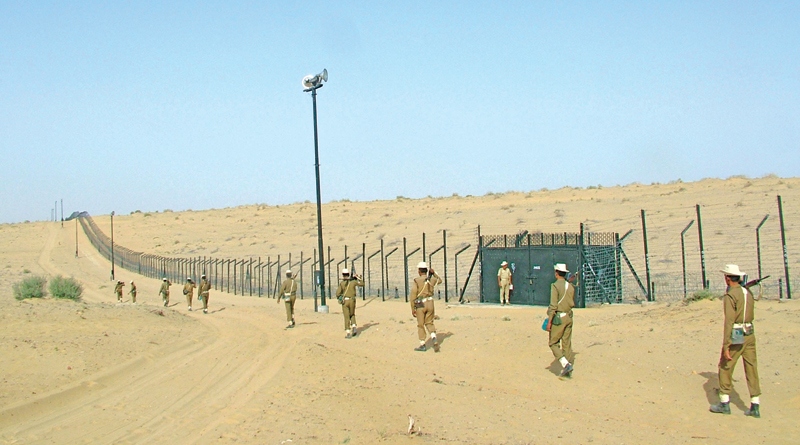
BSF personnel patrolling the Jaisalmer sector[
Ismael’s case is not one of a kind, neither is Kutch’s proximity to Pakistan. India shares land border with Pakistan, Bhutan, Nepal, Myanmar, Bangladesh and China. The total land boundary that India has is 15,106.7km. Even as boundaries stand demarcated, most borders remain porous and the border population in these areas tend to cross over to the other side. Similarly, citizens of other countries also venture inside the Indian territory. Sarabjit Singh’s story remains known far and wide. He, a farmer, ventured into neighbouring Pakistan in 1990 while farming and was mistaken to be an Indian spy. His village, Bhikhiwind in Punjab lies just 5 km away from Punjab. He languished in jail for 23 years before being murdered by fellow inmates. Often, many innocent people are killed in custody on both sides. Usually, there is a mutual agreement on the exchange of the people arrested but the hostilities between the two nations often hinder the exchange. This free movement of individuals is because of the near porous border separating India and Pakistan. The two neighbours, who were meant to have friendly relations along with open borders, freedom of trade and travel, ended up with a fence, thereby limiting cooperation on both sides.
Only last year the government decided to erect a ‘new non-cut steel fence to plug vulnerable and infiltration-prone patches along its sensitive border with Pakistan and Bangladesh.’ These fences were to have concertina wires on top. The pilot project for this was undertaken at Silchar in Assam, along India’s border with Bangladesh. The government, under its Comprehensive Integrated Border Management System (CIBMS), is setting up ‘smart fences’ loaded with a number of gadgets and technologies to enable electronic surveillance. The idea originated from Israel and the Indian government started work in 2018. A year later, in 2019, Rajnath Singh, who was then the home minister, inaugurated the Border Electronically Dominated QRT Interception Technique (BOLD-QIT) after it was completed.
BOLD-QIT enabled the Border Security Force (BSF) to equip India-Bangladesh border of more than 4,000 km, with different kinds of sensors in the unfenced riverine area of the Brahmaputra river and its tributaries. The area with the help of this technology has been covered with data-network generated by microwave communication, optical fibre cable, digital mobile radio communication, all day surveillance cameras and most importantly, the intrusion detecting system. This project is ideal for the BSF to save 24-hour human surveillance by providing a control-room feed. From a security perspective, this system maybe state-of-the-art but from a local’s perspective it’s a major irritant. Imagine being a local, who is well-aware of the vicinity and has relatives across the border but isn’t allowed to cross over—it can certainly be so frustrating. While security threats are real and fences are a must, the truth is also that they divide the people and their land arbitrarily.






 VIDEO
VIDEO