

What it Takes to Lead
When the NDA government came to power in 2014, national, and indeed maritime security was expected to figure prominently in its strategic calculus of making India a significant international power.
The Prime Minister’s personal interest in various maritime activities including a day on board the aircraft carrier INS Vikramaditya, his presence at the commissioning of INS Kolkatta, the hosting of the International Fleet Review at Visakhapatnam in February 2016 and the Global Maritime Summit in Mumbai in April the same year reinforced this perception. The announcement of the Sagarmala Project focusing on port-led development of the country’s maritime infrastructure including inland navigation and the unveiling of the SAGAR (Security and Growth For All in the Region) initiative by the Prime Minister during a visit to Mauritius further underlined this perception.
In the last five years India’s foreign policy has taken on a new momentum with the country revitalising its engagement with the world through numerous bilateral and multilateral initiatives. The invitation to all seven heads of government of the SAARC countries to his swearing-in ceremony in May 2014 signalled the intention to focus on the neighbourhood in what is known as the ‘Neighbourhood First’ policy.
The engagement with ASEAN was emphasised by recognising ASEAN’s centrality in the Indo-Pacific and the invitation to all 10 heads of government of the ASEAN states to attend the Republic Day Parade on 26 January 2018 marking 25 years of the India-ASEAN relationship was a diplomatic masterstroke. The ‘Look East’ policy of the previous government was transformed into the ‘Act East’ Policy as India pursued a very active multi-layered and multi-sectoral approach with the Indo-Pacific region.
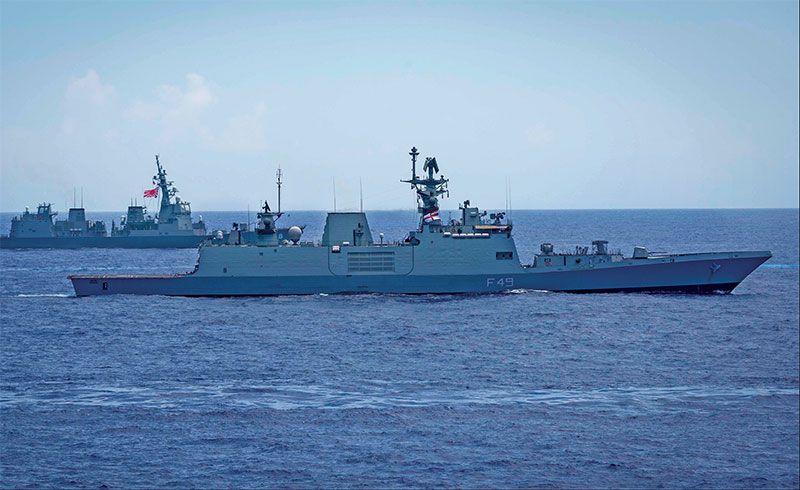
Indian Navy’s stealth frigate Nilgiri
The Prime Minister paid visits to countries that no Indian prime minister had visited before. The ‘Look West’ policy recognised the critical importance of West Asia to India’s energy and economic security and led to the PM not only establishing a personal rapport with the leadership in these countries but shaping a favourable environment in the region. India also reaffirmed its commitment as the net security provider in the Indian Ocean Region (IOR) and was the first responder in offering Humanitarian Assistance and Disaster Relief (HADR) during the frequent natural and man-made calamities which are becoming a frequent occurrence in the region.
Besides these regional initiatives, India has also forged deep strategic relationships with like-minded nations towards addressing transnational threats and maritime aggression which threatens the existing rules-based international order at sea for the safe passage of global trade and energy. Nearer home, India is revitalising the BIMSTEC mechanism which had been languishing and required a fresh impetus. India’s new found confidence is clearly evident in its approach to foreign policy and the regional security scenario. This was also reflected in the bold tactical actions in Uri and Balakot which not only called our neighbour’s nuclear bluff but dispelled the long-held belief that India is a soft state and can be trifled with.
All these foreign policy initiatives are underpinned by a strong security dimension and in the distinctly maritime orientation of the Indo-Pacific, the underlying importance of the maritime domain becomes very evident. Hence, the maritime dimension of our national power is integral to India’s aspiration to become a regional power in a multi-polar world order and a permanent member of the UN Security Council.
Alfred Thayer Mahan, the doyen of maritime strategists, in his seminal work on Sea Power had articulated six fundamental elements for a country to be a sea power. These were geographical position, physical conformation, extent of territory, size of population, character of the people, and character of government.
Subscribe To Force
Fuel Fearless Journalism with Your Yearly Subscription
SUBSCRIBE NOW
We don’t tell you how to do your job…
But we put the environment in which you do your job in perspective, so that when you step out you do so with the complete picture.



 VIDEO
VIDEO