In the last 75 years, turbofan efficiencies have been increased by 375 per cent, thanks to increases in the inlet temperature that in turn results in an increase in engine power-to-weight ratio. Present-day turbofans, however, are at or near the fundamental limit of Nickel-based superalloys and hence new-generation superalloys are required for the next generation of turbines, especially those used in a turbofan’s cold section (making up the compressor) and hot section (for the combustor and turbine).
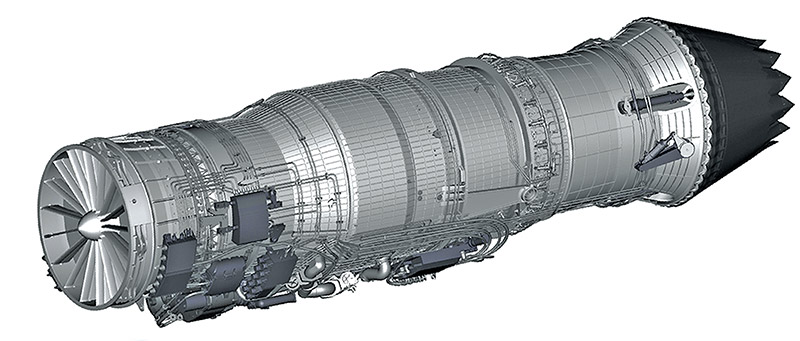
Consequently, Nickel-based superalloys have now begun making way for ceramic matrix composites (CMC), Titanium-based superalloys, Silicon-based Ceramic composites, and polymer composites with carbon fibres. CMCs offer substantially higher temperature tolerances, thereby reducing cooling requirements and turbine weight, which in turn will result in reduced fuel consumption, higher thrust-to-weight ratios, and reduced toxic gaseous emissions
Presently, longer range and subsonic loiter require lower fuel-burn and appreciable cruise efficiency, while higher thrust for supersonic dash demands larger engine-cores and much higher operating temperatures, neither of which is good for fuel burn or stealth. To solve this conundrum and combine both capabilities in one propulsion system in order to usher in a generational change in turbofan performance for both fifth- and sixth-generation multi-role combat aircraft, variable-cycle, or adaptive engine architecture (that takes the best of a commercial airliner’s turbofan and combines it with the best of a military turbofan) is the way forward for futuristic military turbofans. In take-off conditions, such a turbofan will operate like a conventional combat aircraft in a high-pressure ratio, low-bypass mode. Consequently, a fixed-cycle mode of operation allows pilots to maximise thrust, but during cruise or loiter conditions when one doesn’t need that thrust, one can transition to a high-bypass, low-pressure ratio mode in order to become fuel efficient like a commercial airliner’s turbofan.
Adaptable-architecture military turbofans will use an array of variable geometry devices to dynamically alter the fan-pressure ratio and overall bypass ratio — the two key factors influencing specific fuel consumption and thrust. The fan-pressure ratio is best changed by using an adaptive, multi-stage fan. This increases the fan-pressure ratio performance-levels during take-off and acceleration, and during cruise lowers it for improved fuel efficiency. To alter the bypass ratio in such a manner, variable-cycle turbofans will need to add a third airflow stream outside of both the standard bypass duct and core. This third stream will provide an extra source of airflow that, depending on the phase of the mission, can be adapted to provide either additional mass-flow for increased propulsive efficiency and lower fuel-burn, or to provide additional core-flow for higher thrust and cooling air for the hot section of the turbofan, as well as to cool the fuel, which provides a heat-sink for aircraft systems. During the cruise, the third stream will also swallow excess air damming up around the inlet, thereby improving flow-holding and reducing spillage-drag.







 VIDEO
VIDEO