Most Indian border regions are densely populated on both sides. Cross border relations amongst population exist since ages. India has de-jure fenced and unfenced borders, de-facto fenced and unfenced borders and even un-demarcated stretches. The characteristics of Indian borders are sour relations with the counterparts, underdevelopment, illegal migration, inadvertent crossings, infiltration, militancy and terrorism, drug trafficking, smuggling of various products for economic benefits.
Security of international borders is responsibility of border guarding forces. The Border Security Force (BSF) guards Pakistan and Bangladesh border, the Nepal and Bhutan borders are guarded by Sashastra Seema Bal (SSB) and the Myanmar border by Assam Rifles. Border guarding in India is manpower intensive with miniscule technical support. The length of Indo-Pakistan border is 3,323km and Indo-Bangladesh border 4,096.70km. Both borders are volatile, dangerous and difficult to guard due to historical factors and current security environment.
Control of borders signifies sovereignty of nation over its territory. The border-guarding pattern to exercise sovereignty is totally manpower intensive with negligible technical support integrated with manpower. However, to make border guarding impregnable, to reduce stress and for successful operational profile, there is an urgent need to look beyond manpower. Technological solutions have to be found for effective border security and surveillance. This will deter anti-national elements from violating the sanctity of international boundary, enhance border security, improve economic activity in border areas and increase operational effectiveness. This model will also provide respite to troops from tough and gruelling schedule. Let us analyse how to go for this model and how to implement the model.
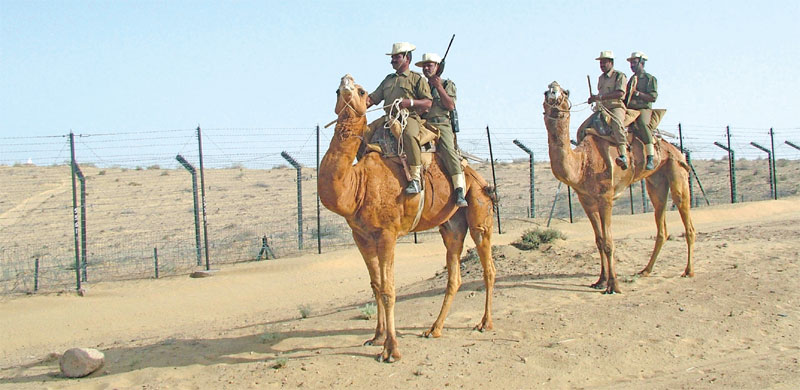
Even with technological advancements, BSF makes do with old methods and equipment for border guarding
West and East
The working environment of western and eastern borders is diametrically and drastically different. The terrain, riverine areas, demographic composition, crime and smuggling patterns, economics of smuggling, operational challenges and difficulties are different on both borders. The security implications of border breaches on both sides too are different in terms of gravity and long-term impact on national security. The following security model for western and eastern borders is recommended. The systems will not succeed unless matched by strong technical surveillance support on ground.
Unilateral Security Model: The border threat characteristics on western border are infiltration, espionage, drug smuggling, pumping of arms and ammunition through land and aerial route, violating border agreements to keep the border tense. Pakistan has adopted all innovative measures successfully to push terrorism into India and destroy the youth through indoctrination and drug addiction. Pakistan’s main aim is to destabilise India. Since Pakistan will not join any border security and coordination mechanism to curb border threats supported by technical surveillance, India needs to develop such mechanism unilaterally.








 VIDEO
VIDEO