In the midst of uncertainty about how things will pan out in Ladakh in the face of China’s inane expansionism, one certitude has emerged emphatically. It is the consistent neglect of needs and wants of Indian defence forces that has now placed them in a situation where their equipment and weaponry leave a lot to be desired and their preparedness for war is under question.
As demonstrated by the events since April this year in Ladakh area, there is no doubt that in a possible kinetic military action with China, Indian forces will give a good account of themselves but regrettably, that would be despite the fact that they do not have all their war fighting wares in place, and not because the establishment met their justifiable demands. The neglect started during the UPA regime but was consolidated institutionally during the years since 2014; the Modi government, with a misplaced confidence in its foreign affairs initiatives, has continued to deny the services their just needs while volubly flying the nationalist flag almost to jingoistic levels.
Indeed, in August 2018, the 29th report of the Murli Manohar Joshi-headed Parliamentary Committee on Estimates on Preparedness of Armed Forces-Defence Production & Procurement had declared that the NDA government had brought down defence preparedness to the lowest ever in history. In recent months, the noises being made by the establishment have altered their tenor and texture in favour of undoing this damage but its cumulative effects cannot be reversed in a day. The worst-affected service is the Indian Air Force (IAF). This article addresses the potential and limitations of innovations and indigenisation to mitigate the effects of the IAF’s blunted air power.
IAF Preparedness
As far back as February 2014, the IAF had stated to the Parliamentary Committee on Defence that its capability to manage a two-front war with the then 34 squadron strength was questionable but clarified that it had plans for that contingency. Two years later, Air Marshal Dhanoa, then the Vice Chief of Air Staff (VCAS), reportedly told media that, “Our numbers are not adequate to fully execute an air campaign in a two-front scenario”; at that time the squadron strength was 33.
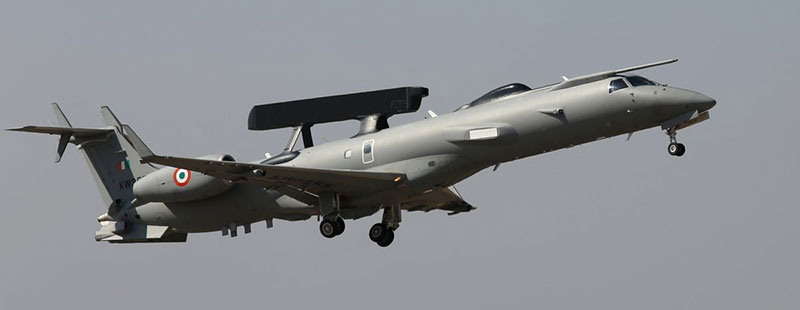
AEW&C
A year and a half later, and with the squadron strength having dropped further to 32, as the Chief of the Air Staff (CAS), Air Chief Marshal Dhanoa declared on 8 October 2017 that the IAF was ready for a two-front war. This perplexity has characterised the IAF combat aircraft strength narrative for years now. The squadron strength has gone from 34 (when the IAF prodded the Parliamentary Committee in 2014) to 30 today and the distant possibility of a two-front war stares the nation at point blank range now.
The 2018 edition of Exercise Gagan Shakti had highlighted the IAF’s preoccupation with fighting a two-front war but was not conducted on both fronts simultaneously and so it was not a two-front war but two single front wars fought serially; the first phase was focused on the Western borders of India in terms of deployment and operations after which the Northern borders became the significant area of operations. In effect it thus created ample doubt about the IAF’s capability to fight on two fronts simultaneously.
In any case the 30-squadron strength falls 12 short of the sanctioned strength of 42 squadrons (a figure which itself dates back by more than two decades and a fresh assessment exercise may produce a figure closer to 60). The 30-squadron strength is poised to drop further in the near future as more old aircraft reach retirement age. Can innovation and indigenisation help assuage this long festering problem?








 VIDEO
VIDEO