In a show of militaristic foreign policy, the chief of army staff, General Bipin Rawat recently upbraided Pakistan and China three days in a row. His warning to Pakistan to stop infiltration was backed by targeting of Pakistani soldiers rather than the terrorists by long-range artillery. He signalled more surgical strikes, if needed. He also said that the army’s attention would shift to Chinese border since the Doklam dispute between China and Bhutan was unresolved.
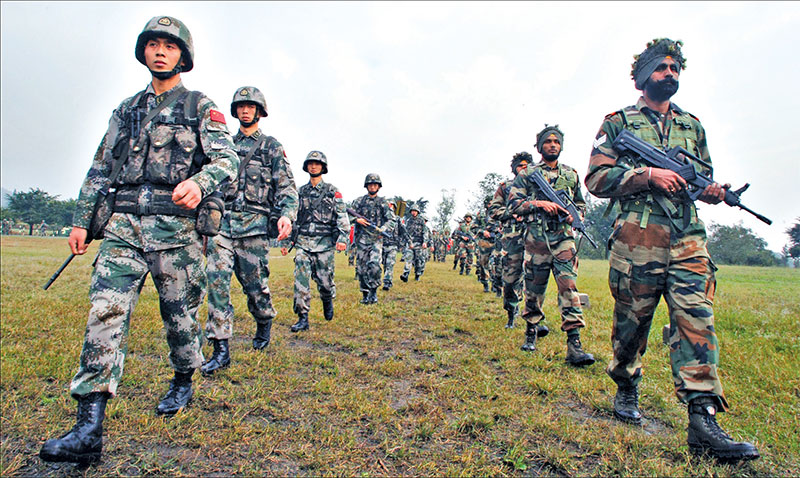
Indo-China joint exercise ‘Hand-in-Hand’ held in 2013
Three observations on General Rawat’s tirade are noteworthy: One, he spoke with full backing of the government. Two, since rhetoric is not expected from military leaders, it was natural for China and Pakistan to take umbrage. China accused General Rawat of upending the peace on the border. Pakistan, on the other hand, increased infiltration, summoned the India deputy high commissioner, J.P. Singh to protest against India’s incessant firings, and cautioned the United States on escalation of hostilities.
And three, with both sides using artillery in direct (line of sight distances) and even indirect mode (for longer ranges), it is fair to say that the November 2003 ceasefire is finally up in smoke or nearly so. To revive the ceasefire, there were reports that Pakistan was considering confidence building measures to end use of high calibre (artillery) weapons and suggest formal talks between the two director general military operations.
That said, it would be naïve to believe that China and Pakistan, which give importance to military power, would end matters here. Just when India was silently congratulating itself, news came that China had built a 36-km road and military posts in the Shaksgam Valley (north Ladakh) located north of the Siachen glacier in Pakistan Occupied Kashmir, which was illegally ceded by Pakistan to China in 1963. Showing Google Earth Imagery, The Print digital newsmagazine reported that the road which was constructed after the Doklam face-off had also been connected with two Chinese military posts outside the Shaksgam Valley. Asked to comment, former northern army commander, Lt Gen. D.S. Hooda said that since Shaksgam Valley is disputed, “The Chinese military presence in the area could be considered provocative.”





 VIDEO
VIDEO