Atul Chandra
The Indian Army and indeed the rest of the Indian armed forces continue to be largely dependent on their existing inventory of Russian platforms. A large part of the reason for the continued and crippling dependence on Russian platforms is the delay in military modernisation of systems, which has often taken decades (if at all) and the comfort of continuing defence trade with Russia. According to a 2020 working paper by the Stimson Center, 70-85 per cent of India's military platforms remain of Russian origin.
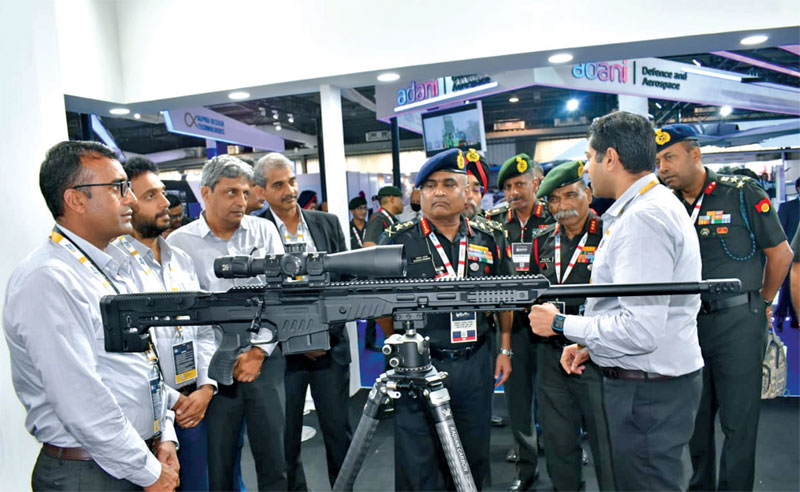
COAS Gen. Manoj Pande with CEO SSS Defence, Vivek Krishnan
The Indian Army has over 5,000 Russian Main Battle Tanks (MBT) and BMP-II Infantry Combat Vehicles (ICV), in the T-90, T-72 and the BMP-II ICV respectively. The proportion of Russian supplied logistics support vehicles for these combat platforms is also large. A large proportion of the army’s air defence guns, artillery guns and small arms as well as rockets, missiles and mortars are also of Russian origin.
Key platforms of the Indian Air Force (IAF) are also of Russian origin—the Sukhoi Su-30 MKI, MiG-29 and MiG-21 Bison, comprise 60 per cent of its combat fleet, while its transport fleet comprises of over 100 AN-32s and nearly 300 Mi-17 helicopters (of all variants). As recently as July 2020, the Defence Acquisition Council (DAC) in July 2020 approved the purchase of 21 more MiG-29s from Russia for about USD 1 billion and an order for 12 Russian-built Su-30 MKI fighters from the Hindustan Aeronautics Limited (HAL) for USD 1.53 billion. This order is unlikely to go through, however.
While the Indian Navy is touted as the champion of indigenisation (and rightfully so), its sole carrier-borne fighter aircraft is the MiG-29K and the Airborne Early Warning (AEW) aircraft for its naval fleet is the Kamov Ka-31 AEW helicopter. A large proposition of the systems on Indian Navy warships remain of Russian origin or design, as is nearly half its submarine fleet and one if its aircraft carriers.








 VIDEO
VIDEO