

View from Pakistan | Not a Fig Leaf
This is perhaps a long overdue pertinent question, which has not been asked in the last few years, especially after the 2019 crisis of India and Pakistan. It is important for the Indian audience to consider this question seriously. However, a little digression by way of a few important points.
On 17 March 2021, two days prior to the scheduled visit of US Secretary of State Antony Blinken and Secretary of Defence Gen. Lloyd Austin to India, Islamabad hosted, under the auspices of National Security Division, the first-ever Islamabad Security Dialogue. The dialogue was inaugurated by Prime Minister Imran Khan. In the course of his speech, he also inaugurated the first ever portal, which enables democratic participation of think-tanks, small and big, from all over Pakistan to offer input to national policy making. This project has been the brainchild of special assistant to Prime Minister on national security affairs, Moeed Yusuf.
Most importantly, the event amplifies the new security paradigm, which Islamabad has set out. However, before the new national security paradigm is studied, it is important to investigate whether India, under the assumption that its policy of coercion against Pakistan is successful, continues to misread Islamabad. This assumption of India merits more than rudimentary investigation. And should it turn out that India is indeed misreading Islamabad, must not New Delhi then contemplate a course correction?
It is also important that the regional and international landscape be appraised alongside Pakistan’s choice of a comprehensive security approach to domestic and regional security.
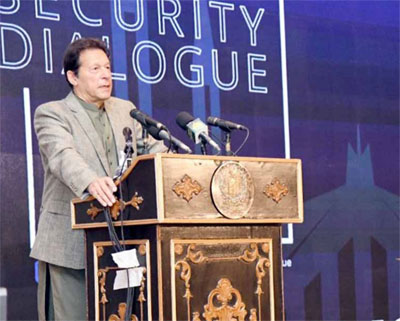
Prime Minister Imran Khan speaking at the Islamabad Security Dialogue[
Afghanistan: What Pakistan Seeks?
The US-Taliban deal despite exhausting multiple rounds, paved the way for Afghan government and the Taliban to come to the negotiating table. The process has seen its own set of hiccups. However, the two sides are now being nudged to come to the talking table at Istanbul for a peaceful settlement.
Pakistan, undeniably, was among critical players during the US-Taliban talks. It also played an important facilitating role at persuading Afghan government, the Taliban and other factions for intra-Afghan dialogue. Unlike what New Delhi likes to believe, Pakistan under successive governments has favoured Afghan peace process to be Afghan-led; it believes only Afghans, inclusively, should determine their future political course. As the date for US withdrawal approaches from Afghanistan, with looming uncertainty about withdrawal, the US is committed to see Taliban and Afghan government break the impasse. In its latest, the US has asked the Afghan government to consider the peace proposal with Taliban.
Pakistan does not eye a repeat of Nineties in Afghanistan. It believes that all tools of diplomacy should be employed to avert such undesired outcome. Another realisation before Pakistan is commitment to see a peaceful Afghanistan, driven towards regional connectivity and trade. To this end, the role of regional players such as China is not ruled out either. Experts such as Richard Fontaine, CEO, Center for New American Security, in a recent webinar also expressed hope that China, despite sharing common interest with the US in Afghanistan, can play a mutually agreed role to stabilise it; provided there is an agreement of approach between the US and China. If in a post-peace deal scenario, Afghanistan becomes part of a sustainable regional connectivity initiative, it will serve overlapping interests of all three: the US, China and Pakistan. Both, the US and Pakistan will be satisfied with access to post-peace deal resources for rebuilding Afghanistan. China and Pakistan, subsequently, may find a key partner to join the regional integration efforts. To see through this process, however, may require ingenuous approach from all involved and it may need to be insulated from possible spoilers.
Subscribe To Force
Fuel Fearless Journalism with Your Yearly Subscription
SUBSCRIBE NOW
We don’t tell you how to do your job…
But we put the environment in which you do your job in perspective, so that when you step out you do so with the complete picture.


 VIDEO
VIDEO