

Unite, Don’t Divide
The need for an overhaul of India’s ‘operational level’ military organisational structures has been identified repeatedly by various committees established in the aftermath of most military conflicts. The reports of the Kargil Review Committee, the Group of Ministers, the expert Task Forces (of 2001-2002) and those commissioned after the 26/11 Mumbai terror attacks (2008) are in the public domain. Each of these reports points to a disjointed approach to military security imperatives. These reports should serve to inform as to why such reform and transformation is essential.
The appointment of Gen. Bipin Rawat as chief of defence staff (CDS) on 1 January 2020 has seen the die being cast by Prime Minister Narendra Modi. Thus, a process of creating joint commands, in addition to the Strategic Forces Command and the Andaman & Nicobar Command established earlier, is underway. As the process gains steam, diverse perspectives emerge, threatening to delay or derail what can be crucial to reforming the Indian military establishment.
Military Organisational Jargon
Certain military organisational jargon from encyclopedia.com can help demystify. One could consider the World War II (WWII) invasion of Normandy, France, by the Allied forces in June 1944. The Allied strategic aim was to enter the continent of Europe and conduct operations into Germany to destroy its armed forces. The endeavour was one of:
Such endeavours involve apportioning of tasks and resources through three levels of organisation:
One, the strategic-level commander organised allied or national land, naval, and air arms among various operational commanders.
Two, the commanders at the operational level organised various tactical units under various tactical commanders. In the context of the landings at Normandy, the ‘operational-level’ tasks included:
Three, the commanders at the tactical level organised small units for landings and holding of assigned beaches. At a ‘tactical-level’, the role of land forces employed in the assault on the French coast was at its most basic, merely to get ashore, secure the beachhead, and hold the fort until relieved by reinforcements.
The Theatre Command
Dr Milan Vego, Professor of Joint Military Operations at the US Naval War College, has on occasions been schooling middle-level leadership at India’s Staff College and Naval War College. Terms from ‘Joint Operational Warfare: Theory and Practice’ needs wider reading, up the leadership ladder, as India evolves her military organisation for modern imperatives.
The term theatre is a geographic area of significant size that contains several potential strategic-level objectives. The route to selected strategic objectives is through intermediate decision points and defensively—or offensively—oriented operational/ tactical objectives, connected by lines of operations. Theatre geometry caters for various functional necessities.
The establishment of robust unified military organisations such as Theatre Commands (TCs) is closely linked to planning for and determining military objectives in times of conflict or emergencies and providing the command and control structures required to achieve military objectives. The organisational structures are also essential to coordinate theatre-wide functions such as intelligence, logistics, force and vital-area/ vital-point protections.
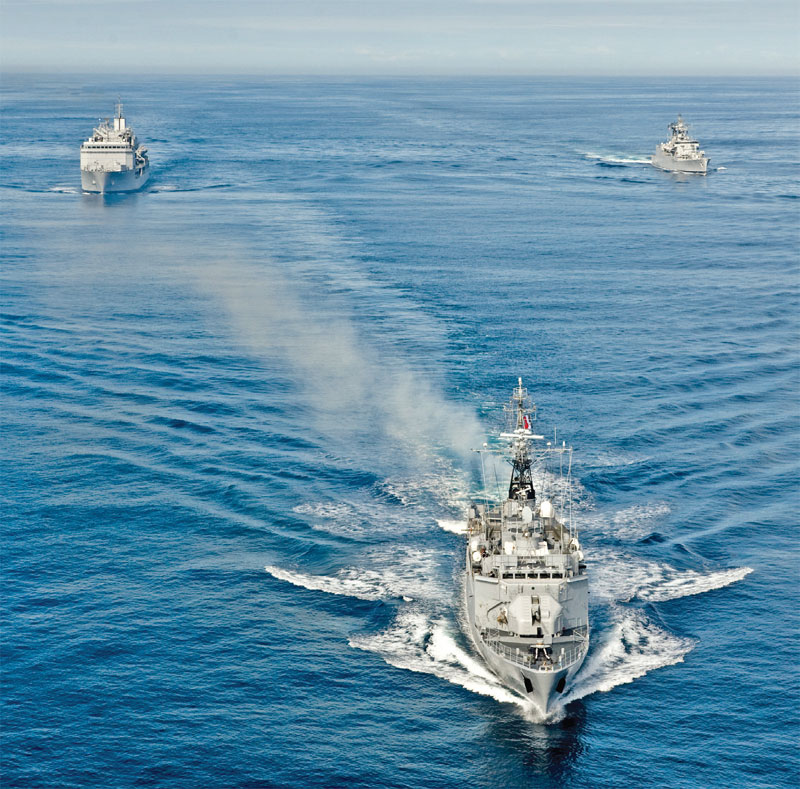
The government needs to articulate and define a military strategy with reasonable precision
The Theatre Commander
The boundaries of a theatre would define the area of responsibility of the theatre commander, the geographic area in which a specific combatant commander has the authority to plan and conduct operations. The military method to handle organisational coordinating bottlenecks is to cater for a unitary ‘Commander’ who can rise above differing opinions and disagreements amongst diverse arms and services of the military. The commander is typically authorised to ensure that all under his command carry out lawful orders and instructions.
India could find itself in a cul de sac if joint military command and control arrangements are not clearly defined. Else, organisational efficiencies and ‘responsibility/accountability’ could elude.
The Maritime Security Mandate
This Maritime Theatre Command (MTC) serves well to illustrate why India needs to rise above the ‘too many chiefs, not enough Indians’ syndrome by creating joint military command control structures. With the sea as a critical element in India’s national strategy, the government of India must ensure modern military and security structures that cater for specialised maritime necessities. Such arrangements would perforce involve air, sea, and land forces operating jointly to influence events in the littoral and traditional blue water concepts of sea control and sea denial. A maritime strategy is not just about naval forces or naval strategy.
Subscribe To Force
Fuel Fearless Journalism with Your Yearly Subscription
SUBSCRIBE NOW
We don’t tell you how to do your job…
But we put the environment in which you do your job in perspective, so that when you step out you do so with the complete picture.






 VIDEO
VIDEO