

Two Worlds
By not attending Prime Minister Narendra Modi’s breakout party at G-20, Chinese President Xi Jinping has announced that the group no longer matters in geoeconomic and geopolitical terms. What matters is G-7 and its direct competitor BRICS. And if the South African edition of BRICS is the sign of the times to come, then this is where the world is converging. However, to convey China’s core message to the world that it favours globalization, it sent Premier Li Qiang to attend the G-20 summit.
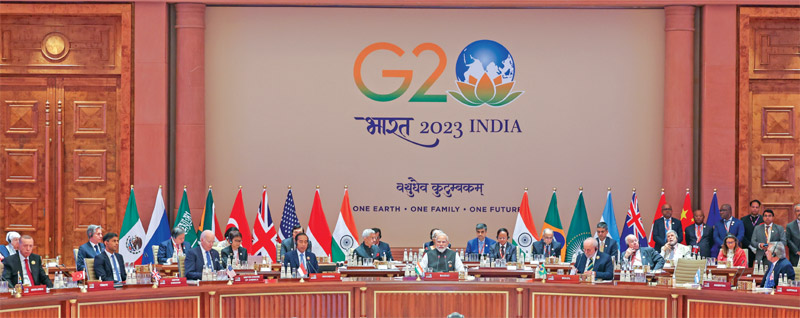 India’s Prime Minister Narendra Modi speaks during the first session of the G20 Leaders’ Summit at the Bharat Mandapam in New Delhi on 9 September 2023
Protocol could be another reason why Xi decided to miss the Delhi jamboree since Modi would have given exceptional attention to US President Joe Biden. Moreover, to communicate that bilateral ties were at an all-time low, Xi Jinping did not bother to personally convey his absence to the Indian Prime Minister.
Except for the US, all nations believe that the world is moving towards multipolarity with two overarching global visions led by the US and China respectively. Therefore, so long as they are not pushed to choose between the two visions, nations are hopeful of drawing benefits from both. What is underplayed is the reality that global prosperity ultimately hinges on the success of the fourth industrial revolution underpinned by Artificial Intelligence (AI). This software driven revolution with its competing standards, rules, norms, and regulations for the two visions will compel the nations to choose between them for digital commerce, trade, and navigation. This may happen as early as 2030. In geopolitical terms, this means that unless the US endorses globalisation in totality (trade, commerce, and especially technology, which is unlikely), early signs of bipolarity in the world fragmented between the two visions may emerge by the end of this decade.
India, which is a key geopolitical pivot in Asia Pacific (where the two visions will play out) has chosen to align with the US vision. Moreover, unwilling to adjust with the risen China, India has picked competition over cooperation with Beijing. Speaking at the Asia Society India on 13 September 2022, external affairs minister, S. Jaishankar said that a multi-polar Asia is necessary for the Asian century and multi-polar world, implying that India and China are equal poles in Asia and the world.
Jaishankar has clearly not read Zbigniew Brzezinski’s book, The Grand Chessboard, which is a fascinating treatise on global strategy. According to Brzezinski, geo-strategic players are those nations which have capability, capacity, and political will to influence events beyond their borders. The US, China, and Russia fail in this category as distinct from major powers like Germany, France, the UK, Japan and the like. Thus, all geostrategic powers are major powers, but all major powers are not geostrategic players. Interestingly, in today’s world, major powers should be assessed by their technology prowess (with the fourth industrial revolution building on the third revolution) since these influences both economic and military power.
Assessed based on technology power (AI and emerging technologies which converge into it), India is nowhere in the global game. Yet, being a significant geopolitical pivot, whose importance is derived not by its national power, but by its sensitive location, India is being sought by all three geostrategic players. Besides its geography which sits astride the 3,000 nautical miles sea lane of communication—from Strait of Hormuz to the Strait of Malacca—through which China’s four trillion dollars trade passes annually, India is also a huge market. The added attractions for the US are India’s massive, disciplined military; it being the biggest arms importer in the world; and the Modi government’s belief that a tight US embrace will help it to compete in the region with China. Before discussing why India’s strategy is a dangerous self-goal, there is need to understand the two global visions.
Subscribe To Force
Fuel Fearless Journalism with Your Yearly Subscription
SUBSCRIBE NOW
We don’t tell you how to do your job…
But we put the environment in which you do your job in perspective, so that when you step out you do so with the complete picture.


 VIDEO
VIDEO