

Two Men, And the World on Edge
Israel’s US war imposed upon Iran will change the world, hopefully for better
 Ghazala Wahab
Over a week into the US-Iran war midwifed by Israel, three facts and two ironies are clear. First the facts. One, the United States (US) has consistently been using the ruse of talks to lull Iran into the belief that a negotiated solution with Washington was possible to lift the debilitating sanctions on the nation. The US, driven by Israel, has no desire to do any business with Iran in its present political form.
The US’ hatred for the Islamic Republic of Iran is both pathological and historical. Instead of burying the past hatchet for geopolitical/ diplomatic interests, the US has nurtured that hatred. Consequently, even as the war is underway, several US commentators refer to the 1979-1981 incident when Iranian revolutionary students had stormed the US embassy in Tehran and taken 66 staffers hostage--eventually, all were released unharmed after 444 days--as evidence of Iran’s barbaric hostility towards Americans. The US policymakers, including President Trump, also refer to the slogan Iranians have often chanted, ‘Death to America’ as a military threat.
Two, while at one point, the US foreign policy in West Asia was to control the oil and gas supply lines, after having secured them by emasculating the Gulf states, including Saudi Arabia, the American objective for the last few years has been to create a pliant neighbourhood for Israel to fulfil its expansionist ambitions. To this end, it has been using both carrot and stick (trade and threats) to align the Arab nations with the larger Israeli objectives. The 2020 US-brokered Abraham Accords between Israel and select Muslim countries, namely, the United Arab Emirates (UAE), Bahrain, Sudan and Morocco, were one of the steps in that direction. In return for trade and economic cooperation with Israel, the signatory Muslim nations accepted Tel Aviv’s complete authority on not only Palestine, but on the narrative of the Palestinian issue. In short, they threw the Palestinian people under the bus for Israeli and American money.
Despite US persuasion and several sweeteners, such as a Major Non-Nato Ally status (same as Pakistan), civil nuclear energy cooperation, and fifth generation F-35 fighters, Saudi Arabia has continued to resist. As custodian of the holiest Islamic sites—Mecca and Medina—and host of the biggest Islamic pilgrimage, Haj, Saudi fancies itself as the leader of Muslim communities worldwide. Hence, it could not be seen as abandoning the cause of Palestine, which is a hugely emotional issue for Muslims, one which has been the single biggest cause of radicalisation among them. While the plight of the Palestinian people is heart-rending, also important is the third holiest Islamic site, al Aqsa mosque or Haram-al-Sharif in old Jerusalem, controlled by Israel. This is the site where Muslims believe Prophet Mohammad prayed before ascending to heaven on a winged horse, Burraq, for an encounter with Allah.
Saudi government rightly assessed that any normalisation of relations with Israel without the resolution or at least a promise of resolution of the Palestinian issue may cause a rebellion among the people, endangering the House of Saud itself. An informal survey in 2021-2022 had indicated that over 99 per cent of Arabian population viewed negatively any normalisation of relations with Israel. However, despite not having signed the Abraham Accord, the Saudi Arabian regime is not hostile to Israel.
The only country openly hostile is Iran, and it demonstrates that hostility by supporting militant organisations like Hamas and Hezbollah against Israel. Hence, the US foreign policy objective in West Asia has been to batter Iran into subjugation by any means possible so that far from being a threat, it becomes amicable to Israel and its expansionists goals. So, from disarming Iran to dismembering it, changing its political system or colonising it—everything is on the table.
Three, Iran is genuinely committed to negotiations because it wants most, if not all, sanctions lifted. Its economy is in tatters, imposing severe hardships on ordinary Iranians. Forget any investments coming into the country, the sanctions also prevent it from benefitting from its oil and gas reserves. It recognises the importance of being part of the global economy and its transformative potential. Despite being a full member of BRICS, sanctions do not allow Iran to take advantage of the possible trade with member countries.
Now for the ironies.
Iran describes the US-Israel attack as a war for choice for them and a war of survival for itself. It’s an accurate description of the war, which Iran was desperate to avoid. It went to the extent of accepting almost all conditions put across by the US interlocutors Steve Witcoff and Jared Kushner in the indirect talks mediated by Oman’s foreign minister Badr Albusaidi between them and Iran’s foreign minister Abbas Araghchi. In a series of interviews, hours before the aerial attack on Iran commenced, Albusaidi claimed a breakthrough in the talks with Iran. He said that Iran had accepted even ‘zero stockpiling’ of fissile material, something it had not done until then. Confident that Oman had averted the imminent war, Albusaidi met US vice president J.D. Vance in Washington on 27 February 2026 to apprise him of the progress in the talks. Vance met him, posed for a happy picture for posterity but did not share with him that the US-Israel duo had decided to launch synchronous attacks on Iran the following day.
The first wave of attacks killed Iranian supreme leader Ayatollah Khamenei, members of his family, including his 14-month-old grand-daughter Zahra, and several members of Iranian government and military, all of whom had converged at Khamenei’s residence in Tehran for a meeting. In Minab, a city in southern Iran across the UAE, the first wave hit a primary school killing 180, including 165 schoolgirls.
Within hours, Iran’s retaliatory attacks began on the US military installations in the Gulf states of UAE, Bahrain, Qatar and Kuwait. Simultaneous attacks were launched at Israel too. The following day, reports emerged that the US government had approached the Italian government to initiate talks with Iran, but Iran refused. One of the Iranian analysts, referred to the phrase used in the context of Israel’s approach of ‘mowing the lawn’ towards Palestine. He said that if Iran once again accepts the US offer of talk without inflicting severe damage on it and Israel, then they will be tempted to carry out aerial attacks on Iran again whenever they desire.
Hence, the irony number one is that while Iran wanted to avoid the war at all costs, now it doesn’t want to end the war until it secures a position of power on the negotiating table. Whoever else sits on that negotiating table, Israel wouldn’t be there for sure. By determining to take the war imposed upon it to its logical conclusion, Iran is also facilitating change in the power dynamics in West Asia.
The irony number two is India’s total irrelevance to events that are reshaping the world, from Russia’s special operations in Ukraine to the US-Israel war on Iran, New Delhi’s status has been reduced to that of a spectator, despite the most peripatetic prime minister ever. When Soviet Union had invaded Afghanistan in December 1979, soon after Indira Gandhi’s return to power in January 1980, Soviet foreign minister Andrei Gromyko flew down to New Delhi to explain to Gandhi why they had to invade and how they expect the situation to unfold. According to several accounts, Gandhi expressed severe displeasure to Gromyko for not consulting India before taking such a huge decision. Thereafter, to mollify her, Soviets offered better credit terms to India on their weapons exports. From then to now, India’s stature has taken a big knock.
Inevitability of the War
Scholars may argue that there is no inevitability in history; that the biggest events of the world wouldn’t have happened if certain incidents had not taken place at the time they did or if certain actors hadn’t reacted the way they did. To further this argument, the example of the two world wars is offered. While this logic may hold true for them, the US-Iran conflict was inevitable, because this was, to borrow the title of Samuel Huntington’s book, the clash of civilisations.
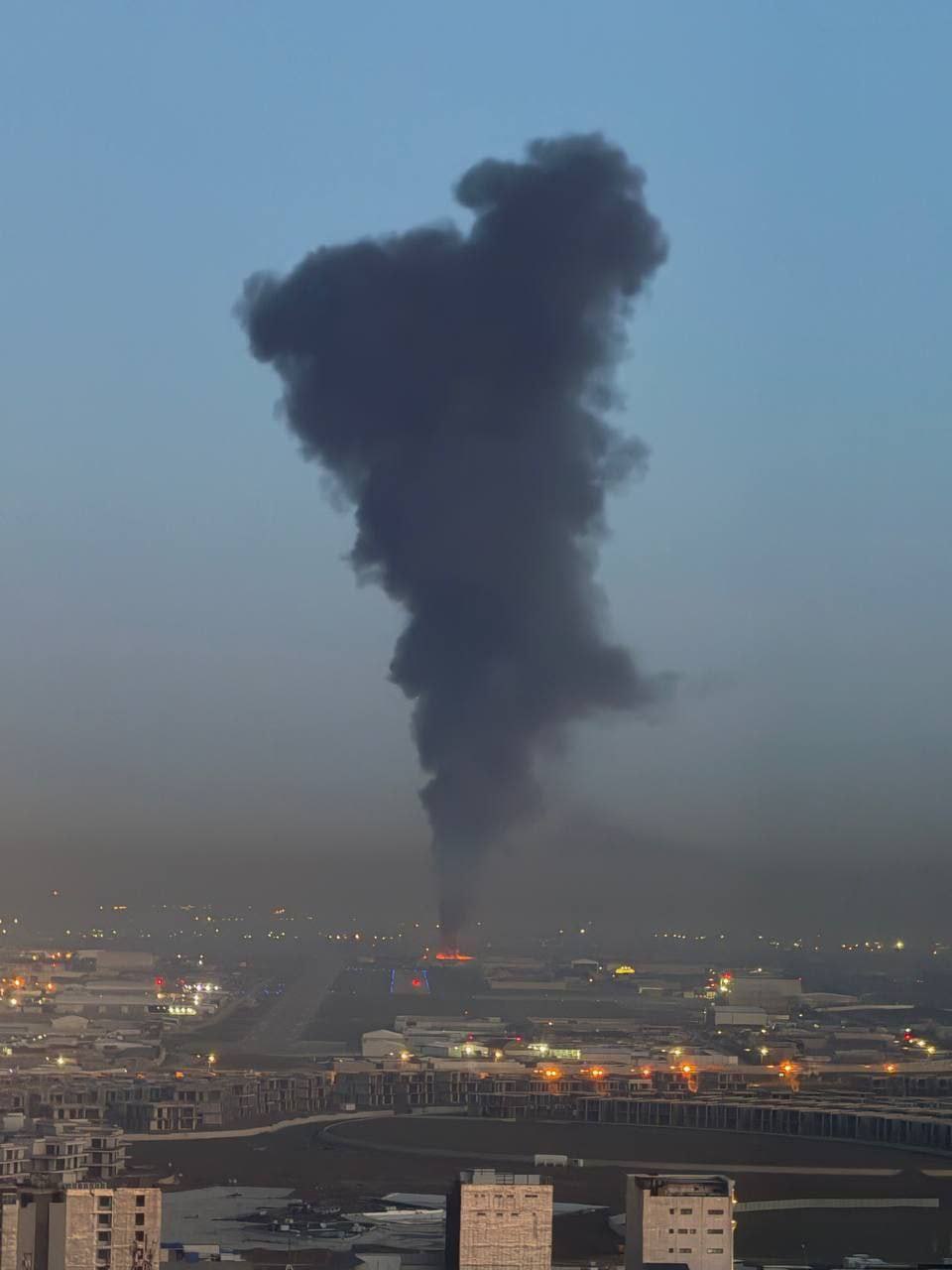
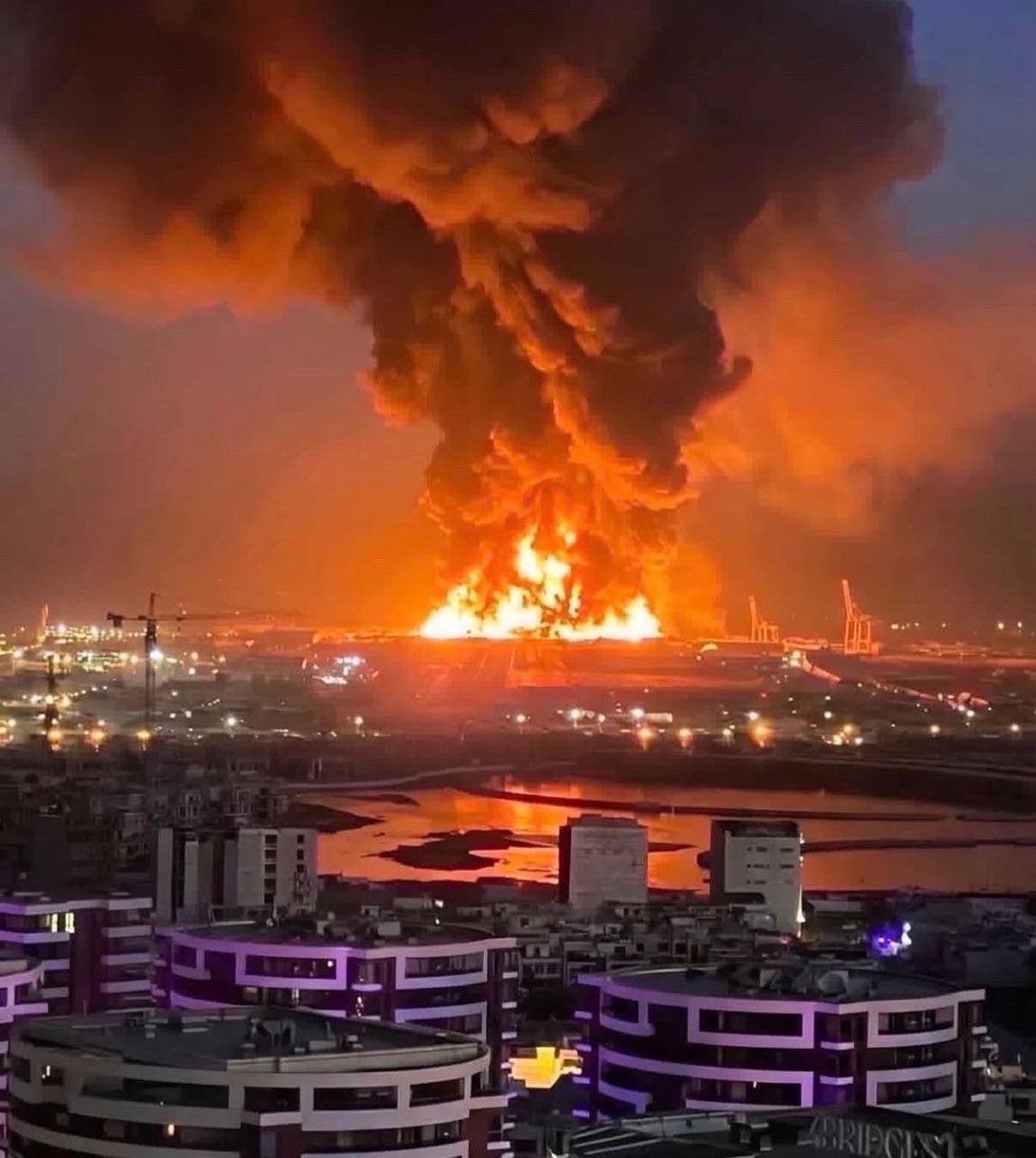
WEST ASIA IN FLAMES Iran has struck US military bases across West Asia, from UAE and Bahrain to Iraq by its ballistic missiles and drones
There are two reasons for this.
The first reason is Iran’s historically cultural streak for independence, even in the worst of times. Despite being invaded several times through its history, Iran, or its forbear Persia, was never fully colonised and always regained its sovereignty after brief interregnums of subjugation. Neither Ottoman, nor British or French could colonise it. This was unique in the West Asian neighbourhood, where even peninsular Arabia was colonised, first by the Ottoman empire and after its defeat, was partitioned among British and French colonisers under the secret Skyes-Picot Treaty after World War I.
Despite waning power in the early 20th century, Iranian people continued to choose their own political leadership. For example, when the 250-year-old Qajar dynasty was flagging, Iranian people rallied around the former military officer, prime minister Reza Khan Pahlavi to formally depose the Qajar king and take control of the country in 1925. It was a coup by popular will. It’s another matter that the British and French governments supported the deposition as they expected to control Iran and its oil resources through Reza Khan. And they did. Which is why Pahlavi’s first term didn’t last long. During World War II, Allied Forces moved into Iran for better control of the oil supply for their war effort after a Tripartite Agreement between Britain, Russia and Iran. The Agreement stipulated that the Allied Forces would leave Iran six months after the end of the war.
Aware that this agreement would not go down well with the Iranian people as they would see this as Reza Khan’s capitulation, he abdicated in favour of his son, Mohammad Reza. However, the government was largely run by an emerging and popular politician Mohammad Mossadegh, first as a governor of one province and thereafter through several ministerial positions in Tehran. Once the Allied forces withdrew in 1946, under the agreement, Iranians started to rally behind Mossadegh, whom Mohammad Reza was forced to give more responsibility. Eventually, Mossadegh contested and won the elections with overwhelming support in 1951, rendering the Pahlavi dynasty irrelevant, forcing Mohammad Reza to leave the country. Mossadegh’s popular support was the result of his nationalist and socialist temperament, something which worried the British who still controlled Iran’s economy through their total capture of its oil run by the Anglo-Iranian Oil Company (AIOC), in which they had 51 per cent stake.
Mossadegh’s two critical policy measures were aimed at restoring the economy for the people of Iran. He started land reforms, quite like the ones happening in India after independence. Ceilings were imposed upon large landholdings and surplus given to the tiller. This angered the rural elite. His second move was nationalisation of oil. This angered not only the British, but also the urban elite, the beneficiaries of the British largesse. Substantially weakened after World War II and end of its colonial empire, the British by this time had already tied themselves to the US coattails. Hence, they collaborated with the Central Intelligence Agency (CIA) for over a year to mount a protest campaign against Mossadegh, while also blockading the refining and supply of Iranian oil. As the economy suffered, imposing hardships on the people, US and British intelligence operatives working with the disgruntled elite harnessed the hardships faced by the poor to topple the Mossadegh government and got the police to arrest the prime minister. Mossadegh spent the rest of his life under house arrest.
Mohammad Reza was persuaded to return to Iran to take over as king. He resisted. He was aware of the popular sentiment being against the monarchy and in favour of Mossadegh, who remained hugely popular among the masses. Because of this, Shah feared for both his life and credibility. He rightly assessed that he would be viewed as a stooge of western powerholders. He eventually accepted the crown of dishonour when the CIA told him that if he doesn’t agree, they will find someone else. Once on the throne, he added Shah to his name, Persian for king, and founded one of the most westernised, profligate and glamourous private club for the rich and the famous in the form of Reza Shah Pahlavi dynasty.
Dictated by the CIA, his key result areas (KRAs) were three. Westernised modernisation (de-Islamisation) of Iran, quite like what Mustafa Kemal Ataturk had undertaken in Turkey; let US-Britain run the oil economy, while he looks out for dissent; and develop close ties with Israel in a neighbourhood hostile to it. In return, he was promised security, financial and military support.
When westerners of a certain age nostalgically recall Iran before the revolution, they refer to the glamourous parties and picnics of the Shah regime in Tehran, hence those memory prompts of laughing women in short skirts and swimwear. Quite like Turkey, with whom Iran not only shares a border but also had deep historical, political, bureaucratic and cultural ties, Shah’s modernisation and de-Islamisation could not go beyond Tehran and some other big cities. Outside them, were disgruntled masses mourning the aborted promises of Mossadegh. The fact that westerners remember the Shah regime and Iranians remember Mossadegh’s term, says a lot about the politics of narrative.
Eventually, Mohammad Reza’s fear materialised in the Islamic revolution of 1979, 23 years after he accepted the crown. Exiled Islamic leader Ayatollah Khomeini, who had spent nearly a year in Turkey’s Bursa, 13 years in Iraq’s Najaf and four months in a Parisien suburb, returned in February 1979, forcing Mohammad Reza to go into his second exile.
The long exile gave a lot of time to Khomeini to understand that mass uprising and popular support is not enough for a revolution to succeed. To convert immediate success into stability, military force was important. He had the examples of Mossadegh’s failure, as well Soviet and Chinese successes. Hence, the revolution didn’t boil over but led to a new political system in Iran.
This huge setback to the US was topped by the siege of its embassy in Tehran by student revolutionaries end of 1979. Scaling the walls of the embassy, they held 66 personnel hostages, as mentioned earlier. Signalling their opposition only towards white men (regarded as colonists), five women and eight African-American staffers were released shortly. Later, one more was released on health grounds. But the remaining were held until January 1981. The US attempt at rescue failed dramatically causing casualties among the rescuing soldiers. Adding to this embarrassment was the fact that the US eventually had to agree to all the conditions of the hostage takers. These included unfreezing of Iranian assets worth USD 7.9 billion, a formal pledge to not interfere in Iranian affairs and termination of all lawsuits against Iran in the US. The US also had to agree to help recover any assets of the Pahlavi family, which they may have transferred outside Iran.
Since the emergence of the US as a great power, capable to exerting its will beyond its borders, revolutionary Iran had heaped unprecedented humiliation upon it. Over the years, this humiliation has been internalised by the US policymakers, including those regarded as that Deep State, and has nurtured its bipartisan hostility towards Iran, even though none of the hostages were harmed.
The second reason for the inevitability of the war was emergence of Israel as the US outpost in West Asia, particularly after the stalemate of the Yom Kippur war of 1973 between Israel and the Arab states of Egypt and Syria. Despite fulsome US support, Israel could not win against the Soviet supported Egypt and Syria pincer on its west and northeast. Thereafter, to humour the autocratic Arab states which feared revolutionary Soviet Union; and to allow quiet Israeli expansionism in the Palestinian territory, the US started the charade of Camp David talks ostensibly to mediate an agreement between Israel and the Palestinians. The talks also gave an excuse to the Arab states to assuage their guilt over leaving the Palestine issue to the US-Israel combine. Progressively, as they got busy doing business with Israel under the US’ indulgent gaze, they outsourced the support for the Palestinian people to their civilian population.
To ensure their complete acquiescence, the US manufactured several threats over the years, namely from Shia Iran, Communist Soviet Union and eventually terrorism, prompting the Arab regimes, all of which except for Saudi Arabia, were artificially created by the retreating European colonisers to keep their control over this territory. The Sauds were the Arabian resistance force which emerged in the early 18th century to fight the Ottomans. Once the Sauds had freed major portions of Arabia, the leader Muhammad bin Saud and a radical Islamic scholar Muhammad ibn Abd al-Wahhab signed an agreement in 1744 to jointly rule the territory, with Saud as the political-military head and Wahhab as the religious head.
The Iranian revolution and Soviet invasion of Afghanistan helped in magnifying their fear and gradually most of them agreed to host US bases on their territory. While ensuring US military power in being in West Asia, this presence also offered a security blanket to Israel. The only outlier was Iran. It returned the US sentiment of hostility with equal intensity. In the face of Arab capitulation on the Palestine issue, Iran ramped up its historic covert and overt support to Palestinian resistance. Incidentally, despite being a theocratic Shia state, Iran has been supportive of the Sunni Palestinian people since 1948, declaring that the creation of Israel itself was an illegal act of occupation.
It is because of this unwavering support to the Palestinian issue that Israel has always regarded Iran as an existential threat. Over the years, through convergence of interests and manipulation by Zionist lobby in the US, Washington owned Israel’s morbid fear of Iran. These are the reasons that the pragmatic, geopolitical logic of ‘no permanent enemies, only permanent interests’ has not been applied to Iran. Instead, the hostility has been made permanent through constant reiteration of Iran as terrorists--though no Iranian has ever carried out any act of terror against the US--, evil and oppressive. For the latter, the violence against women resisting hijab in Iran comes in handy for the sake of narrative-building. All the other Arab states escape this scrutiny.
An enmity of this proportion can either end with a drastic change of heart or war.
Iran’s Resilience
One of the biggest surprises of the present war, at least for Israel and the US, has been Iran’s capacity to hit back with vengeance despite suffering the early loss of its top leadership. This surprise betrays their complete lack of understanding of Iran’s history, religion, political and military ethos. First the military.
Iran was conscious about the inevitability of this war. Immediately after the revolution, Saddam Hussein’s Iraq invaded Iran and the US came in its support wholeheartedly. The US support was so complete that it not only helped Iraq acquire chemical precursors and biological samples, it also overlooked when Hussein weaponised them for use against Iranian fighters and civilians. Just as the US has continuously fed the memory of its hostages in 1979, Iran has kept the wounds of American complicity in the eight-year war with Iraq alive. Hence, it has been preparing for confrontation for 45 years.
Since the outbreak of the war, many Iranian analysts have said that the country has been studying all the military campaigns and wars that the US had initiated. They have seen how the US enters the war, what is its capacity to stay in the war and what causes it to get stuck in an unwinnable conflict. All this helped the Iranian strategists to plan their war campaign.
Iran has also been conscious of its military limitations; the US after all is the world super-power as far as military capabilities are concerned. Hence, Iran understood that it had to fight a different kind of war, one in which the US’ overwhelming force could be turned into its vulnerability. So, while the US is using its superior aerospace power to indiscriminately attack Iran, unmindful of the human casualties, because it believes that too many deaths can demoralise a nation; Iran has been targeting US military infrastructure, degrading its capacity to sustain the war. It is not focussed on causing casualties. Moreover, by attacking the US military infrastructure in the Gulf states, Iran is also demonstrating to the Arabs that the presence of American boots on their grounds is a vulnerability, not strength.
A side-effect of this has been the awakening of public sentiment in these countries, both against American presence there, as well as in favour of Iran in what is now a David versus Goliath war. The Gulf regimes are mindful of this growing sentiment and have therefore stepped back from their earlier overt support to the US. Adding to Iran’s arsenal is the overt and covert support from Russia and China, both of whom are providing it with intelligence and sustenance.
However, Iran’s surprise weapon in this war has been supreme leader Ayatollah Khamenei’s embrace of martyrdom. Not all deaths are equal. When you willingly embrace death, or do not shrink from putting yourself in harm’s way for bearing witness or refusing to recant, then you attain martyrdom—the noblest of all sacrifices in the path of justice. Islamic history is replete with stories, both among Sunnis and Shias, of religious thinkers and leaders embracing death because of their refusal to recant or accept injustice. The most famous example is of Imam Hussain, son of Ali, who embraced martyrdom along with his family members and close associates in the infamous battle of Karbala in the 7th century. To this day, Shias worldwide hold very public mourning for that. However, there are other lesser-known examples too, especially among Sufis.
Hence, instead of creating panic and disorder among surviving Iranian leaders, Khamenei’s death has united the Muslims, across sectarian divide. The more the US tries to demonise him, more Muslims are expressing their collective sorrow at his death. And sure enough, Iran is efficiently broadcasting this global mourning through social media. Iranian embassies across the world have opened condolence books, both in physical and digital space, for people to register their messages on Khamenei’s martyrdom. By extension these are messages of solidarity with Iran too.
For the time being, this change in popular narrative is all that Iran needs.
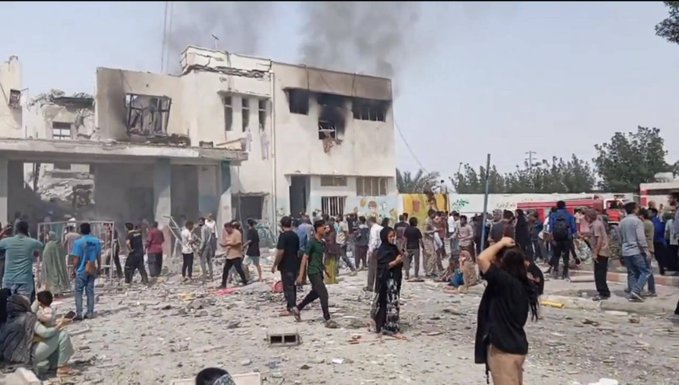
STONE AND DUST Israel has been devastated by severe aerial pounding by Iran
A Whole New World
Many people are still hesitant to let their optimism fly. They think that the US-Iran war will end like last year’s 12-day war, with both sides claiming victory to their domestic audience and the world will go back to the same old. Contrary to this, the only certainty of this war, whatever its outcome and whenever it happens, is that the world will not be the same again. Just as WWII ushered in a new world order, this war will change the power dynamics across the globe and not just in Asia. The signs are already there to see.
The public sentiment pushed to the edge by Israel’s two-year-long genocide against the Gazan people, is now overwhelmingly against the US-Israel combine, including in the United States too. A recent poll in the US showed that 50 per cent of Americans viewed Israel negatively. Even those who decried Iranian government’s oppression against its people are now supporting its courage in not kneeling before the diktats of the US. This sentiment is even more definitive in the Gulf states where people see the difference between the behaviour of their regimes as opposed to Iran’s response to the US.
However, one of the biggest reasons for why the world will not be the same is the existence of the alternative. In the last decade, BRICS has emerged as a collective of nations wanting to cooperate in the spirit of equality. BRICS has been challenging the US dominated world order, both politically as well as economically, to the extent that President Trump mocks it frequently and has tried to undermine it by threatening 100 per cent tariff on BRICS members.
After the war, more nations, including the fence-sitters like Saudi Arabia, would want to join it. Saudi Arabia has been attending BRICS summits for the last few years but has still not joined for the fear of US’ displeasure. This will no longer be the constraint, as the Gulf states see for themselves that the only friend that the US sticks its neck out for is Israel. For all their genuflection, the Gulf states were left vulnerable by the US when it used their territory to mount attacks on Iran, but instead of replenishing their depleted air defence arsenal, focussed on protecting Israel. Worse, despite evidence of Israel carrying out a false flag operation in Saudi Arabia to draw it into the war with Iran, the US did not chastise it. Consequently, after issuing statements that they reserve the right to retaliate against Iran, all the Gulf states led by Saudi Arabia subsequently said that they will not join the war and will not allow the US to use their territory. In reciprocation, Iranian foreign ministry issued a statement saying that it will cease attacking its neighbours as long as their territory is not used for waging war against it.
Outside West Asia, ASEAN countries like Malaysia and Indonesia have severely criticised US and Israel and have mourned the assassination of Khamenei. Several members of the European Union, starting with Spain has not only criticised US’ ‘illegal’ war on Iran but has also condemned the killing of Iranian supreme leader. Even those nations which have not criticised the US openly, have refused to join its US war effort, even indirectly.
It’s not that the world was not aware of US’ unilateralism earlier. The difference today is that Iran has demonstrated that this unilateralism is not without its limitations. Iran’s fight back shows that the alternative to the US’ hegemony is possible if most of the world takes the leap of faith.
Like human beings, nations during conflict must stand with what is right and just and not merely expedient. Unfortunately, India, hostage to its dogmatic policy on Kashmir, and because of the ruling party’s ideological convergence with Zionism, has chosen to be on the wrong side of not just history but justice too. This will have long-term implications for its society, economy and global stature.
 VIDEO
VIDEO