India’s civil aviation market may have grown tremendously over the years with a double-digit growth, but it has been a tough ride for the country’s chartered and private aircraft operators. The data from the Directorate General of Civil Aviation (DGCA) shows that the number of such operators reduced from a peak of 147 in 2011-12 to 111 in 2017-18.
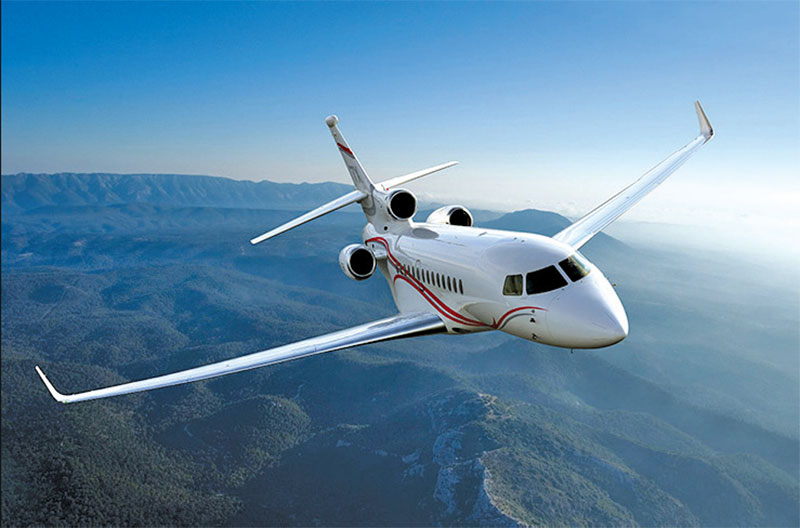
Dassault Falcon 7X business jet
India has registered 512 business aircraft and helicopters in the year 2017, with no significant growth since. The number is expected to grow to 868 by 2023. The business aviation sector contributed USD580 million to India’s GDP, this could grow to USD790 million by 2024. The sector employs whole range of technicians comprising aircraft owners, pilots, engineers, technicians, operations staff and regulators, a diverse sector which contributes directly and indirectly to the GDP in a significant manner.
Despite all the challenges, the charter plane aviation in India has been successful in overcoming numerous obstacles over the years. The sector has been more of a surviving business, with major companies striving to break even. Some of the challenges include lack of trained and qualified staff, a complex regulatory structure and work process, inadequate infrastructure and mounting operational costs, etc. being major hindrances in the sector.
Business aviation is not just about luxury, today it is more of a necessity, and is widely used by corporate houses for travel needs of their top executives. While commercial air travel would mean chaotic, overcrowded airports, with occasional delays, charter services help the businessmen to travel seamlessly saving time and pandemonium.
The global business aircraft market is dominated by companies like Bombardier, Gulfstream, Cessna Aircraft Company, Dassault Aviation, Embraer, Honda Aircraft Company, Pilatus Aircraft, Piper Aircraft, Saab AB and Textron Aviation. The industry is expected to register a CAGR of approximately seven per cent by 2023.
Indian industrialists often prefer Gulfstream jets or Dassault Falcons, while the wide-bodied Airbus A380 or Boeing 727 is preferred by ultra-rich people. Aircraft companies like Gulfstream, Dassault and Bombardier have largely dominated the Indian market because of their optimum price and specifications meeting busy Indian industrialists. The introduction of G650 ER jets by Gulfstream has helped to tap the long-range sector. Dassault Falcon 8X and Bombardier Global 8000 have proven to be foremost competitors for G650/650ER, being preferred by an increasing number of business travellers.
It’s the challenger series from Dassault Falcons and Bombardier that have monopoly over short range flights, and Gulfstream rules the long-range sector. The Falcon 8X also boasts of three engines (as opposed to the Gulfstream’s two) which is supposed to make it more reliable, though no Gulfstream has suffered from having an engine less than the Dassault challenger. Though India is largely a turbojet market, the last decade has seen the arrival of jets such as Embraer Phenom, Eclipse, the smaller Cessna and HondaJet, costing between USD3 million to USD5 million.






 VIDEO
VIDEO