

Towards Safer Tomorrow
Palak Gupta
The 71st Republic Day celebrations on 26 January 2020 witnessed the newly-inducted attack helicopter Apache and transport chopper Chinook make their maiden flight for the R-Day flypast.
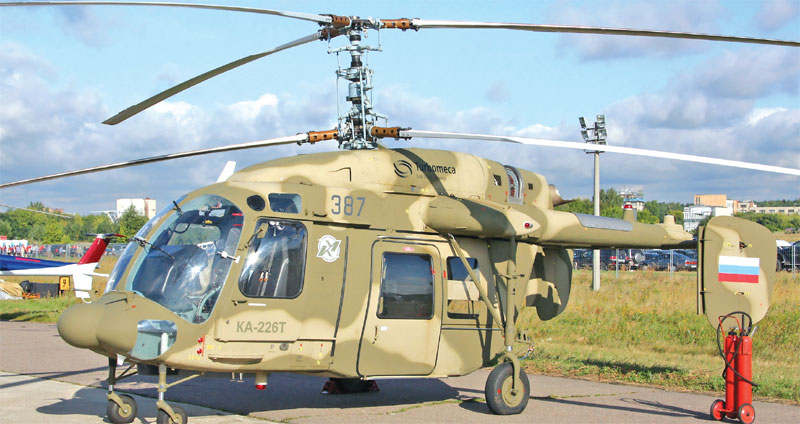
Russia’s Ka-226T helicopter
While the audience witnessed the might of India’s air power, it cannot be forgotten how the helicopter industry is seriously in need of modernisation. The Indian armed forces are still heavily dependent on vintage flying machines by state-owned Hindustan Aeronautics Limited (HAL) such as Chetak and Cheetah of which there seems to be no replacement in sight.
The ageing Cheetah and Chetak Light Utility Helicopters are based on the Fifties designed Alouette Aérospatiale 315B Lama of France. So, it’s time that these ageing machines were replaced.
Till that happens, here is a list of helicopters that the Indian Army Aviation and the Indian Naval Aviation possess or are in the process of acquiring/inducting in the immediate future to give a major boost to its tactical fighting capabilities.
Army Aviation
Boeing’s AH-64E Apache: India and China are the world’s largest military helicopter market but what is surprising is that until very recently, India did not possess a suitable attack helicopter in its inventory.
Much is already being said and written about Boeing’s AH-64E Apache helicopters. India on 3 September 2019 became the 16th country to procure the Apache when the Indian Air Force (IAF) inducted eight of them at the Pathankot Air Base. The Indian Army will procure six Apaches at a cost of Rs 4,168 crore and these would be given to a unit (Strike Corps) on the western borders.
“Six Army Apache attack choppers would be given to an army unit on the western borders from where there is a greater threat from armoured columns,” said Chief of Army Staff General Manoj Mukund Naravane in his first media interaction.
“We can’t get anything better than the latest Apache. 64E is an upgrade and the latest state-of-the-art asset that we (the Indian Army) are adopting. We are getting what the US Army flies currently,” said Lt Gen. Bali Pawar (retired).
The AH-64 Apache is the world’s most advanced multi-role combat helicopter with the latest technology insertions. It is the only available combat helicopter with a spectrum of capabilities for virtually any mission requirement, including greater thrust and lift, joint digital operability, improved survivability and cognitive decision aiding.
The IAF will operate a fleet of 22 Apaches by the end of 2020.
In response to ease in absorption of technology, Lt Gen. Pawar pointed out, “We absolutely have no issues revolving around it. We have very capable test pilots and test engineers. There is no problem in handling technology.”
A major component of the Apache attack helicopters, its fuselage, for the Indian Army will be made indigenously at the Tata Boeing Aerospace Limited (TBAL) facility in Hyderabad. With all said and done, there is no information available by when will the Apache be ready for the Indian Army.
Russian Ka-226T: Russian Ka-226T helicopters, which will be procured by the Indian Army, will substitute Cheetah and Chetak Light Utility Helicopters and are meant for high altitude, surveillance and logistics.
When asked about the number of helicopters the Army Aviation is short of, Lt Gen. Pawar (retd) said, “It is not about shortage. We need replacements. Ka-226T was supposed to replace Cheetah and Chetak but it has not happened till now.”
India signed the Inter-Governmental Agreement (IGA) with Russian Helicopters and Rosoboronexport in October 2016 on the side-lines of the BRICS (Brazil, Russia, India, China and South Africa) Summit in Goa for the procurement of 200 Ka-226T helicopters in the ratio of 60:40:100, of which 60 are to be supplied to India in a flyaway condition; 40 will be assembled by the HAL-Russian Helicopters joint venture and 100 would be manufactured entirely by the joint venture.
Even after four years, Moscow and New Delhi have still not sealed the contract. Issues on cost price and transfer of technology (ToT) are apparently acting as encumbrances and preventing the contract to move forward, as Lt Gen. Pawar (retd) pointed out.
However, Russian deputy chief of mission Roman Babushkin said a contract will shortly be finalised for joint production of Kamov light-weight multi-role military helicopters for India. The latest development on this agreement is that India and Moscow have concluded price talks for 200 Kamov copters reportedly.
HAL-built RUDRA: This is a weaponised version of the Advanced Light Helicopter (ALH) (Dhruv). The Indian Army plans to equip its Army Aviation Corps with a total of 60 helicopters, forming six squadrons.
“The Indian Army possesses 30-40 of these (HAL RUDRA) and another 20-30 are required. It is an ongoing process,” said Lt Gen. Pawar (retd).
The first HAL Rudra helicopter was delivered to the Indian Army during Aero India 2013. It also happens to be the first armed helicopter which is being produced indigenously.
Incorporating a conventional design, RUDRA can carry a payload of 2,600 kg and can be deployed in a wide range of missions, including reconnaissance, troop transport, anti-tank warfare and close air support.
ALH Dhruv: The indigenously designed and developed Advanced Light Helicopter (ALH-DHRUV) is a twin engine, multi-role, multi-mission new generation helicopter in the 5.5 tonne weight class. The helicopter, designed conventionally, is for the army, air force, navy, Coast Guard and civil operations and for both utility and attack roles by day and night. However, the Indian Navy has stopped placing any further orders for these helicopters.
Despite a total production of 216 helicopters for the Indian armed forces by March 2017, Lt Gen. Pawar (retd) said that there at least 35 per cent shortage of these in the Army Aviation.
Light Combat Helicopters: The government approved the development of the Light Combat Helicopter (LCH) by the state-owned HAL in 2006. “The Defence Acquisition Council (DAC) has already cleared the limited series production (LSP) of 15 LCH, 10 for the Indian Air Force (IAF) and five for the Indian Army respectively,” explained Lt Gen. Pawar (retd) adding that the number is due to increase subsequently.
With its distinct ability to operate at high altitudes, it will be deployed in mountains. The LCH, in January 2019, successfully completed all weapon integration tests and became ready for operational induction.
The difference in LCH and Rudra is that while the former is a dedicated Attack Helicopter, the latter is merely an armed version.
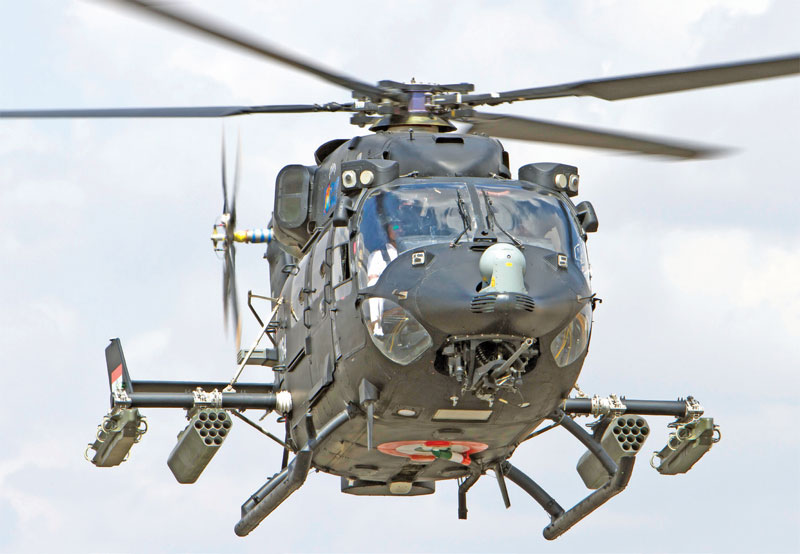
IAF’s ALH-Dhruv
Naval Aviation
One cannot afford to downplay the aspect of aviation in the domain of maritime operations. From simple transport to anti-ship and anti-submarine warfare (ASW), from conducting search and rescue operations (SAR) to human aid and disaster relief (HADR) and Intelligence, Surveillance and Reconnaissance (ISR), naval aviation is of profound significance.
The Indian Navy currently has several high-end ships but without serious, effective naval helicopter capability. It has flagged helicopters as one of its most critical needs before the government. Few of Russian Ka-28s are still fit for service, and the small and aged Sea King fleet faces both technological and airframe limitations.
The Indian Navy had floated a global Request for Information (RFI) for 123 Naval Multi-Role Helicopters (NMRH) in August 2017.
The requirement for 111 Naval Utility Helicopters (NUH) and 123 Naval Multi Role Helicopters (NMRH) for the Indian Navy have already been cleared by the government.
These projects will be undertaken under the government’s flagship ‘Make in India’ Strategic Partnership Model which involves the private sector and a foreign Original Equipment Manufacturer (OEM).
However, the process has not moved as swiftly as the navy would have expected or liked. Despite the shortfall in numbers, a deal is yet to be sealed.
Procurement and upgradation in the Indian armed forces is notoriously tedious and lengthy, often marred by allegations of corruption.
The DAC, in August 2018, approved a project to build 111 Naval Utility Helicopters (NUH) worth Rs 21,738 crore to replace the outdated fleet of French-designed Chetak choppers.
HAL’s attempt to convert the Chetak helicopter into an unmanned version for the navy did not succeed and the project was ultimately shelved. HAL has so far produced over 350 Chetak helicopters and delivered around 80 to the Indian Navy. Presently, 51 helicopters are flying with the navy.
For the last five decades, HAL has been producing the Chetak helicopters under licence from France’s Airbus Helicopters (formerly Eurocopter). The first Chetak helicopter to the Indian Navy was delivered in February 1966. These helicopters are used by the navy for communication duties (passenger transport), cargo/ material transport, casualty evacuation, search and rescue, aerial survey and patrolling, emergency medical services, electronic news gathering, anti-hijacking and offshore operations.
After a wait of nearly 48 years, a multi-billion-dollar deal is in process to procure Sikorsky’s 24 multi-role MH-60R ‘Romeo’ Seahawk choppers. The NMRH are required to replace the ageing UK-made Sea King fleet. It was inducted 40 years ago and has never underwent an upgrade since then.
A key characteristic feature of MH-60R is that it can be deployed from warships for various different tasks like anti-surface and anti-submarine warfare missions. It can hunt down submarines and knock out ships, thus giving an edge to India’s maritime capability.
The deal, which is set to be finalised in the immediate future, will pave the way for the delivery of helicopters between 2020 and 2024. This is crucial as it comes at times when China is vehemently foraying into the Indian Ocean Region (IOR).
The decision on defence procurement deals is also dependent on the bilateral trade relations shared between or amongst countries, explained Vice Admiral Shekhar Sinha (retd).
A news report on January 16 stated that the Indian Navy is cutting down on procurement due to budget cuts. So, will it have any effect on the ongoing procurement process of the helicopters?
According to VAdm. Sinha (retd), it would depend on the budget the navy allocates for the helicopters. The Indian Navy is already contemplating slashing down the acquisition of Kamov Ka-31 Airborne Early Warning and Control helicopters to six, from the original requirement of 10 systems. In May 2019, ministry of defence had approved the procurement of 10 Ka-31 helicopters for the Indian Navy at a cost of Rs 3,600 crore.
A military helicopter developed for the Soviet Navy, Ka-31, is currently in service in Russia, China and India. The deployment of these helicopters largely aims at sanitising air space around the battle groups led by the aircraft carriers.
Apart from this, the Indian Navy also operates a fleet of Ka-28 choppers which were procured in Eighties and require an upgrade for future operations. In July 2016, after the intervention of the then defence minister Manohar Parrikar, a contract was signed between the ministry of defence and Russian manufacturer Rosoboronexport to modernise and upgrade copters. According to the contract these copters will be equipped with state-of-the-art sensors.
Given the ‘obsolete’ and ‘vintage’ machines that the Indian aviators fly, safety of the pilots is a big concern. VAdm. Sinha said that a machine is either fit to fly or not. “On regular/ daily basis, there are flying tests and an elaborate system is in place to evaluate the fitness of the flying machine,” he said.
The helicopters acquisitions in the armed forces must focus on modernisation, building new capabilities and making up for existing shortfalls.





 VIDEO
VIDEO