During the commissioning of INS Visakhapatnam, the first of the four stealth guided missile destroyers under Project 15B in November, the vice chief of naval staff V Adm. S.N. Ghormade said that 39 surface ships and submarines are being constructed in various shipyards across the country. Besides, two frigates are being built for the Indian Navy in Russia. The navy’s intention is to become a 170-ship force by 2027. While the ships being commissioned adds to India’s naval capabilities, there is still a long way to go.
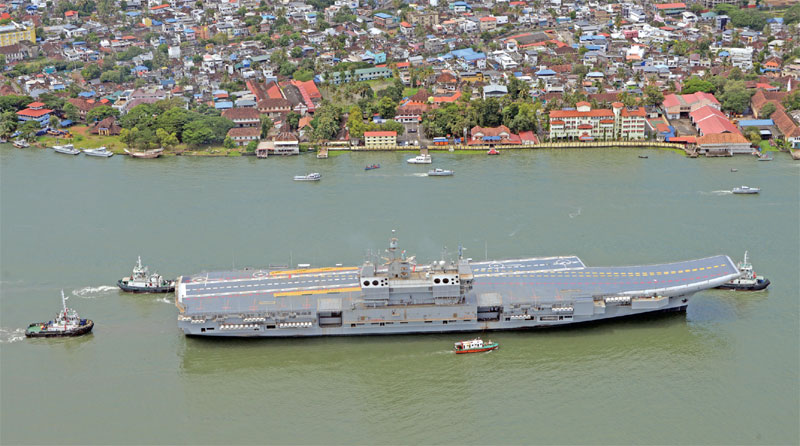
INS Vikrant during its maiden sea trial
The journey of India’s indigenous shipbuilding began in the 1960s. Shipyards under private ownership were taken over by the government as part of setting up the public sector enterprises. It started with building of small ships and auxiliaries for the Indian Navy. A breakthrough came with the Leander project in collaboration with the British Admiralty in the 70s and 80s. Currently, different shipyards are engaging different projects. While the Cochin Shipyard Ltd is building the Indigenous Aircraft Carrier (IAC), Mazagon Docks Shipbuilders are building 15B Destroyers. The construction of Project 17A Frigates is being undertaken jointly at Mazagon Docks Shipbuilders Ltd and Garden Reach Shipbuilders & Engineers Ltd. Follow on Project 1135.6 Frigates is being constructed at the Goa Shipyard Ltd. The construction of the two projects—Landing Craft Utilities and Survey Vessel is being undertaken at GRSE.
The ASW Shallow Watercraft is being constructed at Cochin Shipyard Ltd and Garden Reach Shipbuilders Ltd. The project to construct Naval Offshore Patrol Vessels is given to Reliance Naval and Engineering Ltd while the Diving Support Vessels are being constructed at the Hindustan Shipyard Ltd. The Project 75 submarines are being built at Mazagon Dock Shipbuilders Ltd.
“We are also looking at integrated capability development system which has been introduced and work is progressing well on the tri-service effort to make an integrated system,” VAdm. Ghormade said. Recently, the Navy commissioned INS Vela, the fourth submarine of the first batch of six Kalvari-class submarines. Both the platforms have been built at Mazagon Dock Shipbuilders Limited.
While the Navy has covered a significant distance in shipbuilding, thanks to certain policy decisions, the naval shipbuilding has not been able to perform as required. Some major reasons include monopoly of the DPSU shipyards and import of parts that go into the making of a warship.
Captain Ramesh Babu, who recently retired as the executive director, Mazagon Dock says, “Structurally, almost 90 per cent of the material used is indigenous and the construction too is undertaken indigenously. However, submarine steel is still being imported. So, as far as ships are concerned, 90 per cent of the float component is indigenous. In the case of weapon systems though, we have a long way to go. We need to travel some distance in design, development and manufacturing of futuristic weapon systems and sensors within the country to achieve that figure. In the move segment, many of our ships today are run on gas turbines.”
Citing the example of gas turbines, he adds that there are a couple of major gas turbine OEMs in the world, who supply in India. These OEMs have shown interest in setting shop in India, and they have made several approaches. But India lacks a long-standing policy on this. “If India is going to be using a particular kind of gas turbine for twenty or thirty vessels that are being built in India, the country needs a long-standing policy in place saying that such gas turbines will be built here with collaboration of its foreign OEM, and inducted into all ships of different projects, on the drawing board,” he says.








 VIDEO
VIDEO