

Time for Action
Come May 16 and election results are likely to indicate which dispensation shall govern the country for the next five years. Irrespective of who comes to power, the defence forces ought to be prepared to categorically state their concerns and what they expect from the new government. Without going into generalisations regarding the prevailing external and internal security situation, or the probable nature of conflict in the foreseeable future, I shall straightaway discuss salient issues that should be taken up on priority. Although I shall try and confine myself to army related issues, but frankly most of them are so intertwined that they are equally applicable to all three services directly or indirectly.
Political Direction
According to Admiral Arun Prakash, former Chief of Naval Staff, “India’s political establishment has chosen to follow an unusual paradigm in which policymaking is assigned to the bureaucracy, while strategy is crafted by diplomats, and matters impinging on grand strategy, like nuclear deterrence or ballistic missile defence remain in the hands of scientists or technocrats. Uniquely India has not seen it fit to entrust its armed forces with any role in national security decision making”. The new government, therefore, should be urged to define national aims and objectives, issue strategic guidance, revive vital security issues that have remained stagnant for long including national security reforms.
Northern Borders with China Transgressions:
Every year the same story is repeated along the Line of Actual Control (LAC) with China albeit the location varies. Sometimes it has a Northern flavour of Daulat Beg Oldi (DBO), Depsang plateau, Demchok or Chumar and in other months the scene shifts to Sikkim or Arunachal, be it Doka La, Asaphi La or Maja. The government explanation, spoken more often than not from an Ministry of External Affairs (MEA) standpoint and seldom from the defence viewpoint, is that there is a misperception between the Chinese and Indian claim lines and that respective border forces are patrolling areas as perceived by them. In every forum including the Parliament, the ministers or their spokespersons reiterate that the situation on the LAC is generally peaceful and that laid-down procedures for stand-offs are being followed by troops at the local level. When confronted with the question as to how the Chinese patrols have advanced well beyond their so called claim line and have set up temporary abode with pre-fabricated structures, the standard answer is that the issue has been raised with the Chinese foreign office through diplomatic channels. It is also emphasised that the strategic dialogue between the Special Representatives or the National Security Advisor (NSA) and his counterpart is trying to resolve the border dispute holistically. Unfortunately, the process seems to prolong because the Chinese are in no hurry and the Indian government cannot decide on a coherent policy other than appeasement.
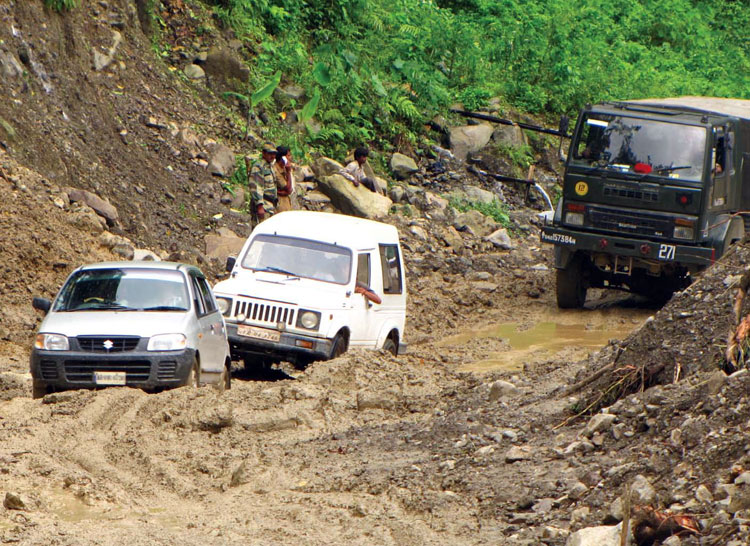
Infrastructure on Border with China: The nation has been hearing about the infrastructure being developed along the border with China in the Northern (Ladakh), Central (Himachal and Uttarakhand) and the Northeastern (Arunachal Pradesh) sectors. The China Study Group (CSG) in its deliberations had recommended the construction and improvement of 72 roads in these regions which were duly funded and budgeted over three Five Year Plans by successive governments. The Border Roads Organisation (BRO) was tasked to complete these by 2013. Needless to mention, there were delays on several fronts. Land acquisition, seeking clearances from border states, ministries of surface transport and environment have been the biggest impediment, despite clarifications and rulings by the Supreme Court. The BRO had its peculiar struggle with procurement of plant and resources as well as mobilising the additional increment in manpower that had been sanctioned. To add to it, the private sector which was intended to participate for outsourced contractual work in selected areas was not forthcoming in the absence of assurances and protection by way of a specific legislation. The bottomline is that the infrastructure, both road and rail, is nowhere near completion of laid-down targets. There are areas where the progress has been woefully inadequate and as a result, even operational criticalities still remain - such as roads to carry our towed artillery forward so as to be in range to support our troops. The Ultra-light Howitzers (ULH) are nowhere in the horizon despite the promise of their procurement through the FMS route.
Subscribe To Force
Fuel Fearless Journalism with Your Yearly Subscription
SUBSCRIBE NOW
We don’t tell you how to do your job…
But we put the environment in which you do your job in perspective, so that when you step out you do so with the complete picture.





 VIDEO
VIDEO