
The Weight of Will
Global military airlift capability, its strategic implications and India’s position
Junaid Suhais
The ability to move heavy things quickly over very long distances has never been merely a logistical function. It is, at its most fundamental, a statement of reach, and reach, in the grammar of statecraft, is power made tangible.
Military airlifts are commonly assessed through payload tables and range rings, reducing a complex capability to a cargo manifest. That framing misses the essential point. What strategic airlift measures is the speed at which a state can convert political will into physical presence: troops on a runway in a theatre of crisis, equipment at a forward operating location, supplies to an isolated garrison that roads cannot reach. The aircraft executing those missions are not in the support role; they are the instrument of decision.
In an era characterised by contested sea lanes, degraded overland routes, and a compression of crisis timelines, air mobility has migrated from the operational support domain into the centre of deterrence calculations. The nations that command sustained throughput across intercontinental distances, not just peak payload, but day-over-day sortie generation under pressure, are the nations that hold strategic initiative. This is why fleet size and composition have become proxy indicators of geopolitical ambition, and why the airlift gap between major powers has become a metric that defence planners monitor with as much attention as fighter-to-fighter ratios or nuclear force structure.
The Hierarchy of Reach
The United States Air Force (USAF) Mobility Command remains, by every measurable parameter, the world’s dominant airlift force, and the margin is not incremental. As of 2026, the USAF operates 223 C-17 Globemaster IIIs and 52 C-5M Super Galaxies as its primary inter-theatre lift assets, supplemented by 165 C-130Js for intra-theatre and tactical tasks.
The C-17 carries 77,519 kg to a range of approximately 4,440 km at maximum payload; the C-5M extends that payload ceiling to 129,274 kg at somewhat shorter range. Together, these two platforms give USAF Mobility Command a combined strategic lift capacity measured not in sorties but in the department of defence’s inter-theatre objective: 50 million ton-miles per day (MTM/D). (U.S. Air Force, Airlift Recapitalization Strategy, November 2025. Referenced via FY2026 Air Force Budget Estimates and USAF official communications)
No other military on the Earth approximates that figure.
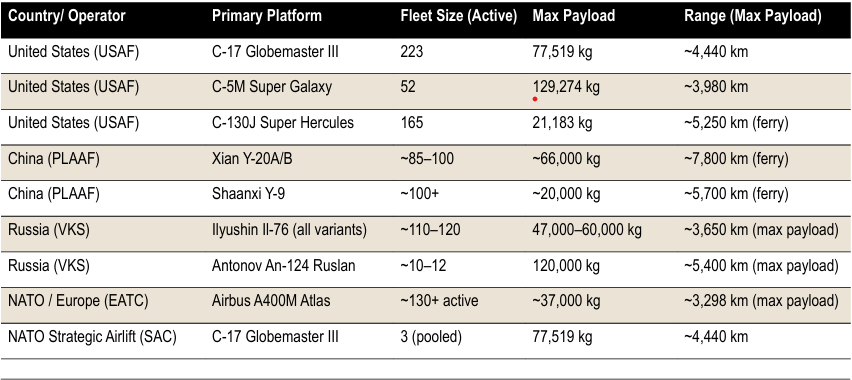
China’s trajectory is the more consequential story of the current decade. The Xian Y-20, China’s first indigenous strategic airlifter, reached serial production well ahead of Western estimates. With approximately 85-100 Y-20A and Y-20B airframes now active, the latter equipped with indigenous WS-20 turbofans replacing the earlier Russian-derived D-30KP-2, the PLAAF has a genuine strategic lift capability for the first time in its history. The Y-20’s 66,000 kg maximum payload and intercontinental ferry range of approximately 7,800 km make it broadly comparable to an early-production C-17, though USAF retains more than a 2.7-to-1 advantage in heavy airframes. The more revealing comparison is in tanker support: the USAF operates approximately 610 tankers against China’s roughly 46, a disparity that constrains the People’s Liberation Army (PLA’s) ability to sustain long-range airlift missions without forward-basing support, and China has been systematically building that support, with confirmed upgrades to facilities at Djibouti and an emerging presence at Ream Naval Base in Cambodia.
Russia’s airlift posture has significantly degraded since 2022. The Il-76 fleet, once numbering 150 or more across variants, has been battered by a combination of combat attrition and sanctions-driven maintenance failures. Eight Il-76 airframes have been visually confirmed destroyed or severely damaged, with notable strikes against Pskov Air Base in 2023 and Belgorod in 2024. More structurally damaging is the maintenance crisis reported in early 2026: engine bearing failures and avionics shortages linked to Western sanctions have grounded an estimated 25 per cent of the modernised Il-76MD-90A variant. The An-124 Ruslan, with its extraordinary 120,000 kg payload, survives in only 10-12 active military airframes, and production of a replacement airframe remains stalled. Russia retains functional airlift, as its sustained logistics bridge to Syria and the Africa Corps operations in Mali and Libya demonstrate, but its long-range surge capacity has contracted markedly from Cold War heights.
The European picture is one of the qualified improvements hampered by structural fragmentation. The Airbus A400M Atlas has become the backbone of European tactical-to-operational lift, with over 130 aircraft active across Germany (53 aircraft), France (25), the United Kingdom (22), Spain (14), Turkey (10), and Belgium (7). The A400M’s 37,000 kg payload positions it above tactical platforms but well below the C-17, a capability gap that Nato member states bridge through the Strategic Airlift Capability (SAC) arrangement at Papa Air Base in Hungary, which pools three C-17s, allocating 3,165 flight hours annually among 12 partner nations. The SALIS programme provides two contracted An-124s through late 2026 for outsized cargo requirements. The European Air Transport Command (EATC) in Eindhoven coordinates over 180 assets across member states, an impressive bureaucratic achievement that nonetheless cannot fully compensate for the absence of a single-owner deep strategic lift reserve.
The Case for Throughput
Payload figures are the most cited metric in airlift analysis, and they are also among the most misleading. The payload of a single aircraft on a single sortie is a data point; the throughput of a fleet over a sustained campaign is a capability. The distinction matters enormously under operational conditions.
Throughput, measured as the tonnage delivered to a specified point over a defined period, is a product of aircraft availability, sortie rate, crew endurance, airfield capacity at both origin and destination, and the robustness of the maintenance pipeline. During the 2021 non-combatant evacuation operation from Kabul, US forces evacuated 124,334 people across 2,627 sorties. That operation, conducted against a collapsing security environment with a single airfield effectively functioning as the choke point, illustrated two distinct lessons: first, that the C-17’s combination of payload, range, and rough-field performance is operationally irreplaceable; and second, that even the world’s largest airlift force can approach throughput limits when infrastructure concentration and sortie saturation converge.

Lockheed Martin built C-130J
The payload of a single aircraft on a single sortie is a data point. The throughput of a fleet over a sustained campaign is a capability. The distinction matters enormously under operational conditions. Sortie generation rate, the number of sorties an aircraft or fleet can produce within a defined cycle, is closely held by most air forces, and publicly available figures from exercises are deliberately conservative proxies for wartime maximums. What can be inferred from exercise data and historical operations is that sustained high-tempo airlift requires a maintenance-to-flight-hour ratio that most non-US air forces cannot maintain across an extended campaign. The USAF’s Airlift Recapitalisation Strategy, released in November 2025, implicitly acknowledges this by extending C-5M service life to 2045 and C-17 viability to 2075, while accelerating the Next-Generation Airlifter (NGAL) development timeline toward a 2038 initial fielding, the first formal acknowledgement that peer competition in airlift has rejoined the procurement calculus after a post-Cold War lull.
Survivability in Denied Airspace
The strategic weight of an airlift fleet is meaningless if that fleet cannot operate in the environment where the crisis is occurring. Large transport aircraft are among the most physically conspicuous and aerodynamically constrained platforms in any air force inventory. They are slow, high-signature, operationally dependent on prepared airfields, and profoundly vulnerable to a threat spectrum ranging from man-portable air defence systems (MANPADS) to advanced long-range surface-to-air missiles.
The war in Ukraine has generated a real-time dataset on transport aircraft vulnerability that defence planners are analysing with considerable intensity. The loss of Il-76 airframes to drone strikes and standoff weapons at Pskov and Belgorod, operations within Russian sovereign territory against aircraft on the ground, demonstrated that the vulnerability of these platforms extends beyond their flight envelopes to their home basing infrastructure. An adversary with precision standoff capability can attack the maintenance and parking infrastructure of an airlift fleet without ever contesting the airspace directly, degrading throughput without engaging in air combat at all.
Against networked integrated air defences, the operational options for unarmed or minimally defended transport aircraft narrow dramatically. In a high-intensity conflict scenario involving Chinese A2/AD architecture in the Western Pacific, or Russian long-range SAM coverage in Eastern Europe, strategic airlifters would be routed through corridors that avoid engagement envelopes, imposing geographic constraints that extend transit times and effectively reduce sortie generation.

STRATEGIC REACH IAF’s Boeing-built C-17 Globemaster III during Exercise Vayu Shakti
The USAF’s conceptual response, codified in the Agile Combat Employment (ACE) doctrine under AFDN 1-21, is to distribute basing across a wider number of expeditionary locations, reduce aircraft signatures on the ground, and increase the frequency of base switching to deny adversary targeting cycles a stable picture. This is sound concept design, but it requires each forward location to have sufficient infrastructure for heavy aircraft operations, a logistical constraint that limits genuine ACE implementation to a narrower set of locations than doctrine implies.
The most significant long-term survivability development is the emerging concept of high-speed or stealthy large transport aircraft, currently at the conceptual level in US NGAL studies and Chinese research publications. Until such platforms exist operationally, the fundamental tension between the strategic value of airlift and the vulnerability of the platforms that execute it will remain unresolved.
Airlift as Geopolitical Signal
Beyond its warfighting function, military airlift has become a primary instrument through which states communicate capability, demonstrate commitment, and project soft power in moments of international crisis. The mechanisms are distinct, but mutually reinforcing non-combatant evacuations establish the credibility of a state’s protection guarantee; humanitarian airlifts build diplomatic capital; and the rapid deployment of military assets to distant theatres signals deterrence intent before a word of formal policy is uttered.
China’s deliberate use of Y-20 airframes for high-visibility missions reflects an awareness of this dimension that is increasingly sophisticated. Six Y-20s deployed to Serbia in 2022 as part of an air defence equipment delivery, a mission whose military substance was less significant than its optics, photographed by Serbian crowds and broadcast across European media as evidence of China’s reach. The dispatch of Y-20s carrying 33 tonnes of aid to Tonga following the 2022 volcanic eruption served a parallel function in the Pacific context, establishing a physical presence in a region where both the US and Australia have historically dominant influence. The aircraft is, in both cases, a message.
Russia has maintained an Il-76 and An-124 logistics corridor to Syria’s Hmeimim Air Base for over a decade, a sustained airlift operation that enabled the projection of ground and air power into the Mediterranean theatre with minimal dependence on overland or maritime routes. The same Il-76 fleet has sustained Russia’s Africa Corps presence in Mali and Libya, providing the logistical lifeline for operations that Western nations have struggled to counter or disrupt precisely because the airbridge is difficult to interdict without triggering escalation. This is airlift as a tool of strategic persistence, the ability to maintain presence in contested political environments at distances that would otherwise strain conventional logistics.
India
India’s military airlift capability is operationally sophisticated, geographically specialised, and numerically constrained, a combination that defines both its current utility and its structural limitations at the strategic level.
Fleet Composition: The Indian Air Force (IAF) operates one of the more varied transport fleets in the Asia-Pacific, reflecting decades of procurement from multiple suppliers against a threat environment that spans high-altitude glacier supply runs and transoceanic non-combatant evacuations. The core of the IAF’s strategic airlift is its 11 C-17 Globemaster IIIs, acquired from Boeing between 2013 and 2014, a fleet that provides genuine heavy-lift capability with full compatibility with Western tanker architectures. Twelve C-130J Super Hercules serve as the primary medium-lift and special operations platform, with a proven record of operations from austere forward strips that no other aircraft in the IAF inventory can access.
The IAF’s numerical backbone remains approximately 102 An-32 turboprops, a Soviet-era platform that has been upgraded in tranches under the An-32RE programme, with roughly 55 aircraft now carrying uprated engines and avionics. The An-32 carries 6,700 kg over a combat radius of approximately 1,100 km, modest figures by any inter-theatre standard, but entirely adequate for the sub-regional and high-altitude missions the aircraft was designed for.
Rounding out the heavy-lift inventory are approximately 11 operationally active Il-76MD airframes, a number that reflects both the original procurement of about 17 aircraft and severe serviceability constraints driven by the disruption of Russian maintenance and spare parts supply chains following 2022. Reported serviceability for the Il-76 fleet has fallen below 50 per cent, a statistic that materially compromises the IAF’s surge capacity in scenarios requiring simultaneous heavy lift and high-altitude operations. The C-295MW, with 16 flyaway aircraft now delivered and the first India-built unit nearing induction from the Vadodara facility, is beginning to establish a domestically produced medium-lift baseline.
High-Altitude Advantage: Where the IAF’s airlift capability genuinely distinguishes itself from most peer competitors, and in one specific domain, from China, is in high-altitude operations. India maintains forward airstrips at elevations that test the physical limits of heavy transport aircraft. Daulat Beg Oldi (DBO), situated at approximately 5,065 metres (16,614 feet) in the Karakoram, is the world’s highest designated airstrip and a critical logistics node for the Siachen sector and the Depsang plains. C-130J Super Hercules aircraft have conducted landings at DBO since 2013, establishing a record for the world’s highest C-130J landing and effectively demonstrating India’s ability to sustain forward positions that no road network reaches reliably.
Altitude imposes severe payload penalties that compress theoretical capability against operational reality. A C-130J operating into DBO can carry approximately 8-10 tonnes rather than its standard 19-tonne capacity, a 50 per cent or greater reduction driven by density altitude effects on lift and engine performance. The C-17, which operates regularly into Leh (approximately 3,256 meters/ 10,682 feet), faces similar constraints: maximum payload at Leh is typically restricted to 37–50 tonnes against a standard capacity of 77.5 tonnes. There are no documented C-17 operations at DBO as of April 2026, a limitation attributable to the combination of runway length (approximately 1,500 meters) and density altitude that exceeds even the C-17’s performance envelope under high-gross-weight conditions.
Throughput and Scale Limitations: The contrast in scale between India’s strategic airlift inventory and those of the two powers whose interests most directly bear on Indian security is stark and consequential. India’s 11 operational C-17s represent a total strategic lift capacity of approximately 1,900 tonnes per sortie wave. China’s estimated 85-100 Y-20 airframes can generate 6,500-7,500 tonnes in a comparable wave; the US’ combined C-17 and C-5M fleet exceeds 24,000 tonnes. These are not equivalent forces given different operational assignments; they reflect a genuine disproportion in the speed at which each country can move significant military mass across strategic distances.

The throughput constraint is compounded by tanker dependency. India’s aerial refueling capacity, based on a small number of Il-78 Midas tankers whose serviceability tracks the broader deterioration of Russian-origin platforms, limits the C-17’s ability to operate at extended range without intermediate staging. Operations beyond the Indian Ocean rim effectively require either staging bases or significant tanker augmentation, both of which constrain the spontaneity that characterises genuinely effective rapid-reaction airlift.
Capability Gap
The most structurally significant vulnerability in India’s airlift architecture is not fleet size; it is industrial. India currently has zero indigenous design, manufacturing, or engine production capability for transport aircraft in the medium-to-heavy categories. Every heavy and medium airlifter in the IAF inventory is either a foreign-origin design or a foreign-origin design assembled under license. The propulsion systems that power those aircraft, GE CF6 engines on the C-17, Rolls-Royce AE 2100 on the C-130J, Ukrainian AI-20 on the upgraded An-32, represent a complete dependency on foreign OEMs for sustainment, modification, and replacement.
India’s Medium Range Transport Aircraft (MRTA) programme, cleared by the Defence Procurement Board in March 2026 for 60–80 aircraft in the 18–30 tonne class, represents an attempt to address this gap, but the contenders, Embraer’s C-390 and Lockheed Martin’s C-130J, are both foreign designs offered through ‘Make in India’ production arrangements. They would reduce manufacturing dependency without resolving the design and propulsion gaps that define genuine indigenous capability. Hindustan Aeronautics Limited (HAL’s) SARAS Mk2, a light transport prototype projected for its first flight in 2027, remains in a category that has no bearing on strategic or even operational lift requirements. The absence of an Indian turbofan or turboprop in the 10,000–30,000 lbf thrust class means that even a nominally indigenous transport aircraft would require a foreign-origin engine, the most critical single dependency in the entire supply chain.
Strategic Positioning
India’s airlift posture reflects a strategic reality that is distinct from both the US and Chinese models. Washington uses airlift to project power globally with speed and scale; Beijing is building toward the same capability while investing in the forward basing infrastructure to make it operationally viable at range. India’s requirements are concentrated on a continental geography where the critical operational arenas, the Line of Actual Control (LAC) in Ladakh, the Andaman and Nicobar Islands, the Indian Ocean maritime domain, are at most 2,500 km from major IAF bases. In that sense, India does not require, and has not yet had reason to acquire, the intercontinental surge capacity that defines the US and aspirational Chinese airlift doctrine.
The asymmetry that matters is not with the US; India does not compete in the same operational tier. The asymmetry that matters is with China, specifically in the scenario of a simultaneous high-altitude border crisis and a requirement to demonstrate power in the Indian Ocean Region (IOR). A China that can move multiple brigade-sized elements by air to Tibetan Plateau staging bases within 72 hours, while India’s 11 C-17s and altitude-penalised C-130Js sustain Ladakh forward posts against active interdiction pressure, is a China that holds an operational initiative the IAF currently cannot neutralise by airlift capacity alone. Infrastructure investments on the LAC, particularly the Border Roads Organisation’s (BRO) work on lateral connectivity, partially offset this, but they are slower and more vulnerable than air-based logistics in the scenarios that matter most.
India’s use of airlift in its statecraft portfolio has been notably effective within its operational range. Operation Raahat in 2015 evacuated more than 5,600 personnel, including 960 foreign nationals, from Yemen using C-17 and Il-76 airframes in a joint inter-service operation that demonstrated genuine multinational evacuation capability. Operation Ganga extracted approximately 18,282 Indian nationals from Ukraine in early 2022; Operation Kaveri moved 4,097 people from Sudan in 2023, the C-17 serving as the primary instrument in both operations. These operations have built both operational experience and diplomatic currency in a way that a purely defensive posture would not have generated. The question for the next decade is whether that currency compounds into expanded strategic mobility, or whether fleet stagnation and industrial inaction gradually erode the edge that current operational experience has built.
Next-Generation Airlifter
The trajectories of major airlift programmes converge on three themes that will define the operational landscape through 2040: distributed basing to reduce vulnerability, enhanced survivability features for platforms operating in contested environments, and a step-change in payload or range performance from next-generation designs.
The USAF’s Next-Generation Airlifter programme, with a 2038 initial fielding target embedded in the November 2025 Airlift Recapitalization Strategy, is the most consequential near-term development in the global airlift architecture. The Analysis of Alternatives scheduled for FY2027 will determine whether the NGAL represents a modest performance improvement over the C-17 or a qualitative leap toward survivability-first design, potentially incorporating low-observable features, advanced electronic warfare integration, or propulsion architectures that reduce infrared and acoustic signature. The decision will have cascading implications: a survivability-focused NGAL would deepen the gap between the US and all other airlift forces, since neither China, Russia, nor Europe has equivalent programmes at comparable development maturity.
China’s parallel path will see the Y-20B, powered by the domestically developed WS-20 engine, reach full operational capability across the People’s Liberation Army Air Force (PLAAF) fleet through the late 2020s, removing the residual dependency on Russian D-30KP-2 propulsion and enabling unrestricted export and further-range operations. The Y-30 tactical transport, analogous in concept to the C-130J class, is progressing through developmental flight testing and is expected to begin serial production in the 2027–2028 timeframe, eventually displacing ageing Y-8 and Y-9 variants and providing a fully indigenous tactical-to-operational lift chain.
For Europe, the question is whether increasing defence spending commitments, driven in part by the NATO burden-sharing recalibrations of 2024-2025, will translate into additional A400M orders and a genuine European strategic lift reserve, or whether pooling arrangements will remain the primary mitigation for individual national fleet shortfalls. Germany’s defence budget increases and France’s sustained investment in strategic autonomy both suggest upward pressure on A400M procurement, but a European SAC of meaningful scale, multiple C-17 equivalents under permanent multilateral command, remains more aspiration than programme.
Air Mobility as a Layer of Deterrence
Military airlift has completed its long migration from support function to deterrence instrument. The capacity to move a credible military force to a strategic location faster than an adversary can reinforce theirs, or to demonstrate that capacity without moving at all, is now a determinant variable in crisis outcomes, not a trailing indicator of military readiness.
The global hierarchy of airlift power is stable at the apex and dynamic in the middle tiers. The US’ structural advantage, in fleet size, tanker support, global basing infrastructure, and now in a recapitalisation strategy that extends C-17 viability to 2075 and pursues NGAL simultaneously, is not at meaningful risk of near-term erosion. China has achieved the minimum threshold for genuine strategic projection and is building beyond it, closing the qualitative gap with each Y-20B delivery. Russia has lost a meaningful fraction of its Cold War airlift inheritance and is currently incapable of the sustained heavy-lift surge its doctrine once assumed. Europe remains well-supplied for sub-strategic operations but dependent on US capacity for true strategic lift.
India occupies a position that is operationally distinctive but strategically constrained. Its demonstrated proficiency at extreme altitude, its operational history across major evacuation and humanitarian missions, and the IAF’s genuine institutional depth in transport operations represent assets that cannot be replicated quickly. What India lacks is the industrial infrastructure to build, maintain, and sustain an indigenous airlift fleet; the fleet size to generate strategic-scale throughput against a peer competitor; and the tanker depth to project that fleet at intercontinental range, are gaps that no amount of doctrine or experience can substitute for.
The states that will shape strategic outcomes in the 2030s and beyond are those that understand airlift not as a support function to be funded after fighters, ships, and missiles have been resourced, but as the enabling condition for all of those capabilities to matter. The aircraft may not carry weapons. But the platforms that put weapons, troops, and will where they need to be, those platforms are among the most decisive instruments in the modern order of battle. The weight of will, ultimately, must be airlifted.
Subscribe To Force
Fuel Fearless Journalism with Your Yearly Subscription
SUBSCRIBE NOW
We don’t tell you how to do your job…
But we put the environment in which you do your job in perspective, so that when you step out you do so with the complete picture.

VIDEO