

The War Has Changed
United States’ National Security Advisor, Jake Sullivan on his visit to China held extensive talks with Chinese seniormost diplomat Wang Yi on August 27-28. Both sides shared their concerns and agreed that strategic communication was important since this bilateral relationship was most consequential for shaping the evolving world order. Sullivan’s two key concerns of regular military to military and Artificial Intelligence (AI) talks underscored that in the ongoing intense security competition with China in the Asia Pacific region, the US military was unsure of its deterrence and war fighting capabilities against the People’s Liberation Army (PLA). This should concern India and its military leadership since the Indian military and the PLA have been in a standoff on the Line of Actual Control (LAC) since April 2020 with no signs in easing of border tensions.
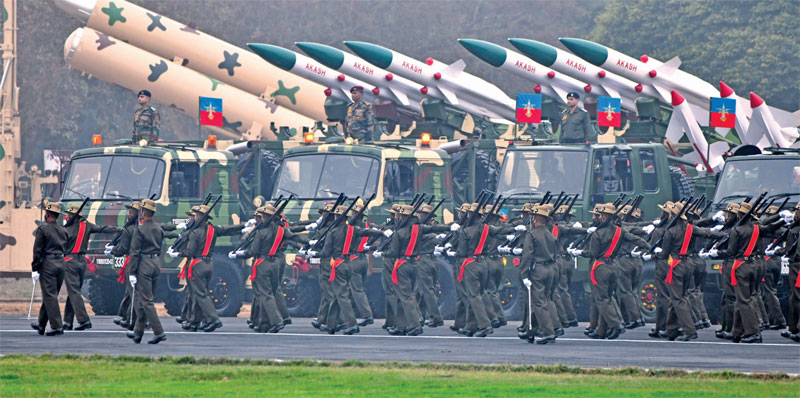
The question to ponder over is this: If the US military is unsure of its capabilities against the PLA, does the Indian military leadership which regularly assures the nation that it is prepared for a two-front war (with the PLA and Pakistan military) even understand the formidable adversary that it is up against on the LAC? The answer is a big No, since the army leadership, which has designated itself as the lead service in war (with the other two services, the air force and navy supporting its operations), talks about shifting of its forces from one theatre to another as if both the PLA and the Pakistan military have similar war concepts.
The reality is that while the Pakistan military has established its deterrence against the Indian military (evidence is Pakistan Army’s ongoing proxy war into Jammu and Kashmir), the PLA, in an entirely different league, has deterrence against the US military in West Pacific, which it has done by its asymmetric warfare strategy. Asymmetric warfare is about not matching the adversary’s capabilities but identifying and attacking the adversary’s vulnerabilities to end the war quickly on favourable terms with minimal casualties.
Before explaining this, three crucial issues should be understood. One, unlike the Indian military which is preparing for a border war with the PLA, the latter will have nothing to do with it. On 1 January 2022, China announced that nibbling of its territory on the disputed border would amount to infringement of its sovereignty over which it will fight. So, in case of a war between India and China, the PLA will fight for its sovereignty to reclaim its territories: the state of Arunachal Pradesh and the Union Territory of Ladakh.
Two, following the revocation of Articles 370 and 35A from Jammu and Kashmir on 5 August 2019, the PLA and Pakistan military have come in a tight operational embrace with China publicly stating that it would ensure Pakistan’s sovereignty. This means that in an event of war with either adversary, India would fight with both. While Pakistan would certainly join in a war between India and China, in the war between India and Pakistan, China may not show its hand openly but might support Pakistan with its non-kinetic capabilities. China may do this to ensure that its narrative of peaceful rise which is the basis on its global economic Belt and Road Initiative strategy is not jeopardised. However, this should be no comfort for the Indian military since PLA’s non-kinetic capabilities include providing round the clock visibility of the battlespace to the Pakistan military. Moreover, PLA could unleash cyberwar and use its non-kinetic space capabilities to create chaos in civil life across India. The PLA would also ensure operational sustenance such as ammunition, spares and other war waging capabilities to Pakistan military to meet its war surge needs.
And three, unlike the Indian military which has capability to fight in three physical war domains of land, air and sea, the PLA can fight in six war domains: four physical ones of land, air sea, and space, and two virtual domains of cyber and Electro Magnetic Spectrum (EMS) by cyber and electronic fires. By definition, a war domain implies capability to confront, contest, and combat in that space.
War Control
PLA’s ability to fight in six as compared with three war domains by the Indian military has implications for conventional warfare. For the beginners, the latter is fought at three levels: tactical, operational and strategic. Tactical level is the lowest level of war where battles happen resulting in attrition. The operational or the intermediate level of war is more than the sum-total of all battles in a battlespace since cognitive confrontation (the mind game) between the two military leaderships plays a big role in one side winning while the other losing a war. The highest strategic level of war brings the two political leaderships in cognitive confrontation.
Subscribe To Force
Fuel Fearless Journalism with Your Yearly Subscription
SUBSCRIBE NOW
We don’t tell you how to do your job…
But we put the environment in which you do your job in perspective, so that when you step out you do so with the complete picture.






 VIDEO
VIDEO