

The Threat of Invincibility
Yom Kippur war in 1973 was a landmark conflict in more than one way. It was the first time that the ground-based air defences (GBAD) gained ascendancy over the air. The attrition caused by GBAD especially the surface to air missiles (SAM) was such that the commander of Israeli Air Force, Ezer Weizman, was forced to comment ‘the missile (had) bent the aircraft’s wing’.
Even Chaim Herzog, a career soldier and later President of Israel, typified this view in his post-war analysis: ‘The role of the plane in war has changed… to a degree air power will not be as influential as it has been and will affect the battlefield less than it did.’ For some time, the Yom Kippur war appeared to suggest a growing primacy of defence over offence and that the hypothetical plans for the future wars may have to be re-written. Richard E Simpkin in his book ‘Race to the Swift’ went so far as to suggest that, ‘Soon, if not now, any which aircraft which climbs out of the nap of the earth into hostile radar vision within the range of SAM will be destroyed.’
The book had been written when PVO Strany (Protivo Vozdushnaya Oborona Strany) was the most formidable air defence force in the world and the Soviet armies were well defended by tiers of SAMs and anti-aircraft guns. The Soviet SAMs had delivered on their promise during the Yom Kippur War and had proved to be a tough opponent during the Vietnam War also. Thankfully, Soviet Union never went to an overt war against a major power and Simpkin’s assessment was never really tested. It remains a matter of speculation thus if most, if not all, aircraft would have been shot down by the Soviet SAMs in a symmetric war.
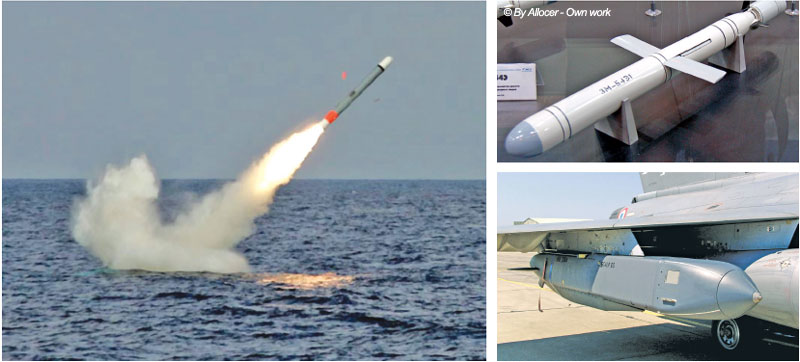
CLOCKWISE: Raytheon’s Tomahawk; Russian Klub Missile 3M-54E1; and MBDA’s Scalp
Over the years, like everything else, air power evolved and slowly but surely gained ascendancy over the air defences. As this evolution outpaced the advances in air defences, air power dominated the airspace and greatly influenced and shaped the battlefield in all conflicts since the Yom Kippur War. The Gulf Wars and conflicts in Kosovo and Bosnia were almost like demonstrations staged to showcase the air power capabilities.
While the manned aircraft still largely remains the face of air power, it is today applied in multiple dimensions by diverse platforms like unmanned aerial systems (UAS), ballistic missiles and rockets that have emerged from the shadows of the aircraft and today present a potent force in themselves. The change has been so transformative that for an increasing number of countries and non-state actors, the UAS and missiles are today the primary means of application of air power. Some analysts believe that it is the UAS that will very soon dominate the battlefield and may even make the traditional machines of war redundant. Improvised missiles and UAS have given even the non-state actors like the Houthis an ‘air force without aircraft’. With an ever-increasing proliferation, this capability will only increase in the times to come and spread to more states and non-state actors.
The proliferation and increased use of UAS and ballistic missile has brought the air defence systems back in focus after years of relative neglect. Germany recently cancelled its air defence system under development and has now decided to develop a counter-UAS system instead. The United States has similarly started inducting short range air defence systems after decades as it considers the UAS threat more serious than previously appreciated. While the focus largely remains on the UAS and ballistic missiles, one threat that has literally and figuratively remained under the radar and is of greater concern than the UAS and ballistic missiles is that of the cruise missiles.
In their book, The Cruise Missile Challenge: Designing a Defense Against Asymmetric Threats, Jeff Kueter and Howard Kleinberg define cruise missiles as, ‘a guided missile, the major portion of whose flight path to its target is conducted at approximately constant velocity; depends on the dynamic reaction of air for lift and upon propulsion forces to balance drag.’
Cruise missiles are precision weapons designed for use against both land and sea targets and are launched from land, air, or sea platforms. They can be designed to strike targets at ranges varying from 25 miles as in the case of the French Exocet anti-ship missile to over 2,200 miles for the Russian AS-15 Kent, which also can carry a 200 kiloton thermonuclear warhead.
The two broad categories of cruise missiles are land-attack cruise missiles (LACMs) and anti-ship cruise missiles (ASCMs). ASCMs use radar and/ or heat-seeking sensors to find and strike their targets. LACMs, are equipped with Global Positioning System (GPS) capabilities and ground-map/ terrain-following systems that enable them to fly low-altitude, terrain-following, defence-evading paths, and accurately strike land targets. They are easy to hide, highly capable and relatively cheap. They can carry a variety of warheads, with the capacity to strike population centres, military bases, ships and deployed combat units. This makes them one of the adaptable weapons, flexible in use, giving strategic and tactical strike options to military and political leaders.
Cruise missiles are not a new phenomenon and have been around for over seven decades with the first cruise missile having been used in combat during World War II. German V-1 could carry a payload of 850kg over a range of 250km, flying at about 600m altitude with the speed of 640km/h. Between June 1944 and March 1945, approximately 10,000 V-ls were launched against London. Of these, 1,200 were air-launched but as V-1s were often prone to exploding prematurely, resulting in the loss of the aircraft to which they were attached, it was not a very safe option. Such setbacks aside, V-1 proved to be a very cost-effective weapon system as the Allies were forced to invest heavily in defensive measures and divert bombers from other targets to try and suppress the V-1 launchers.
Subscribe To Force
Fuel Fearless Journalism with Your Yearly Subscription
SUBSCRIBE NOW
We don’t tell you how to do your job…
But we put the environment in which you do your job in perspective, so that when you step out you do so with the complete picture.



 VIDEO
VIDEO