

The Silent Threat
India needs a renewed and resolute focus on a dedicated mine warfare capability
Junaid Suhais
The Strait of Hormuz represents an indispensable artery for global energy commerce, consistently ranking among the most critical maritime chokepoints worldwide. Its strategic importance is highlighted by the immense volume of trade transiting its waters: approximately 20 per cent of the world’s total crude oil and petroleum liquids, 34 per cent of seaborne oil trade, and 30 per cent of global liquefied natural gas (LNG) exports annually flow through this narrow passage. The inherent geography of the Strait, characterised by restricted transit lanes and high traffic density, creates predictable routes that are exceptionally vulnerable to maritime interdiction, particularly through the deployment of naval mines. Any disruption here carries immediate, profound implications for global energy prices, shipping costs, and supply chain stability.
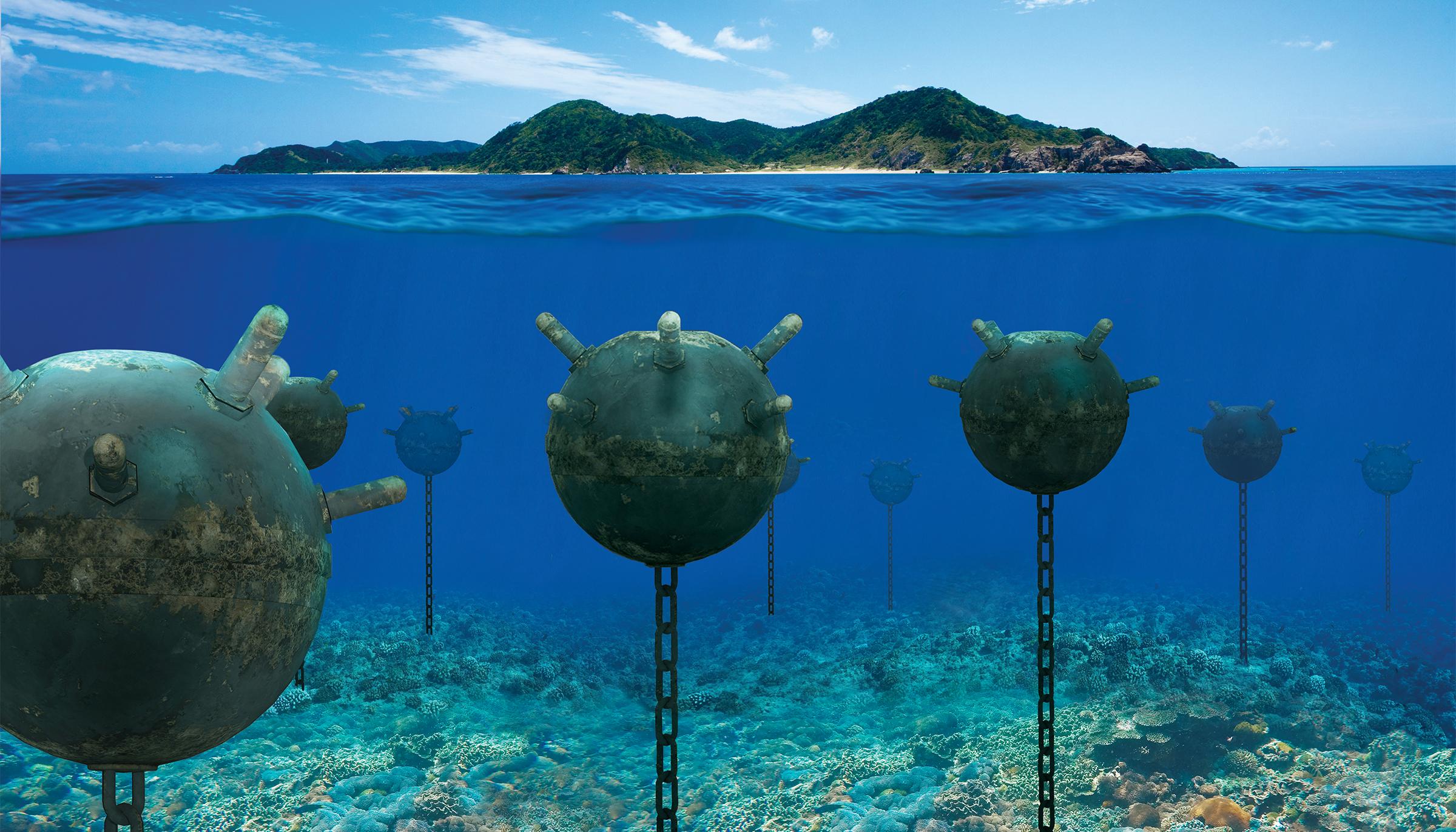
The escalating US-Israel-Iran war has brought the prospect of a Strait of Hormuz blockade to the forefront of strategic calculations. Iran’s capacity for asymmetric warfare, deeply embedded in its naval doctrine, positions mine warfare as a primary tool for achieving sea denial. Historical precedents illuminate the disruptive power of mines in this region. The ‘Tanker War’ phase of the Iran-Iraq War (1980–1988), and the subsequent US-led Operation Earnest Will, vividly demonstrated how even rudimentary mining operations could inflict significant economic damage and force a costly military response. The inability of conventional convoy operations to effectively counter scattered minefields, as witnessed during Operation Earnest Will, emphasises the enduring challenge posed by this asymmetric threat. Iran’s naval strategy, particularly that of the Islamic Revolutionary Guard Corps Navy (IRGCN), is explicitly designed to exploit these geographic realities and leverage low-cost denial capabilities against technologically superior adversaries, prioritising surprise, mass, and speed. This doctrine makes mine deployment a core component of its anti-access/ area-denial (A2/AD) architecture in the Persian Gulf.
Iran’s Naval Mine Arsenal
Iran’s naval mine inventory is substantial and diverse, estimated to comprise between 5,000 and other units of various types and vintages. This arsenal is not homogeneous; it includes older, contact mines, alongside more modern, sophisticated influence mines acquired through proliferation networks. Notable components include legacy Soviet-era designs, Russian-origin MDM series mines (such as the MDM-3, known for its multi-influence capabilities), and Chinese EM-52 rocket mines. The MDM-3, for instance, is an advanced bottom mine capable of being dropped from various platforms, and the EM-52 is a rocket-propelled mine designed for enhanced lethality against modern vessels. This heterogeneous inventory ensures that Iran can tailor its minefields to specific operational objectives and target profiles.
Deployment methods are central to Iran’s asymmetric doctrine. The IRGCN, optimised for coastal defence and asymmetric operations, employs a range of platforms for covert and overt minelaying. Fast attack craft (FACs), midget submarines, and even ostensibly commercial shipping can be utilised to rapidly seed minefields in strategic locations. Midget submarines, in particular, offer a low-signature platform for covert mine placement, complicating attribution and initial response. The strategic intent behind this extensive mine inventory and diverse deployment capability is clear: to establish an effective A2/ AD bubble within the Strait and its approaches. The objective is not necessarily to sink numerous vessels, but to paralyse maritime traffic, instil fear, disrupt global markets, and force escalatory responses on terms favourable to Tehran, without necessarily engaging in direct, fleet-on-fleet confrontation. This approach maximises political coercion while minimising direct military risk, exploiting the fact that even the suspicion of mines can be as disruptive as their physical presence.
Mining the Strait
The operational implications of even limited minefields within the Strait of Hormuz are profound and immediate. Maritime traffic in the Strait adheres to strictly defined traffic separation schemes (TSS), channelling hundreds of vessels daily through narrow, predictable routes. The introduction of mines into these lanes would immediately force a suspension or severe rerouting of commercial shipping, particularly for large oil and LNG tankers that represent a significant portion of global energy transport. The disruption would not be limited to actual mine strikes; the mere credible threat of mines, or intelligence indicating their potential presence, is often sufficient to trigger significant operational changes. This is because the cost-benefit analysis for commercial shippers, insurers, and charterers quickly shifts against transit through a potentially mined area.
Subscribe To Force
Fuel Fearless Journalism with Your Yearly Subscription
SUBSCRIBE NOW
We don’t tell you how to do your job…
But we put the environment in which you do your job in perspective, so that when you step out you do so with the complete picture.






 VIDEO
VIDEO