

The Sharp Curve of Technology
In 2016, the Russian defence ministry unveiled the Derivatsiya-PVO self-propelled anti-aircraft gun capable of firing smart munition. The field trials of the Derivatsiya were completed in 2020 and one of the munitions developed for the gun system was a laser-guided smart shell which can manoeuvre using folding fins towards the target.
With a range of 3km, it was specifically developed to take on drones and attack helicopters and would have been effective in countering the drones in the ongoing Russia-Ukraine conflict but like many systems developed by Russia, it proved to be a non-starter during the war. Added to this are the reports coming in of fast depleting Russian inventory of smart munitions and their alleged high failure rate. All this does not present a very rosy picture of Russian smart munitions capabilities. But Russia is not the only one to struggle with development and fielding of smart munitions and even after decades of the operationalisation of the first smart munition, there are only a handful of nations with this capability.
First developed during the Spanish Civil War when the Germans experimented with radio controlled or wire guided munitions to strike ships, smart munitions came into their own during the Vietnam War when the laser guided munitions were used with telling effect by the United States. One of the oft repeated references to the early use of smart munition is of the destruction of the Thanh Hoa Bridge during the Vietnam War. Between 1965 and 1972, the US conducted 869 bombing raids against the Bridge. All 869 attacks failed, and 11 aircraft were shot down in the process. When a new bomb was used in May 1972, the bridge was destroyed at the first attempt. The advantages of using smart munitions were obvious and by the 1990’s the United States had developed enough types and numbers to use them with telling effect during the Gulf War.
The Smart Munitions
The smart munitions in vogue today can actually trace back their lineage to the late 1980s when the United States started refining its Air Land Battle concept wherein smart weapons were identified as one of the key components needed for future warfare. These weapon systems would enable the army to carry out precision deep attacks, provide the capability of simultaneously engaging multiple targets while enhancing fighting capability and survivability. Smart munitions formed the basis of these weapons systems as these munitions were to have the self-contained capability to search, detect, acquire and engage targets.
Theocratically smart munitions were one of three classes of precision guided munitions, the other two being guided munitions and brilliant munitions. Guided munitions were characterized as one-on-one munitions that required an operator in the loop to function. At the next developmental stage were the smart munitions that operated autonomously. They had the self-contained capability to search for, detect, acquire, and engage targets but had minimal capability to discriminate among target classes or target types. They were designed for the ‘many-on-many’ situation where a number of munitions are directed into an area known to contain numerous targets.
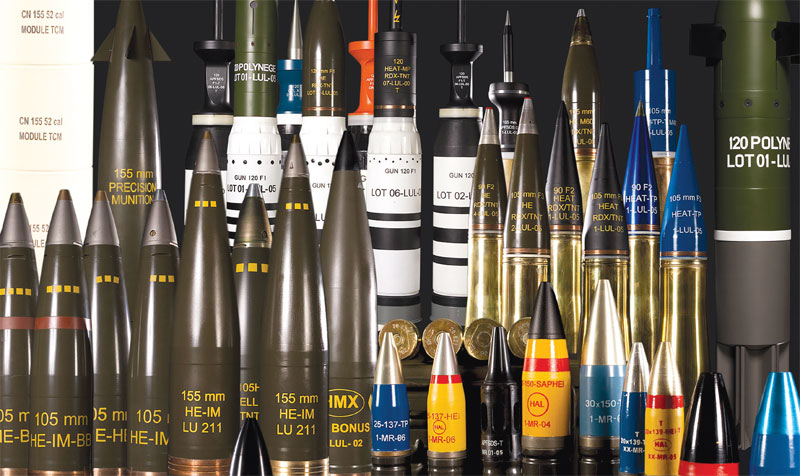
As these systems developed, the lines separating the ‘smart’ and ‘precision’ munitions have blurred as most munitions are now expected to deliver on both counts. From air launched smart munitions to ‘smart bullets’ for the infantry, these munitions are now increasingly being fielded by all services though air forces use them more than surface forces primarily because the target sets vary and there are many challenges in developing and operationalising them. However, smart artillery munitions especially top attack munitions are now widely being developed for different artillery calibres with varied ranges. One class of these munitions are the cargo rounds that were developed for engaging hard targets such as armoured fighting vehicles (AFV). The cargo rounds have a large number of small sub-munitions fitted with a small high-explosive anti-tank (HEAT) warhead to penetrate the vulnerable, lighter armoured upper surfaces of AFVs but as the sub-munitions can have a high dud rate they can limit the manoeuvre of follow up forces. The other class of smart munitions are the top attack munitions e.g., GIWS SMArt 155 and the Bofors/Nexter BONUS.
Subscribe To Force
Fuel Fearless Journalism with Your Yearly Subscription
SUBSCRIBE NOW
We don’t tell you how to do your job…
But we put the environment in which you do your job in perspective, so that when you step out you do so with the complete picture.






 VIDEO
VIDEO