

The Sea is Deep, Dark and Dangerous
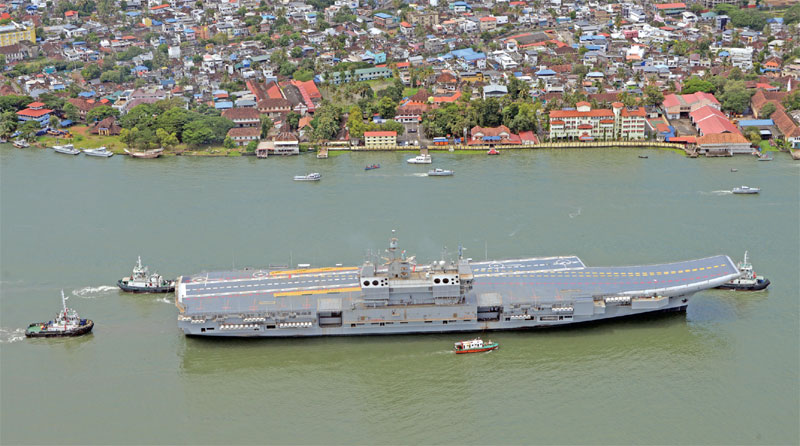
The Indian Navy, as one of the country’s principal instruments of both foreign policy and national security also reflects this confidence with its ability to project power as a force for good. The commissioning of the country’s first indigenously built aircraft carrier, the INS Vikrant on 2 September 2002 by Prime Minister Narendra Modi, marked a significant milestone in the navy’s development as a balanced, multi-dimensional blue water force with the ability to protect and further the country’s maritime interests anywhere in the world.
In keeping with its theme of being a credible, cohesive and future-proof combat ready force, the Indian Navy has been maintaining a very impressive operational tempo over the years, furthering India’s maritime interests and its strategic objectives with this year being no different. On 15 August 2022, seven Indian naval ships proudly hoisted the national flag in six different continents extending from Brazil to Singapore to commemorate 75 years of the country’s independence (Azadi ka Amrit Mahotsav).
This not only symbolised India’s cultural ethos based on its belief of Vasudhaiva Kutambakam or ‘The World is one family’, but also sent an important message of the Indian Navy’s reach and ability to project power wherever in the world it may be required. This was followed in September with the commissioning of INS Vikrant. In mid-October, INS Arihant, the country’s first nuclear powered ballistic missile submarine (SSBN) successfully fired a ballistic missile and established the efficacy of the complex command, control and communication architecture required to launch a nuclear armed ballistic missile from hundreds of metres below the surface of the sea, thousands of miles away in the ocean.
This underlined the navy’s capability to pre-empt an incoming nuclear attack or to deliver a devastating retaliatory second strike at a precise time on a precise target at a single command from the National Command Authority located well inland, at a time when it may be under attack itself. The success of this firing validated the efficacy of India’s nuclear triad and established the credibility of India’s strategic deterrence capability. This was followed in November by Exercise Malabar, which has come to represent India’s pivotal role in the Quadrilateral Security Dialogue (Quad), the informal grouping of four nations (Australia, Japan, India and the USA), committed to furthering its main objectives of ensuring a rules-based maritime order and a free and open Indo-Pacific. Besides these, the navy continued with its mission-based deployments with over a dozen ships operating across the Indio-Pacific on different missions with the underlying emphasis being on enhancing regional maritime domain awareness (MDA).
Indo-Pacific
The emergence of the Indo-Pacific as the global geopolitical centre of gravity has focussed attention on the maritime domain. China’s rise and the emerging great power rivalry with the United States is going to define the future geopolitical and geoeconomic contours of the region and the world. The Indo-Pacific is home to more than 60 per cent of the global population and generates about 64 per cent of the global GDP.
Globalisation, maritime connectivity, economic imperatives and trade dependencies will ensure that this region will remain at the epicentre of global affairs well into the second half of the 21st century. Nine of the world’s top 10 navies operate in this region, nine of the world’s 10 largest ports are located here, and six of the 10 declared and undeclared nuclear powers are resident here. As the existing pre-eminent maritime power in the Indian Ocean, India, therefore, has to develop the necessary capacities and capabilities in the maritime domain to retain that edge and ensure that it is able to shape the outcomes in the region and not allow itself to get shaped by them.
Subscribe To Force
Fuel Fearless Journalism with Your Yearly Subscription
SUBSCRIBE NOW
We don’t tell you how to do your job…
But we put the environment in which you do your job in perspective, so that when you step out you do so with the complete picture.





 VIDEO
VIDEO