

The Reset
China has convincingly won the Doklam cold war — started by India on 18 June 2017 by blocking Chinese road construction body — by its successful military coercion strategy. This should not be a surprise since no diplomacy or pretentious muscle-flexing, however adroit, can substitute for real power. Consequently, Prime Minister Narendra Modi reached out and met with President Xi Jinping over two-days on April 27-28 in Wuhan seeking strategic peace.
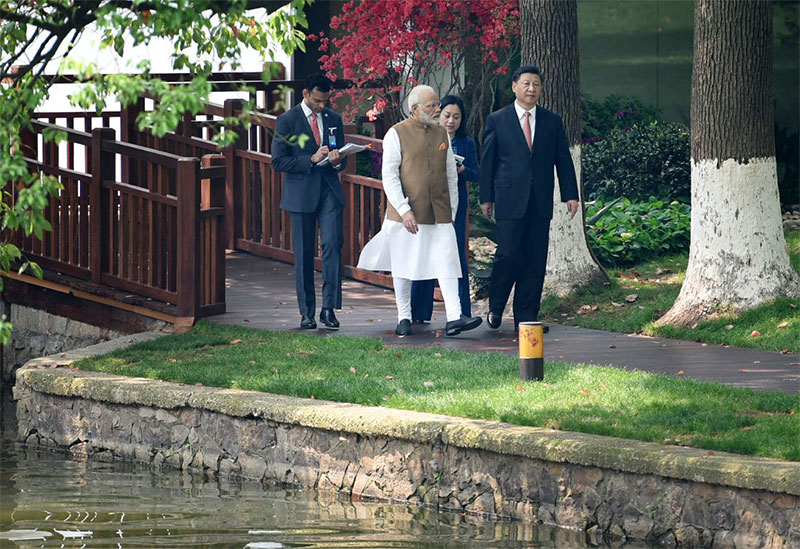
PM Narendra Modi and the President of the People’s Republic of China, Xi Jinping take a walk together along the East Lake in Wuhan, China
By nipping the snowballing military crisis on the border in the bud which had the potential to jeopardise Modi’s 2019 election prospects by another 2013-Depsang intrusion or worse, India would have to pay the strategic and tactical price to the victor China by tangible deliverables. Evading these might not be possible since the Damocles sword in the form of increased Chinese military infrastructure, military presence (army and air force) and political determination, besides excellent border management, could coalesce into a major predicament for India in little time.
Couched in diplomatic language, India and China, in their respective statements, sought strategic communication, issued strategic guidelines to their militaries to effectively manage border affairs, and hoped that the two nations would work together for development and prosperity of the region (starting with joint economic development project in Afghanistan) to create conditions for the Asian century. The Indian statements dwelled at length on border peace, while the Chinese side merely iterated the need to follow agreed confidence building measures.
A report in the daily newspaper Hindustan Times (30 April 2018) quoting top sources, said that the Indian Army, which had, post-Doklam, increased its strength on the border by denuding troops from other vital sectors, would take two tactical-level steps to ensure border peace. The first step would entail, ‘less aggressive patrolling, albeit without lowering the guard.’ This implies that the Indian Army would avoid patrolling in the disputed areas. Also, patrolling limits would be reduced especially in sensitive areas which are likely to snowball into disputed area. At present, agreed disputed and sensitive areas along the Line of Actual Control (LAC) are: Trig Heights, Depsang bulge, Pangong Tso, Dumchele, Demchok and Chumar in the western sector; Sumdrong Chu, Yangte, Asaphilla, Long Ju, Fish Tail I and II and Dichu in Arunachal Pradesh. It is interesting to note that before the high-profile face-offs at Depsang bulge in 2013 and Chumar in 2014, these were not listed as disputed or sensitive areas.
The other tactical level step for the Indian Army, according to the report, would be to ensure that there ‘are no jostling, fist-cuffs or stand-offs’ between the two sides. Indian Army would actually help the PLA patrols ‘to complete their military objectives and then escort them back.’
These two steps are not mere concessions from the Indian side, but total military surrender by India. The Indian Army, meant for border-guarding, would now be doing border-escort duties. Let me explain this. All intrusions and transgressions are one-sided by the PLA. Had the Indian Army been transgressing too, Modi would not have sought Xi in Wuhan, and the Chinese side, like the Indian side, would have been holding the 3,488km long LAC with a large number of troops. Given the present ground situation and the two new steps to be undertaken by the Indian Army, the People’s Liberation Army (PLA) is now free to walk in anywhere it likes and increase the numbers of disputed or sensitive areas. For example, as they have built military infrastructure and increased a few soldiers in north Doklam, about five to eight km from the Doklam crisis site, they can now regularly saunter in anywhere on the Doklam plateau and even come close to Indian defences in Doka la. Over time, they would make legal claim (like in the case of South China Sea) on the entire Doklam plateau. What stops them from doing the same to the entire route leading to the Siliguri corridor for which India in June 2017 flexed muscles? Once they make the claim, the next step would be to build the road there. Ironically, the Indian Army would actually assist them in their military objective. Moreover, the increased numbers (in thousands) of the Indian Army would watch the PLA walk anywhere in Arunachal Pradesh freely and at will. The PLA tell-tale signs, which they would leave after each foray into the Indian territory, would over time, establish their claim over entire Arunachal Pradesh, which they call South Tibet.
Subscribe To Force
Fuel Fearless Journalism with Your Yearly Subscription
SUBSCRIBE NOW
We don’t tell you how to do your job…
But we put the environment in which you do your job in perspective, so that when you step out you do so with the complete picture.


 VIDEO
VIDEO