

The Police Story
In Madhya Pradesh’s Guna district, a Dalit farmer couple attempted suicide by consuming pesticide in front of their children, after police began bulldozing their crops on the plea of clearing government land.
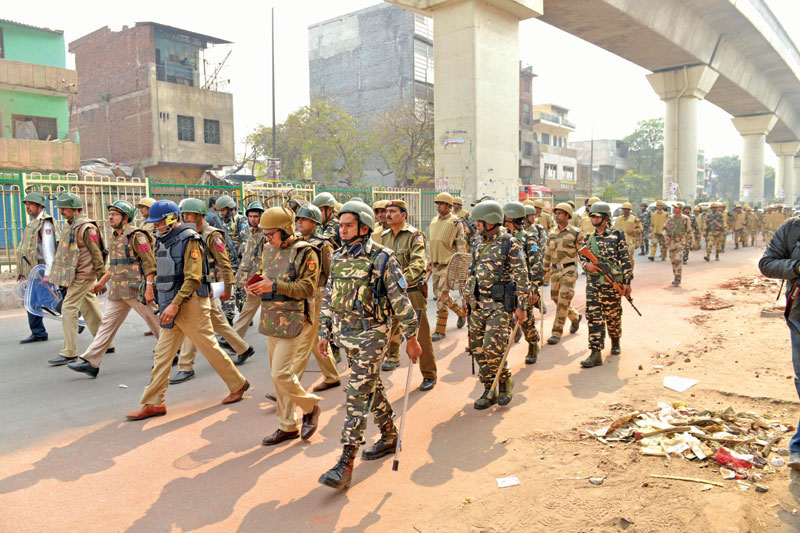
Police take out a Flag March in East Delhi during the riots that hit the capital in early months of 2020
A month ago, in June, a horrific case of police brutality had come to the fore. A father-son duo, Jeyaraj and J. Bennix, died due to the excesses by the police while in custody. The reason: J. Bennix had kept his mobile phone shop open for 15 minutes past the state-imposed curfew time. The police not only beat up the father-son duo, they even sexually harassed them by mutilating their private parts.
Gangster Vikas Dubey’s encounter is the latest case of police brutality. After Dubey’s death, five other ‘encounters’ of Dubey’s gang members took place. Dubey had escaped to Madhya Pradesh when police arrested him at the Mahakaleshwar temple in Ujjain a few days after he and his men killed eight policemen in a shootout in Kanpur’s Bikru village. On their way back to Kanpur, police claimed, the vehicle overturned and Dubey snatched a gun and tried to escape and hence, was shot dead in ‘self-defence’ by the Special Task Force.
In other recent incidents recorded during the lockdown, videos surfaced of police on a rampage, vandalising vegetable carts and harassing vendors across the country.
Police high-handedness arises due to a variety of reasons that are endemic to the Indian society. Of them, some are: gender, religion, caste, class, political affiliations or support and overt masculinity. The fact that the law should take its own course in the solution of a case or allegation is not respected and that alone gives way to fake encounters and custodial killings. As per a report by the National Campaign Against Torture, 2019 saw 1,731 people die in custody of which 125 died in police custody and 1,606 in judicial custody.
The D.K. Basu Vs. State of West Bengal case in 1986 was a big step in keeping police excesses in check. D.K. Basu, a retired Calcutta High Court judge wrote to the Supreme Court about the lack of attention being paid to the police brutality suffered by individuals behind bars. This then took the form of a Public Interest Litigation (PIL). The D.K. Basu judgements are a set of 11 guidelines that would be a shield for those in custody against police brutality by asking for police accountability. The guidelines also highlight the rights that a prisoner has. These laws are, however, not followed by the police. To take an example of the Tamil Nadu police in the case, they came up with a statement that the law applies only in police custody and not in judicial custody. The amicus curiae in the case, Abhishek Singhvi, wrote in The Indian Express,
“Starting with a letter complaint of 1986, this converted PIL spawned four crucial and comprehensive judgments—in 1996, twice in 2001 and in 2015, laying down over 20 commandments.
Additionally, it led to at least five other procedural, monitoring and coordinating judicial orders, in the best traditions of continuing mandamus. These have created a valuable and seamless web of legal principles and techniques to reduce custodial death and torture. Little more by way of theoretical structure is required if D.K. Basu’s comprehensive coverage is genuinely implemented. But where we fail—as in many other things in this country—is in operationalising the spirit of D.K. Basu, in punitive measures, in last mile implementation, in breaking intra-departmental solidarity with errant policemen and in ensuring swift, efficacious departmental coercive action plus criminal prosecution.”
Custodial Deaths
While the treatment meted out by the police to the arrestees in jail are increasing, there are glaring lack of convictions of the police. In 2017, as per figures put out by the National Crime Records Bureau (NCRB) of India, around 100 people died in police custody but no convictions were made. In a democratic set up, where one has the right to fight for themselves, the police play an important role.
However, when the sensitivity of their duty is lost and people start fearing the police rather than respecting them and bestowing their trust in the duties that they carry out, a society remains crippled with individual voices being crushed. During the nation-wide citizenship protests early this year, there were many instances of violent backlash from the police. They lathicharged the people protesting peacefully, detained them and abused them. The videos that emerged from some of India’s best institutes in the capital, where police entered the colleges, harmed students, destroyed property and instilled a sense of fear for exercising their right to protest, are an example of why public-police relation in India is usually strained.
The survey, Status of Policing in India Report (SPIR), 2019, carried out by the Lokniti Centre for the Study of Developing Societies (CSDS), found that less than 25 per cent Indians trust the police highly. More people, 54 per cent, trusted the army more. This comes as a grave challenge for a democracy because a citizen is required to approach the local police station for his or her grievances and is likely to run into a policeman or a policewoman on a daily basis than he/she would into an army man/woman. Lack of trust in police means more suffering for an individual on both, personal and social level.
Subscribe To Force
Fuel Fearless Journalism with Your Yearly Subscription
SUBSCRIBE NOW
We don’t tell you how to do your job…
But we put the environment in which you do your job in perspective, so that when you step out you do so with the complete picture.






 VIDEO
VIDEO