

The P-75(I) Soap Opera
In 2001, to speedily end dependence on imports, defence manufacturing in India was opened up for private sector participation. Previously, private sector participation in defence supplies had been seen as being prejudicial to national security. However, despite the opening up of the defence sector for the past two decades no contract of any significance has been awarded to the private sector.
The government’s efforts to enhance private sector participation in defence manufacturing are principally motivated by three reasons. The first being the inability of state-owned enterprises to fulfil the equipment requirements of the armed forces. despite the extended, virtually monopolistic run given to them. Second, in the relatively short time since 2001, when defence manufacturing was opened up to the private sector, the private sector has proved itself capable of assimilating the technologies involved. Third, defence manufacturing is characterised by the requirement of large investments. The private sector has demonstrated its ability to raise capital and to make substantial investments in essential assets, resources, acquisitions, JVs, and other capabilities required to undertake defence production.
The RFIs/ RFPs issued by the ministry of defence for the supply of 111 Naval Utility Helicopters (now shelved after the entry of HAL into the fray), 110 fighter jets for the air force (currently on hold), and the RFP for the construction of conventional submarines, Project P-75(I) (now in a state of uncertainty with four of the five OEMs who had been approached expressing an unwillingness to bid) under the ‘Strategic Partnership’ (SP) model had infused in the private sector a sense of optimism and heightened expectation.
The provisions of the SP model outlined in the Defence Acquisition Procedure 2020 (DAP-2020) were first promulgated by the government in 2016 in the Defence Procurement Procedure-2016 (DPP-2016). The SP model aims to spur indigenous production of defence equipment by encouraging private sector participation.
When the RFP for P-75(I) was issued, it was widely expected that it would be the first project to be undertaken under the SP policy. The optimism and hope have, unfortunately, been belied. But despite the tardy progress of the P-75(I) project, the prevailing sentiment is one of optimism and even a sense of resignation that such tardiness is typical for projects of this significance and value. Everyone expects that the P-75(I) project will eventually be back on track.
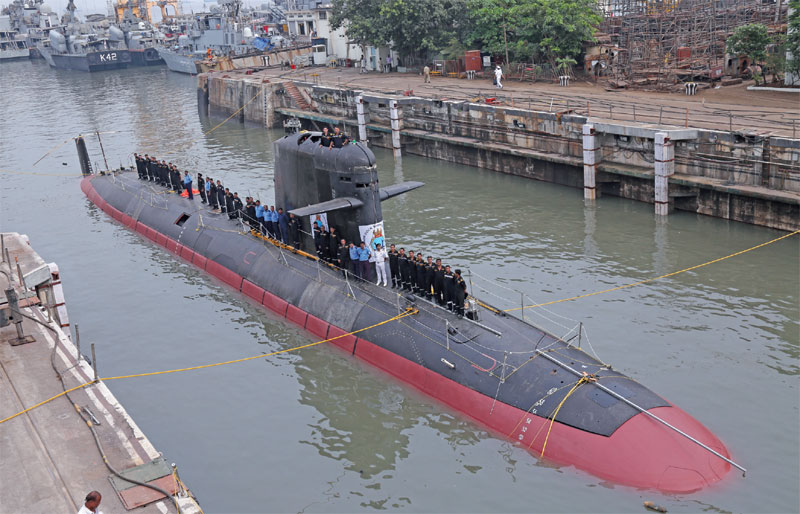
INS Kalvari at Naval Dockyard Mumbai
Strategic Partnership model
Before getting in deeper into the P-75(I) project, an overview of the SP model is in order. It envisages, initially, the selection of SP only in the following segments:
The Indian firm that is selected as the SP is required to tie up with the shortlisted foreign Original Equipment Manufacturer (OEM) for the manufacture of equipment belonging to one of the above segments.
To enable wider participation of the private sector and to ensure that the SP maintains focus on its core area of expertise, only one SP will be selected per segment. Defence Public Sector Undertakings (DPSUs)/Ordnance Factories (OFs) are also eligible to be considered for selection as the SP, depending on their order book position and price competitiveness.
The principal criteria for the selection of OEMs are the conformity of their products’ capabilities with the services’ Staff Qualitative Requirements (SQRs) and the OEM’s commitment to providing transfer of technology together with an initial period of hand-holding to enable technology assimilation by the SP to maximise indigenisation.
To maintain transparency in the process, the selection of the SP and the foreign OEM partner would be undertaken in parallel through a competitive bidding process. The Indian SP would need to meet minimum requirements related to infrastructure, technical capabilities and financial strength. The shortlisted Indian SPs would be issued RFPs along with a list of the potential OEMs. The Indian SPs are required to coordinate with the OEMs and submit a response. Field trials would then be undertaken for the equipment that meets the technical requirements specified in the RFP.
The commercial bids of the firms, whose equipment qualifies field trials, would then be examined to identify the lowest (L1) bidder—who would qualify to be designated as the ‘Strategic Partner’ for that particular segment. The DAP-2020 chapter on SPs additionally clarifies that a firm selected as the SP in a particular segment would not be the automatic choice for future contracts. However, the firm during future competitive bidding processes would be accorded due weightage for the expertise developed during the execution of the earlier contract under the strategic partnership model.
Subscribe To Force
Fuel Fearless Journalism with Your Yearly Subscription
SUBSCRIBE NOW
We don’t tell you how to do your job…
But we put the environment in which you do your job in perspective, so that when you step out you do so with the complete picture.



 VIDEO
VIDEO