

The Missing Middle
Can India’s vast tactical drone industry build the engines, autonomy, and weapons?
Junaid Suhais
Defence industries tend to be measured by what they exhibit, and air forces by what they launch. Peacetime rarely audits the two ledgers against each other, which is why a short war is so revealing.
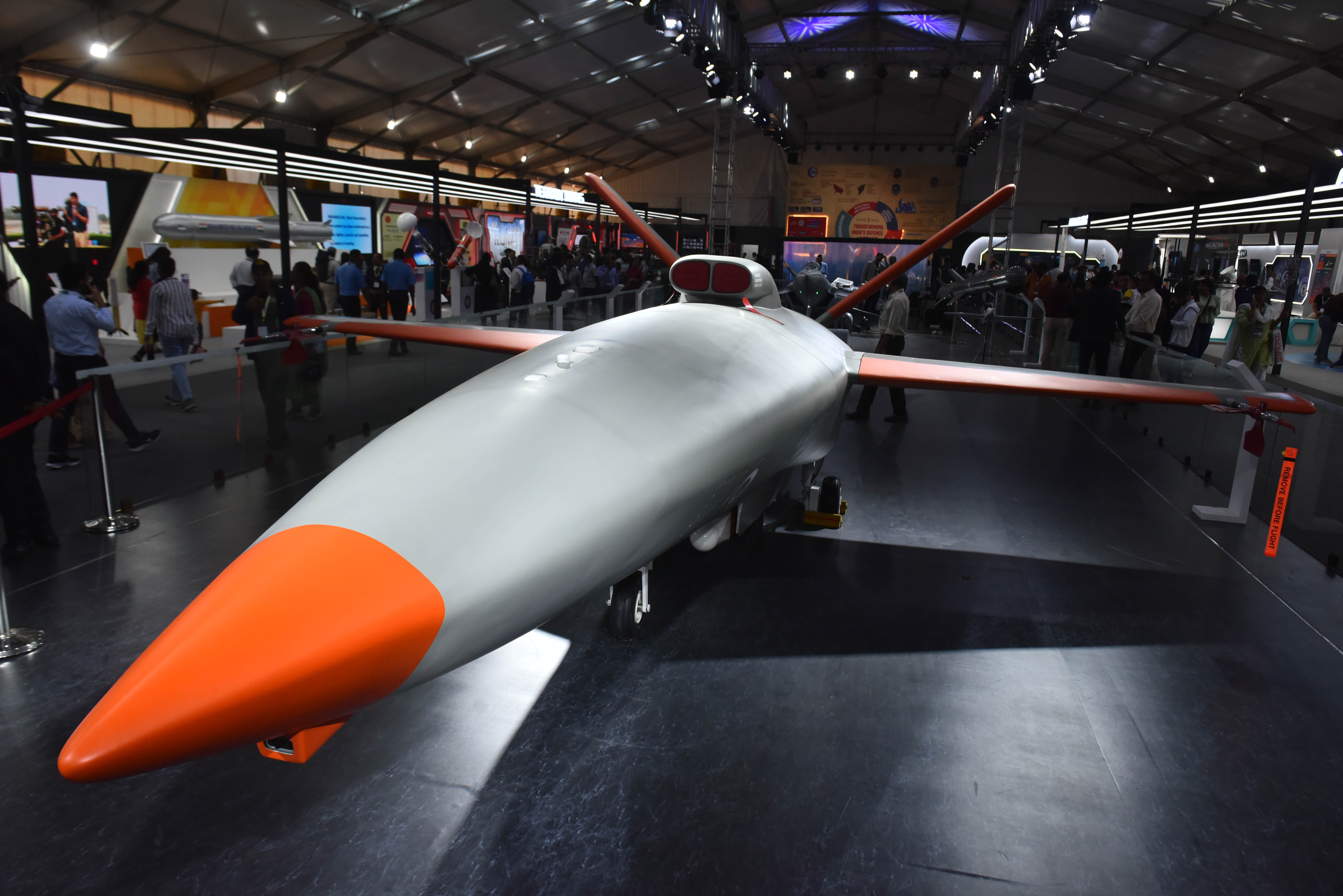
When the Indian Air Force (IAF) turned on Pakistan’s air defence network during Operation Sindoor, its unmanned hunters were imported. A Swiss think-tank study reported by The Print found that the IAF’s campaign against border surveillance radars and long-range surface-to-air missile batteries, which ran until the evening of 9 May 2025, relied on Israeli-origin Harop and Harpy loitering munitions. The same study counts eight air-defence sites struck on May 8 and four more the following day, with at least two early-warning radars at Chunian and Pasrur visibly neutralised. The government’s own account of the operation describes loitering munitions finding and destroying enemy radar and missile systems, and credits modern indigenous technology, from long-range drones to guided munitions, for the precision of the strikes. Both accounts can be true at once, and the space between them is the subject of this story.
That space sits alongside one of the fastest-growing supplier bases in Indian defence. The Drone Federation India (DFI) represents more than 550 drone companies, and the government notified a Rs 120 crore production-linked incentive for drones and components in September 2021. Asia Times puts the number of drone startups at around 500, observes that many assemble rather than manufacture, and tracks sector funding from USD 3-4 million in 2015-16 to USD 108 million in 2024. Capital has followed the orders.
The Ken reports that Raphe mPhibr raised USD100 million in 2025, one of the largest private rounds the sector has seen, and that wealth managers are filling the gap left by cautious venture funds, with 360 One’s Rs 1,000 crore defence fund among them. Industry on this scale invites a pointed question from the service that has to fight the air war. How many of these firms build systems that can enter a defended airspace, survive electronic attack and close a kill chain against an integrated air defence system? On the evidence of signed contracts, the answer is one system in IAF service, one large competition under way, and a flagship loyal-wingman programme still on the ground.
A Soldier’s Market
Every procurement boom follows its paying customer, and India’s paying customer is the army. The order book shows it. ideaForge’s ZOLT tactical drone won a Rs 75 crore capital emergency procurement order after field trials in electronic warfare environments and country-of-origin checks, with a further Rs 30 crore for the SWITCH 2 vertical take-off platform. The army’s drone literacy drive, as the Takshashila Institution records, aims to train one lakh personnel and employ 30,000 drones within a year.
The largest indigenous loitering-munition deal to date points the same way. The ministry of defence (MoD) signed contracts worth about Rs 1,577 crore with Tata Advanced Systems Limited (TASL) and NIBE in August 2026 for the army’s artillery regiments, under the Buy (Indian) category through the Fast Track Procedure, covering 84 systems and 840 munitions with ranges of up to 100 km. Even the swarm drones born in an air force competition went to the army first: The Print reported that the initial swarm deliveries from NewSpace and Raphe mPhibr were bound for mechanised formations for surveillance and attack missions.
The logic is sound. The Line of Actual Control (LAC) and the Line of Control (LC) are battalion-scale problems that reward cheap, numerous systems operating within 100 km of a gun line, and a quadcopter that survives a winter at altitude is worth more to an infantry commander than a stealthy airframe on a design board. Indian industry organised itself around that demand, and it delivered. The air force’s requirement begins where this market ends, at the edge of a hostile radar picture, and very few of the 550 are built to cross it.
Subscribe To Force
Fuel Fearless Journalism with Your Yearly Subscription
SUBSCRIBE NOW
We don’t tell you how to do your job…
But we put the environment in which you do your job in perspective, so that when you step out you do so with the complete picture.






 VIDEO
VIDEO