China is building three separate intercontinental ballistic missile (ICBM) silo-fields capable of housing about 350 DF-41 ICBMs, each capable of delivering ten independently targeted Multiple Independent Re-entry Vehicles (MIRV) warheads.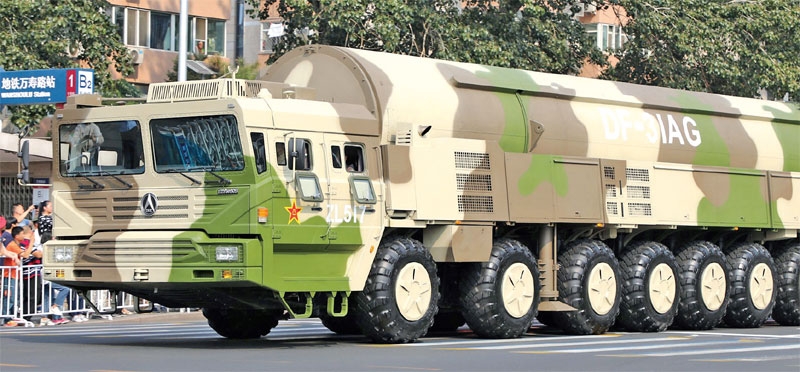
DF-31AG Intercontinental Ballistic Missile
The first silo-field was discovered at Yumen in Gansu province, with the second being located 380km northwest of the Yumen field near the prefecture-level city of Hami in eastern Xinjiang, while the third is at Hanggin Banner in Ordos City, Inner Mongolia. Each of the three sites is expected to host about 120 silos. Construction at the first two sites began in early March this year and work continues at a rapid pace. Since then, dome shelters have been erected over at least 14 silos and soil cleared in preparation for construction of another 19 silos at Yumen.
The grid-like outline of the entire complexes at the first two sites indicates that each of them may eventually include approximately 120 silos. The silos at Hami are positioned in an almost perfect grid pattern, roughly 3km apart, with adjacent support facilities. Construction and organisation of the Hami silos are very similar to the 120 silos at the Yumen site, and are also very similar to the approximately 12 silos constructed at the Jilantai training area in Inner Mongolia. These shelters are typically removed only after more sensitive construction underneath is completed.
Just like the Yumen site, the Hami site spans an area of approximately 800sqkm. China has for decades operated about 20 silos for liquid-fuel DF-5 ICBMs. With 120 silos now under construction at Yumen, plus another 120 silos at Hami, a dozen silos at Jilantai, and possibly more silos being added in existing DF-5 deployment areas, the People’s Liberation Army Rocket Force (PLARF) can be expected to have approximately 350 silos under construction—more than 10 times the number of ICBM silos in operation today.
The number of new PLARF silos under construction exceeds the number of silo-based ICBMs operated by Russia and constitutes more than half of the size of the entire US ICBM force. The PLARF missile silo programme thus constitutes the most extensive silo construction since the US and USSR missile silo construction during the Cold War. The new silos under construction are in addition to the force of approximately 100 road-mobile ICBM launchers (for its DF-31AG and DF-41 ICBMs) that the PLARF deploys at more than a dozen bases.






 VIDEO
VIDEO