

The Long Road
In a bold move amending the Defence Acquisition Procedure-2020 (DAP-2020), government in end April 2022, announced that ‘going forward, all modernisation requirements of the defence services and the Indian Coast Guard are to be indigenously sourced irrespective of the nature of the procurement.’
Other enabling amendments to the extant rules, related to earnest money deposit (EMD) and performance bank guarantee (PBG), are also being introduced. Collectively, the amendments are intended to accelerate ‘Make in India’ and enhance the ‘ease’ of doing business in India—especially for the domestic manufacture of defence equipment.
The abrupt departure from what has hitherto been a policy of incremental change is ambitious. Incremental change through various measures such as enhanced limits for FDI in the defence sector, Make-I/II schemes, strategic partnerships, defence offsets etc. have not delivered the hoped-for impact in ending India’s reliance on imports for its defence needs.
Admittedly, India is unprepared to deal with the fallout of the latest changes in its policies for defence acquisition. These changes place an onerous responsibility on the DRDO, the DPSUs, the Ordnance Factories and the private defence industry to meet the modernisation requirements of the armed forces. However, equally, this is also a moment of significant opportunity for the various actors in the Indian defence ecosystem.
In the long-term, self-reliance in defence can only be attained through the acquisition of indigenous capability in Design & Development (D&D) & manufacture of defence equipment. This requires a multi-fold increase in investment in defence R&D (both, the government and the private sector), increasing researcher density, shifting the focus from applied research to basic research, and most importantly, creating a broader defence manufacturing eco-system with the public/ private sector defence firms and the MSMEs. No nation has ever achieved self-reliance in defence without sustained investments in indigenous R&D capability.
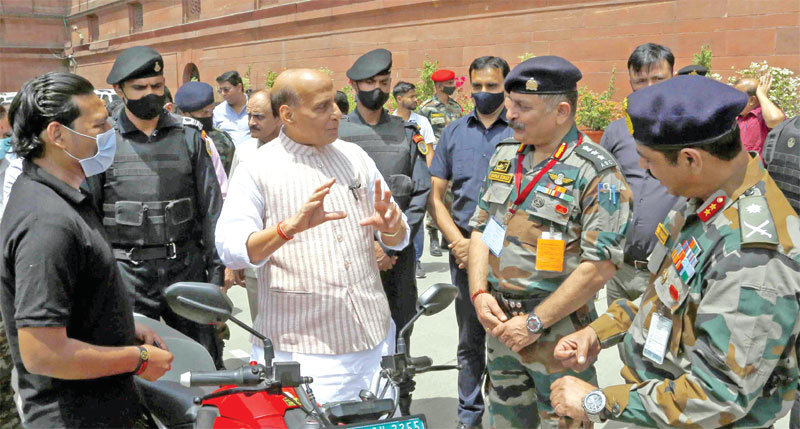
Rajnath Singh inspecting the display of electric vehicles
The two World Wars and the years leading up to the wars spurred the frenetic development of several technologies in Europe, the USA and Japan. The technologies, systems, platforms and strategies developed in response to the wars, fundamentally altered how wars were fought and finally won.
Israel’s geographical location, amidst hostile neighbours, drives and sustains its self-reliance. South Korea’s experience in the Korean war spurred the growth of its defence industry.
During the war with China in 1962, India was a young republic, just beginning to find its feet as an independent nation. The defeat in 1962, exposed India’s vulnerabilities and aroused defence consciousness after years of neglect. Several defence reforms have been undertaken since then, but they were largely piecemeal and ad-hoc and failed to address the root causes that continue to hold back the growth of the Indian defence industry.
The present moment of global geopolitical ferment and a radical domestic policy shift on defence equipment sourcing, is an apt moment to reflect on and take stock of the various attempts at policy reform and their success/ failure in impacting India’s self-reliance in defence.
Supply Diversification
Russia launched its invasion/ special military operation in Ukraine on 24 February 2022. Predictably, the west, led by the US, imposed a slew of diplomatic and economic sanctions aimed at isolating Russia and crippling its economy.
Ever since the conflict began, India has abstained from voting on different UN resolutions on the conflict, including the resolution moved in early March 2022 to censure Russia for its decision to initiate aggressive action against Ukraine.
Liz Truss, UK’s foreign secretary while speaking to the UK’s foreign affairs committee commented that India’s position in the UN on the Russia-Ukraine conflict was chiefly driven by India’s dependence on Russia for its defence needs. The accuracy of this assessment cannot be denied, since over 50 per cent of India’s defence equipment is of Russian origin.
Subscribe To Force
Fuel Fearless Journalism with Your Yearly Subscription
SUBSCRIBE NOW
We don’t tell you how to do your job…
But we put the environment in which you do your job in perspective, so that when you step out you do so with the complete picture.






 VIDEO
VIDEO