A century has elapsed since armies and navies first experimented with airplanes as elements of warfighting. In the ensuing years, airpower has become integral to the conduct of modern warfare, and in the past several decades, its central element. Its use and effects are an increasingly important matter, and it would be fair to say that while characteristics of land and sea power, remain more familiar to most, airpower remains esoteric.
Airpower is a vast subject for our political and military leaders to fully imbibe its tenets. It is also quite demanding. Hence, they do not give much attention to how best to control and organise it to enhance nation’s military power. The statement from the CDS equating airpower with artillery and engineers in support of land warfare bears testimony to the existence of such habitude. This lack of understanding is also manifesting itself in dysfunctional theatre structures that will inherently stymie the application of airpower to its full capacity and capability. It is therefore important that we fully comprehend airpower’s uniqueness and how it must be employed in our context, and combined to enhance military power, lest it costs us a war. Some compelling considerations that impinge on its use and on the construct of our theatres are discussed in the following paragraphs.
A future war is likely to be multi-domain and multi-dimensional and will require to be dominated in each domain. Which force is to be applied when, in what quantity, and in what sequence would depend largely on the ensuing operational situation and governed by the emerging operational contingency. Given the diverse forms in which such a confrontation can manifest in our midst, the tactical, operational, and strategic value of airpower will always be situational. Therefore, our theatre structures must provide for airpower to manifest its prowess in the entire spectrum and at all levels of war. This fundament where air power is employed to dominate the air domain and combine as co-equals to fight a collective war, must be the strategic covenant to carve them.
Our belligerents lie conjoined on our western and northern borders and could threaten us individually or in collusion/ support of each other. This situation of a two-front war is typical to India. Our adversaries have strong air forces, that far outweigh ours both in numbers and technology. Our air force assets are just sufficient to counter a single front contingency and hence would have to be multiplexed on both sides, to contain a two-front situation. Only such employment can make up for the lesser numbers.
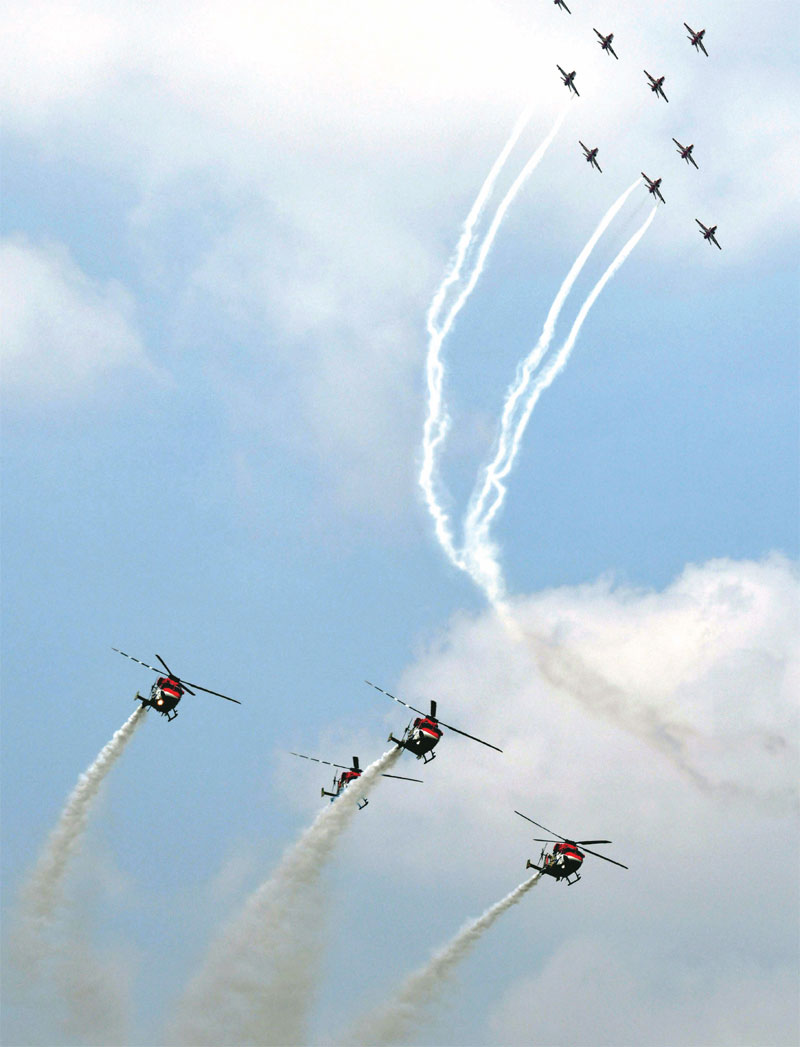
The Sarang and Surya Kiran aerobatic teams of the IAF
Even this would require combining speed, ubiquity, agility, quick turnaround, and concentration of mass with distinctive tactical and strategic acumen, for which, central execution of the air campaign with the entire force under one command, would be imperative. Our theatre commands, on the contrary, gestate dividing the air force into the five proposed theatres. This would be highly undesirable and inadmissible as division of an already outnumbered force will immensely enhance asymmetry in favour of the enemy, in each theatre, whereupon losing the air advantage across both fronts would be a certainty. In the words of Field Marshal Bernard L. Montgomery, ‘If we lose the war in the air, we lose the war and we lose it quickly’. By dividing the air force, this is where we will be headed.








 VIDEO
VIDEO