Describing China’s approach to border disputes, a foreign diplomat once said, “A Chinese stands on the border and takes a broad sweep of the neighbour’s land. Then he takes off his hat and throws it across the border. A while later he points to the hat on the neighbour’s land and says, ‘that hat has been there since antiquity. It proves that this has historically been my land’.”
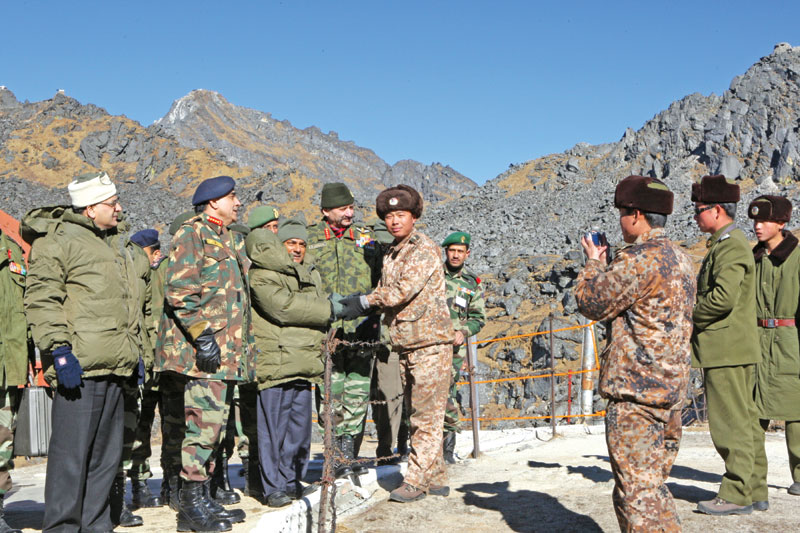
Former defence minister A.K. Antony and COAS Gen. Deepak Kapoor being greeted by a Chinese soldier at Nathu La
Then posted in Delhi, the diplomat had several years of experience negotiating with the Chinese and knew more than a thing about their negotiating skills.
As the Ladakh crisis becomes even more protracted than initially expected, the hat analogy sums up India’s dilemma. Howsoever the negotiations between India and China unfold, two stark realities are obvious: The existing diplomatic framework crafted by the 1993 agreement of peace and tranquillity for containing volatility of the Line of Actual Control (LAC) has been jettisoned by China. Moreover, the illusion of Indian Army’s two-front war capability created in 2009 has been shattered. A reset is needed.
The PLA has ruled out status quo ante to April 2020 position. According to sources, de-escalation or pulling back of forces including tanks, artillery guns, air defence equipment, electronic warfare vehicles etc will only happen once the Indian Army signs the minutes conforming to PLA’s new positions on the ground. And signing it is the biggest roadblock to de-escalation.
In the last four months, China has moved the LAC as agreed to in the 1993 agreement well inside Indian territory. This ranges from 1.5km in some places to 4.5km in others. And as it usually does, China has offered a legal argument to justify its new positions on the ground. It says that the 1993 agreement, which created the LAC, was merely a legal document, signed by the two countries to maintain peace and tranquillity. The Line itself was created in 1959 (albeit unilaterally) when Chinese Prime Minister Zhou Enlai wrote to Prime Minister Jawaharlal Nehru offering a package deal for border resolution. In that letter he had mentioned a ‘line of control’ in Ladakh offering grid references as to where this line runs on the ground. This line, the Chinese maintain, has been their consistent claim line in Ladakh, and this is where the LAC runs.
According to the Chinese version, in 1993, both sides signed the agreement on the LAC without demarcation and delineation (neither on the maps nor on the ground), for the simple objective of peace. The line which India believed to be the LAC according to the 1993 agreement is not the real thing as it is way east to the 1959 claim line and was basically the ground position of the two sides at that point. Hence, in the Chinese narrative, instead of China occupying Indian territory, latter has been nibbling at former’s land. Given this, the 1993 peace agreement and all other follow-on agreements—1996, 2003, 2005, 2012 and 2013—should apply to the 1959 LAC, unilaterally decided by China. By delinking the 1993 agreement from the creation of the LAC, China has effectively eviscerated the line which was the border for all practical purposes for the last 27 years and was known to the Indian Army as the LAC. The Indian ministry of external affairs’ statement that the 1993 LAC alignment is known to India and the Indian Army never violated it has to be seen in this context.








 VIDEO
VIDEO