The Modi government might still win the war of perception within India, but India’s conventional deterrence has been compromised. Its war-fighting capabilities — pivoted on air power — have been blunted without a fight. This will have implications for the on-going proxy war by Pakistan.
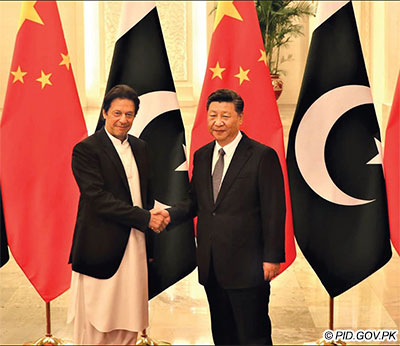
Pakistan Prime Minister Imran Khan with President of China Xi Jinping
Meanwhile, Pakistan maintained credibility of both its first combined civil-military government and its air power.
While Indian political leadership failed, India’s military, this time the Indian Air Force (IAF), saved the day through courage, skill and resolve of its pilots. Moreover, as respect for the seven-decades old MiG-21 fighter was restored, all Russian aircraft might now be assessed with added deference by India.
By using air power for political and electoral gains, the Modi government appears to have scored in the perception war. Three main arguments being bandied around in its favour are:
(a) It demonstrated extraordinary courage by ordering the IAF to strike beyond the Pakistan Occupied Kashmir inside Pakistan;
(b) The government’s pressure compelled Pakistan to return the captured pilot, wing commander Abhinandan Varthaman post-haste, and
(c) International opinion favoured India’s strike for self-defence against Pakistan’s unending terrorism. Being a strong leader, Prime Minister Narendra Modi has created the new normal by use of air power, which done repeatedly like the 2016 (army-led) surgical strikes, would force Pakistan to stop terrorism across the Line of Control. More on this later.
To recapitulate the events, on February 26, the world was informed that the IAF had struck at Balakot (Khyber-Pakhtunkhwa) in the early hours, around 3.30am. Following its ‘intelligence-led, non-military strike avoiding civilian casualties’, the IAF killed ‘a large number of terrorists, their handlers and supports’ and returned safely. With official obfuscation done, it was left to the ‘reliable’ journalists to spin the unending yarn of uncorroborated news and theories.
The entire operation, people were informed, was known to only seven people — the Prime Minister, National Security Advisor, three services’ chiefs, and heads of India’s external and internal intelligence agencies (RAW and IB). RAW identified the target, a Jaish-e-Mohammed seminary and training camp. The IAF then planned and executed the operation keeping two things in mind: no aircraft should be lost or intercepted, and the aircraft should return fast after releasing its payload. It was evident that the operation was meant for publicity. A case in point, unsubstantiated media reports claimed that 300 to 350 Jaish terrorists in Balakot were eliminated by IAF strikes, a claim that has since been questioned by the international media, which was allowed by Pakistan to visit the target site. Subsequently, other media reports have emerged claiming that the IAF fighters did not actually cross the Line of Control. Instead, Balakot was attacked using stand-off weapons. Hence, deliberate confusion continues.








 VIDEO
VIDEO