

The Eyes Have It | November 2026
How police is using facial recognition and digital intelligence as a weapon against protesters
Junaid Suhais
From Delhi’s student protests to Paris, Tbilisi, Tehran, and Nairobi, internal security technologies have become an off-the-shelf market. For India, the harder questions now concern the rulebook that governs them and the supply chain that feeds them.
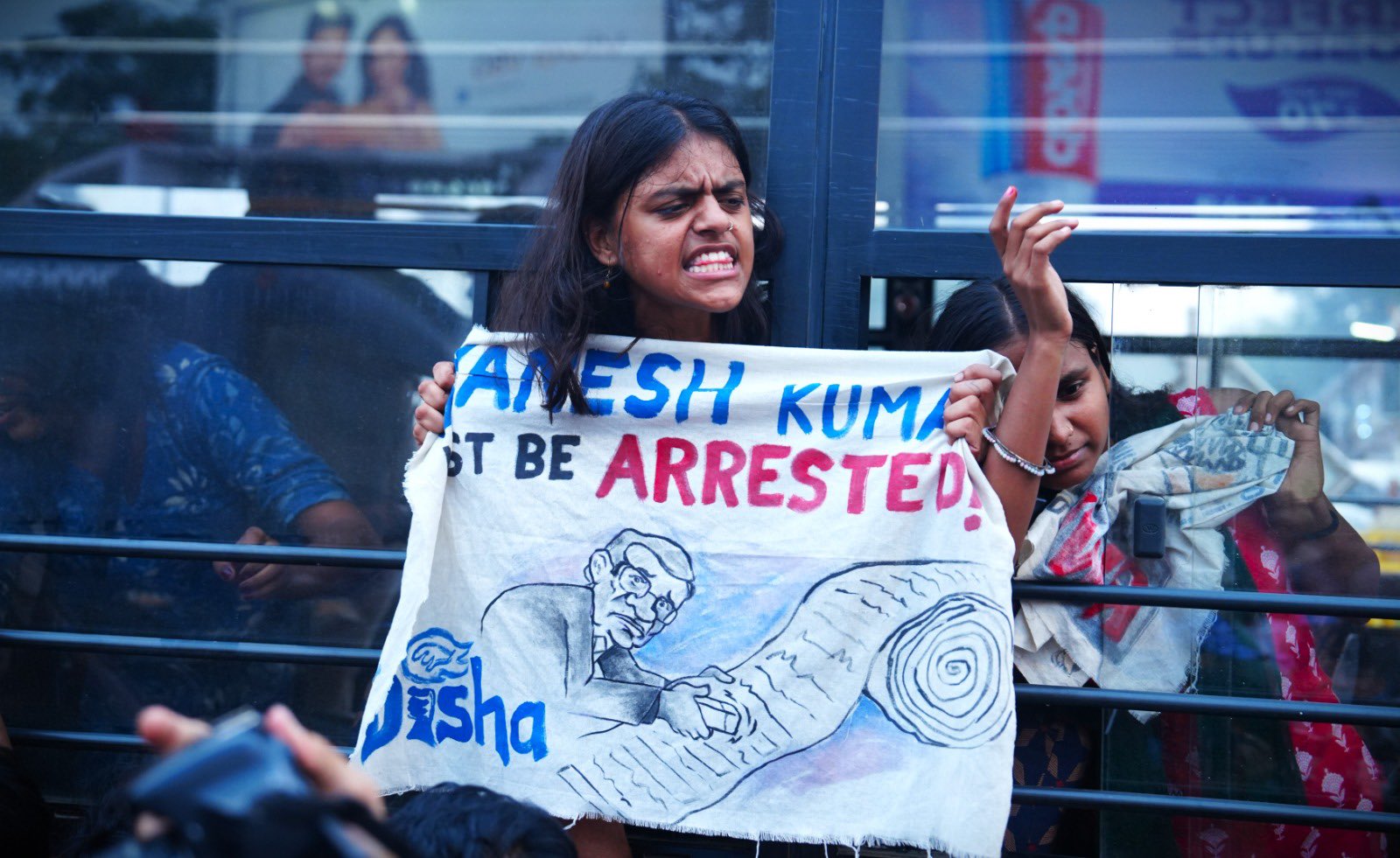
Every new instrument of state power seeks a proving ground, and in this century that ground has increasingly become the street where young people gather. Armies test their sensors on firing ranges; police forces test theirs on crowds. Through the summer and autumn of 2026, India’s proving ground was a short stretch of road in central New Delhi, beside an 18th-century astronomical observatory that became the country’s best-known protest site, partly because of its proximity to Parliament. It was here that the Cockroach Janta Party (CJP), a satirical youth platform, staged a sit-in and hunger strike beginning on 20 June 2026, protesting repeated examination paper leaks.
Parked a few hundred metres away stood a white van bearing the Delhi Police crest and a name borrowed from Sanskrit: Ikshana, the faculty of sight. Inside, officers watched live CCTV feeds run through facial recognition software that drew boxes around faces and matched them against a police database, and a senior officer told The Indian Express that the force was running recognition on protest footage against its criminal records. The van carried eight fixed facial recognition cameras on a telescopic mast, giving it a 360-degree view of the road. When the movement returned in October, more than 35,000 police and paramilitary personnel were deployed, supported by multiple facial recognition systems across Central Delhi, drones over the approaches, rooftop spotters and body cameras mounted on officers’ uniforms.
Facial recognition, social media controls, drone overwatch and data fusion platforms are now available to any state with a procurement budget, and the same equipment has turned up outside lycées in France, along Rustaveli Avenue in Tbilisi and on the streets of Minneapolis. Because the capability has become a commodity, the variables that actually distinguish one state from another are the legal architecture that disciplines its use and the supply chain that determines whose code sits inside the camera. India has begun securing the second and is still drafting the first.
The Protest as Test Bed
Security technology rarely stays within the purpose for which it was bought, a drift that practitioners politely call function creep. The facial recognition system the Delhi Police used in 2020 had originally been acquired to identify missing children. After the violence in north-east Delhi that February, the Union home minister told the Lok Sabha that software fed with voter identity and driving licence data had identified more than 1,100 people, and the same force had already used the system to screen crowds at rallies against the Citizenship (Amendment) Act.
Six years on, retrospective matching has matured into live crowd analytics. The platform deployed at Jantar Mantar is reported to support facial detection and recognition, crowd density analysis, hand gesture recognition and automatic number plate recognition, and a petition before the Supreme Court alleges that the deployment also involved smart glasses and a mobile application linked to the National Automated Fingerprint Identification System.
The arithmetic behind those identifications rewards close reading. Delhi Police stated in reply to a 2022 RTI application that it treats an 80 percent similarity score as a positive match, and it later told the Supreme Court that its system had identified 2,873 people with criminal antecedents at the site, 2,402 of them through the Crime Kundli biometric database and 471 through criminal records. An Indian Express investigation of police, prison and court records then found that at least 25 of those flagged were already in judicial custody when the software placed them at the protest. The force has committed that no action will follow a match until field verification establishes physical presence, and that safeguard deserves credit. Its necessity concedes that the system runs at a confidence level its own operators do not fully trust. The governance layer is thinner still: RTI replies indicated that the force had no specific rule for the technology in 2022 and had conducted no privacy impact assessment, and an officer acknowledged that no specific retention guidelines were followed, so footage could remain on police systems indefinitely.
Behind the camera sits the data-mining layer, where a face becomes a profile. The National Intelligence Grid gives agencies real-time access to driving licence, vehicle registration, bank, Aadhaar registration, FASTag, airline, tax, and telecom and internet usage records, receives about 45,000 requests a month, and has been linked to the National Population Register (NPR) covering 119 crore residents. Its analytics tool, Gandiva, can reportedly match a suspect’s image against photo identity documents, and access has widened from about 10 central agencies to police officers of superintendent rank. The online layer runs on a parallel rail. The Sahyog portal, launched by the home ministry’s Indian Cyber Crime Coordination Centre in October 2024, gives government agencies a centralised channel for issuing takedown notices to platforms, and X has said it received 29,118 government removal requests in the first half of 2025 and complied with 91.49 percent of them.
The Global Mirror
The world’s protest-policing technologies sort into four families: denial, which switches off communication; identification, which attaches a name to a face; infiltration, which enters the device itself; and inference, which reads intent from data.
Protesters first treated the camera as an adversary in Hong Kong in 2019. Demonstrators shone laser pointers at surveillance cameras and hid behind masks and umbrellas to frustrate facial recognition, and crowds sawed down smart lampposts they believed carried surveillance hardware, even as the government insisted the posts only monitored traffic, weather and air quality. The chilling effect of surveillance runs on perception as much as on capability, and the masks at Jantar Mantar are the Hong Kong umbrella in a different climate.
Serbia shows infiltration at work inside a European accession candidate. Amnesty International’s December 2024 report found that Serbian police and the Security Information Agency had used Cellebrite forensic tools and a previously unknown domestic spyware, which Amnesty named ‘NoviSpy’, against peaceful protesters, activists and journalists, often unlocking phones while their owners were held for questioning and then implanting the spyware. The SHARE Foundation has since documented at least 14 people connected to the student movement and opposition targeted with spyware in 2026, and Citizen Lab confirmed with high confidence that the phone of Vladan Djokić, rector of the University of Belgrade, had been infected with Pegasus. A movement led by students eventually draws the instruments toward the people who teach them.
The United States demonstrates that inference is no autocratic monopoly. In March 2025, the State department announced an AI-assisted effort, called ‘Catch and Revoke’, to review the social media accounts of tens of thousands of student visa holders for perceived support of designated terrorist groups. Inference has since acquired a handheld form: Mobile Fortify, a smartphone app carried by immigration agents, searches a face against roughly 200 million images in government databases and has been used in the field more than 100,000 times, according to a lawsuit filed by Illinois and Chicago. Civil liberties groups report that people cannot opt out of a scan and that agents may treat a match as definitive even against contrary evidence, and the department of homeland security’s own AI inventory names Japan’s NEC as the supplier of the matching technology.
Denial remains the blunt instrument. Nepal blocked 26 social media platforms on 4 September 2025 and lifted the ban within days after security forces fired on marchers, killing 19 people. Turkey ran a subtler variant: after the detention of Istanbul’s mayor in March 2025, authorities narrowed bandwidth to X and other platforms, and X restricted student solidarity accounts at Galatasaray, Middle East Technical University and Boğaziçi at the government’s request, out of more than 700 accounts Ankara sought to shut. In Indonesia, the platform pulled the switch on itself, as TikTok suspended its LIVE feature for several days at the end of August 2025, citing escalating violence at the protests. Denial is loud and costly; identification and inference are silent, which is precisely their appeal.
The Watchers’ Busiest Year
The 18 months to the autumn of 2026 produced the densest record yet of how states watch young protesters. Liberal democracies, hybrid regimes and theocracies all reached for the same instruments; what separated them was the paperwork attached.
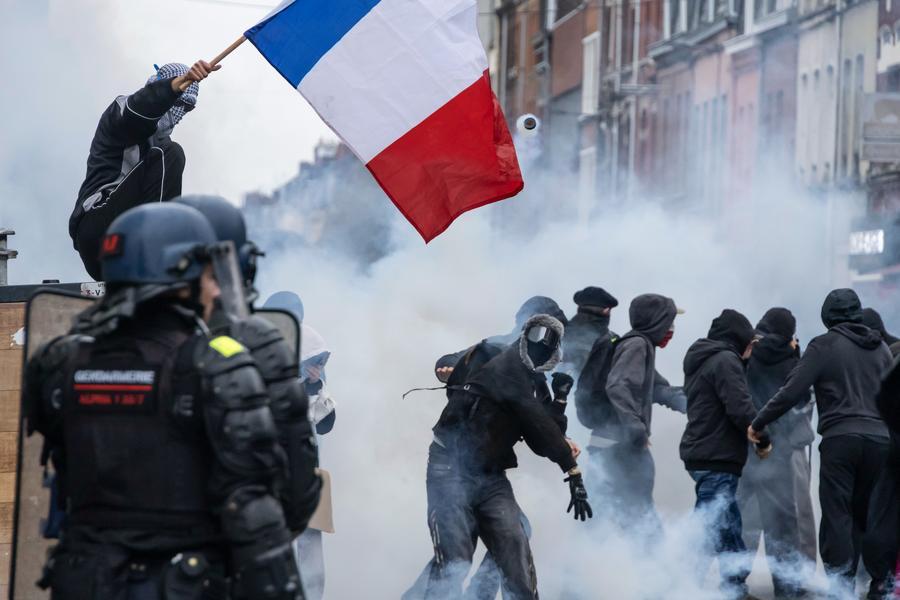
France supplies the closest parallel to Delhi, because its movement also began in the classroom. Students started blockading lycées in late September 2026 over teacher shortages, deteriorating buildings and Parcoursup, the algorithmic platform that allocates university places, and by October 7 the interior ministry had recorded more than 6,500 arrests, most of them minors. The Rhône prefecture announced that police could fly camera drones over gatherings outside schools, specifying no sound recording and no facial recognition, while the RIPOST law, promulgated on August 18, had already extended algorithmic video surveillance to the end of 2030 and widened it to the interiors of buildings open to the public. The statutory ban on live facial recognition has its own leak. An investigation by Disclose found that officers had been matching faces photographed on their NEO work phones against the TAJ criminal records database, which holds 9 million frontal portraits, with queries rising from about 375,000 in 2019 to nearly 1 million in 2024. Europe’s strictest rulebook governs the mast-mounted camera and struggles with the one in a constable’s pocket.
Britain crossed a threshold of its own in May 2026. The Metropolitan Police deployed live facial recognition at a protest operation for the first time on May 16, positioning cameras in Camden off the route of the Unite the Kingdom march, with intelligence-led watchlists and a commitment to delete non-matching biometric data within seconds, and the Biometrics and Surveillance Camera Commissioner cautioned that the technology is not foolproof. A democracy that chose to use the lens on a crowd also chose to tell that crowd where the cameras stood and how long its faces would be kept.
Hungary moved in the opposite direction, writing law to enable the lens. Parliament passed legislation in March 2025 banning Pride events, making attendees liable to fines of up to Euro 500 and permitting facial recognition to identify participants. Research cited by the Thomson Reuters Foundation counts some 35,000 CCTV cameras linked into a single searchable system called Dragonfly, with more than 10,000 Huawei-powered cameras visible in Budapest, and a European Commission spokesperson said real-time recognition of Pride participants would breach the EU AI Act. Around 100,000 people marched anyway in June, after authorities installed additional cameras in the city centre. A lens announced in advance can provoke as much as it intimidates.
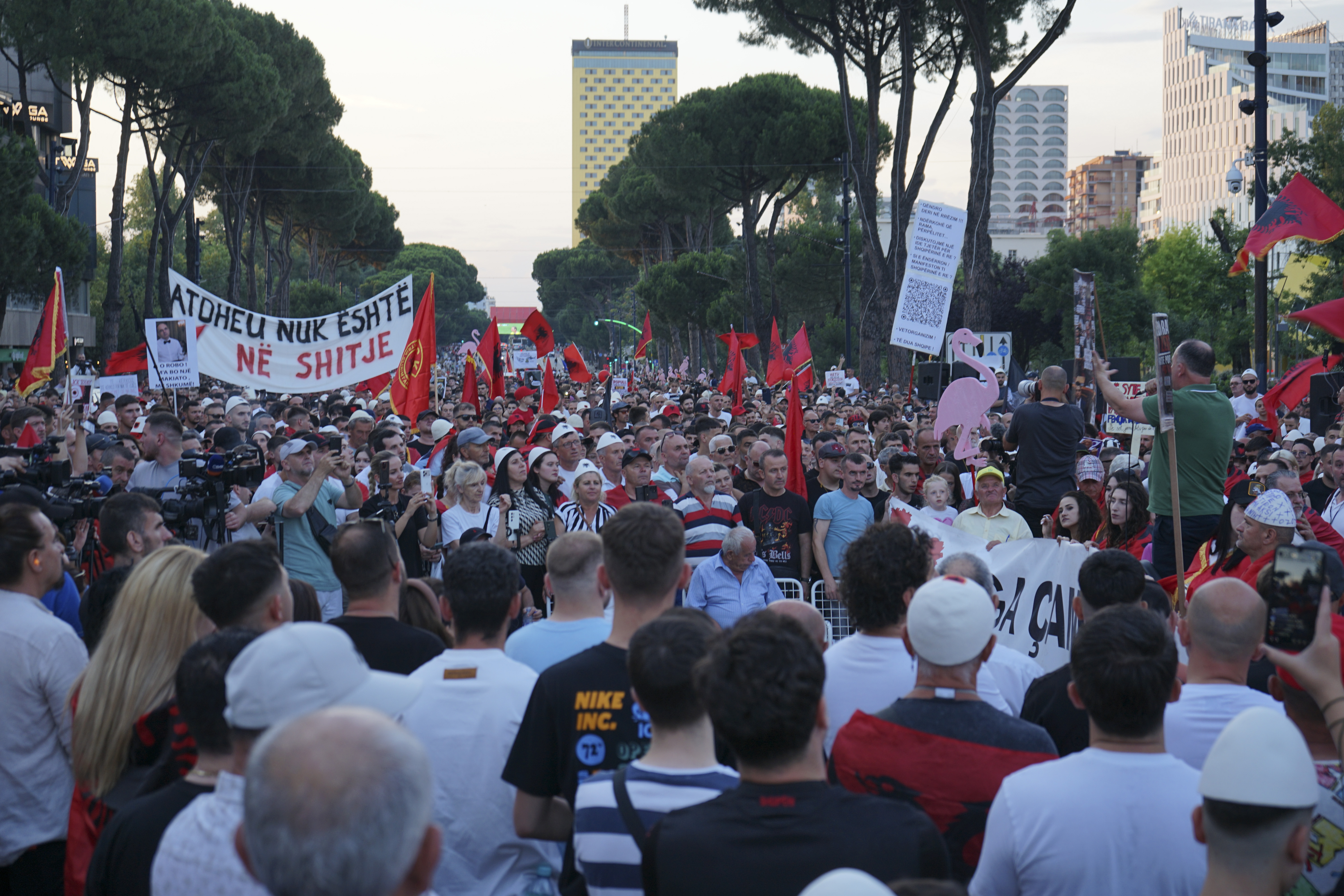
Georgia shows what the model becomes once the courtroom gives way to the bank notice. The interior ministry has bought a facial recognition system called Polyface since 2013 from Papillon AO, a Moscow-based firm sanctioned by the US, Switzerland, Ukraine and Japan, and the system runs on an algorithm from the Novosibirsk company 3DiVi, findings republished by Global Voices. Chinese pan-tilt-zoom cameras with powerful optical zoom watch the approaches to parliament, and the ministry presents their footage in court, where a Georgian lari 5,000 fine for blocking the road has become routine. The Georgian Young Lawyers’ Association says camera footage is often the sole evidence, and that fines had reached about lari 2 million by March 2025. Covering one’s face became a criminal offence in 2025, and one protester discovered five months after a march that her bank accounts had been frozen. The punishment arrives by post, weeks later, which is precisely what makes it scalable.
Iran joins denial, identification and inference in a single apparatus. Even before the latest uprising, a UN fact-finding mission reported that facial recognition had been installed at the entrance gate of Tehran’s Amirkabir University to monitor women students, alongside drones and a citizen-reporting app called Nazer. Protests that began on 28 December 2025 reached all 31 provinces; the government imposed a nationwide shutdown of internet and mobile communications from January 8 that lasted nearly five months, the longest on record, and the same UN mission concluded in September 2026 that the suppression amounted to crimes against humanity. Detainees were interrogated on the basis of facial recognition and phone location data, and some protesters received text messages informing them that their presence at illegal gatherings had been noted. The shutdown blinded the citizens while the state kept its sight.
Kenya demonstrates the telecom network turned sensor. Amnesty International’s November 2025 report, ‘This fear, everyone is feeling it’, documented at least 128 deaths, about 3,000 arrests and more than 83 enforced disappearances across the Gen Z protests of June 2024 to July 2025, figures carried in Kenyan reporting. The report alleges unlawful access to call data and mobile network triangulation, and describes abductees being shown screenshots of their own private messages. Activists believe the operator Safaricom enabled police tracking, which Safaricom denies. In a country of smartphones, the most powerful surveillance asset is the network the phones connect to.
Who Sells the Eyes
The Carnegie Endowment’s AI Global Surveillance Index, covering 176 countries, found that technology linked to Huawei, Hikvision, Dahua and ZTE supplied AI surveillance in 63 countries, 36 of them Belt and Road signatories, with Huawei alone serving at least 50. The same index found that 51 percent of advanced democracies also deploy AI surveillance systems, which should unsettle anyone who imagines this to be an authoritarian problem.
China’s home market is the scale model. Chinese state media reported in 2017 that the Skynet project had equipped the country with more than 20 million cameras dedicated to live surveillance, while IHS Markit estimated the entire national network at over 170 million cameras that year. The cameras are the sensory layer; the fusion platforms are the brain. Human Rights Watch reverse-engineered the app police use to interface with Xinjiang’s Integrated Joint Operations Platform and found that it collects personal information, reports activities deemed suspicious, and prompts investigations of people the system flags, with triggers as mundane as avoiding the front door, failing to socialise with neighbours, or using any of 51 network tools, including VPNs and WhatsApp. A system that treats a back door as a warning sign has moved from identification to the prediction of disloyalty.
Israel and the US supply the intrusive and the scraped. NSO’s Pegasus and Cellebrite’s extraction tools appear in the Serbian record above, and the Dutch Data Protection Authority fined Clearview AI Euro 30.5 million in 2024 for building what it called an illegal database of more than 30 billion facial images. Europe has written the most restrictive rulebook: the EU AI Act’s prohibitions, in force from February 2025, bar real-time remote biometric identification in public spaces for law enforcement, subject to narrow exceptions wrapped in procedural safeguards. The newest cases complicate the old binary of Chinese supply and Western restraint. Georgia’s faces are matched by Russian software, Hungary’s capital is watched by Chinese hardware inside the European Union, America’s street-level scans run on Japanese algorithms, and Article 19 reports that Huawei and ZTE have supported Iran’s surveillance and censorship apparatus since at least 2010. China builds and exports with few constraints, the US innovates and litigates afterwards, Europe legislates first, and India stands at the junction as a buyer steadily becoming a builder.
India’s Exposure Runs Through the Supply Chain
At this junction, internal security turns into counter-intelligence. Industry figures cited by Reuters put CP Plus at 48 percent of the Indian CCTV market and Hikvision and Dahua together at 30 percent, with some 80 percent of all CCTV components sourced from China. New Delhi has responded with one of the more serious supply-chain regimes anywhere. Since 9 April 2025, every internet-connected CCTV model made or imported for sale in India must be tested in government laboratories, with requirements for tamper-proof enclosures, malware detection and encryption, and laboratories may demand source code where proprietary communication protocols are used. The US had banned sales of Hikvision and Dahua equipment in 2022 on national security grounds, and India’s approach, which names no country, achieves comparable scrutiny through certification.
The Ikshana van illustrates both progress and residual exposure. Its development partner was CP Plus, an Indian firm, which described the platform as equipped with AI-powered and varifocal bullet cameras, having built the prototype with Delhi Police and integrated monitoring software with face recognition cameras. A domestic champion therefore sits at the front of the stack, an Aatmanirbhar success. Yet the sensor modules, chipsets and firmware libraries in the wider market still trace back to Chinese suppliers, and a camera pointed at Indian citizens is also a camera that a foreign service would very much like to read. Privacy and counter-intelligence therefore demand the same engineering: audited code, data that never leaves the device without authorisation, and retention limits that shrink the archive any adversary could steal.
Intrusive tools remain the least transparent layer. The Supreme Court’s technical committee on Pegasus examined 29 phones, found malware on five, could not conclude that the malware was Pegasus, and reported that the Union government had not cooperated with its inquiry. At the national level, procurement once carried a design restraint: the revised 2020 tender for a National Automated Facial Recognition System stated that the project would neither install CCTV cameras nor connect to existing ones. Live recognition in central Delhi six years later shows how far city-level practice has moved beyond that boundary.
The Ethics of a False Match
The ethical case against careless deployment begins with mathematics before it reaches philosophy. The US National Institute of Standards and Technology (NIST) found in its 2019 vendor test that false positive rates across demographic groups often varied by factors of 10 to beyond 100, with elevated false positives among the elderly and children, and NIST noted that differentials in one-to-many matching matter most because their consequences can include false accusations. The field record bears the laboratory out.
Iranian detainees were wrongly identified by facial recognition and location data, and in Oregon a woman scanned twice by Mobile Fortify during a single enforcement operation was returned two different identities, both of them wrong. Student protesters are young by definition, Indian police databases are populated with faces captured under uneven conditions, and no public evidence shows the 80 per cent threshold being validated against Indian demographic data. A match threshold chosen without that validation is a policy decision disguised as a technical parameter.
The philosophical cost is subtler. Democratic assembly has always depended on a measure of anonymity in the crowd. The Supreme Court held in 2018 that the right to protest at Jantar Mantar is protected under Articles 19(1)(a) and 19(1)(b). When every face becomes a query, that protected right acquires a hidden price, paid by the student who weighed a future job application against a placard and stayed home.
India’s data protection statute does not yet close this gap. The Digital Personal Data Protection Rules were notified on 14 November 2025, with the substantive obligations taking effect on 12 May 2027. The Act grants wide exemptions to government bodies for national security, public order and crime prevention, so the law that will discipline a food delivery app offers little structure for a police database of protesters’ faces.
A Model Worth Building
India possesses the hardware, domestic vendors and a certification regime that already reaches into source code. What it lacks is a statute that tells police, vendors and citizens where the lines sit. A credible Indian model would separate crowd management from individual identification in law; require magistrate or judicial authorisation before live recognition is run at a lawful assembly; publish match thresholds validated by an Indian testing body, extending the laboratory regime that now certifies cameras to the algorithms that interpret their feeds; mandate deletion of non-matched templates within a fixed period; and report usage annually to Parliament.
None of this requires invention. London has shown that a police force can publish watchlist criteria and delete non-matches within seconds, France has written the exclusion of live facial recognition into statute even while extending algorithmic cameras, and the EU AI Act supplies a tested template for judicial authorisation. Each of these measures strengthens the security apparatus as much as it protects the protester, because a system with audited code, short retention and published error rates is harder for a foreign adversary to exploit and easier for a court to trust.
The window to legislate is open before live recognition becomes so routine that rolling it back looks like disarmament. Jantar Mantar’s masonry instruments were built to read the heavens; Ikshana was built to read a crowd. The state that sees most clearly in the years ahead will be the one that can show its citizens the rules by which it looks, and India is well placed to write those rules first among the large democracies, provided it treats the lens at Jantar Mantar as the opening chapter of a legislative project.





 VIDEO