

The Dragon’s Stealthy Moves
Prasun K. Sengupta
Following the conduct of OP Bandar by the Indian Air Force (IAF) in the early hours of February 26 at Balakot in Pakistan’s Khyber Pakhtunkhwa province, China’s People’s Liberation Army Air Force (PLAAF) has been gradually ramping up its periodic deployments of combat aircraft within Tibet Autonomous Region (TAR) of the type not witnessed before. For instance, two of the PLAAF’s Xian Aircraft Corp-built (XAC) H-6K bombers were deployed to Shigatse dual-use airport between March 2 and 12.
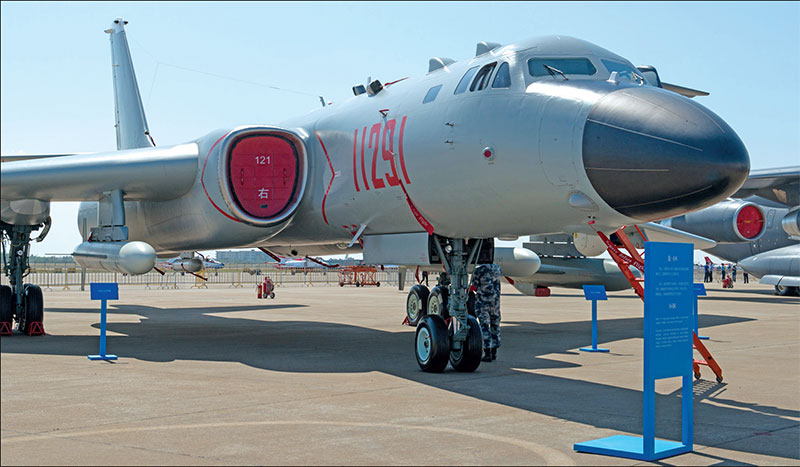
PLAAF H-6K bomber with AKD-20 air-launched cruise missiles
They were observed on the eastern alert ramp of the airport, along with a new rotation of CH-5 unmanned aerial systems (UAS). Although both the H-6K and CH-5 had been observed at Shigatse in 2016 during their field evaluation trials, this is the first time that extended operational deployments of these two platforms have been observed. The CH-5s have since replaced the Guizhou Aviation Industry Group-built EA-03 Xianglong high altitude long endurance (HALE) UAS that are now located at Yishuntun airbase in Jilin province near China’s borders with Russia, and at Lingshui air base in Hainan Island on the South China Sea.
Since 2011, the H-6Ks have been operational with the PLAAF’s 10th Bomber Division’s 28th Air Regiment of the Eastern Theatre Command at Anqing and the 22nd Air Regiment at Shaodong; the 8th Bomber Division’s 24th Air Regiment of the Southern Theatre Command at Leiyang; and the India-specific 36th Bomber Division’s 108th Air Regiment of the Central Theatre Command at Wugong (from where the two H-6Ks were sent to Shigatse).
All H-6Ks come armed with K/AKD-20/CJ-20 ‘Long Sword’ subsonic air-launched cruise missiles. XAC has also developed the H-6KH variant, which features two additional underwing pylons for KG-800 escort jamming pods. Satellite imagery of the XAC airfield in Yanliang, China, shows an H-6KH with unidentified pods and a belly-mounted KD-63 data-link pod. A new variant of the Xian Aircraft Corporation (XAC) H-6K long-range bomber has entered service with the PLA Navy Air Force (PLANAF). This variant (known as H-6N, which made its maiden flight last December) is equipped with a nose-mounted fixed aerial refuelling probe. All H-6Ks feature lightweight composites, new fuel-efficient D-30-KP2 turbofans, advanced mission avionics (like a nose-mounted search radar and chin-mounted optronic sensor), and a full glass cockpit.
China Aerospace Science and Technology Corp’s Caihong 5 (CH-5), or Rainbow 5 medium-altitude long-endurance (MALE) UAS, has an endurance of 60 hours and its range is in excess of 10,000km. Powered by a 330hp heavy-fuel engine (HFE), the UAS has a service ceiling of 30,000 feet (7,000 metres). Heavy-fuel is denser and contains more energy than regular petrol, which translates into greater endurance and range for aircraft limited in their fuel volume. The CH-5’s maiden flight was conducted in Gansu province, China in August 2015. The flight lasted for about 20 minutes. A prototype of the new UAS was publicly displayed for the first time in November 2016. The CH-5 has a wingspan of 21 metres and can carry a payload of up to 1,200kg. Overall, the CH-5 can carry up to 16 air-to-ground weapons, including Lan Jian-7 (Blue Arrow-7) laser-guided air-to-surface missiles, TG-100 laser/INS/GPS-guided missiles, and AR-1/HJ-10 anti-armour guided-missiles. The CH-5s at Shigatse were flown from the PLAAF’s Uxxaktl air base in Xinjiang, while an additional detachment is located at Asku/Wensu air base of the Western Theatre Command.
The two KJ-500 airborne early warning and control (AEW&C) platforms deployed to the dual-use Lhasa-Gonggar Airport since mid-2017 hail from the PLAAF’s 26th Special Missions Aircraft Division’s 76th Regiment at Wuxi/Shuofang air base. The only other combat-support platforms of the PLAAF that have yet to be deployed to TAR are the Y-9JB ELINT and Y-9G EW platforms that are operated by the PLAAF’s 20th Air Division’s 58th EW Regiment at Guiyang/Leizhuang and Jiaxing air bases, and the 59th EW Regiment at Zunyi/Xinzhou air base.
In another development, the PLA Rocket Force has expedited the commissioning of permanent ballistic missile bases in both Sichuan and Yunnan provinces that lie alongside India’s Northeastern states. For instance, a base housing DF-16 tactical ballistic missiles has come up 15km east of Yibin town in Sichuan province. Its construction began four years ago and it presently hosts eight missile storage garages, with six of them being interconnected. Yet another facility houses the 622 Missile Brigade in Yuxi in Yunnan province, to add to the 626 Brigade in the same province. Yunnan is also home to the CJ-10 ground-launched cruise missile Brigade in Jianshui.
The above-detailed deployments can be contextualised only after analysing the respective threat perceptions of both China and India along the LAC. While those pertaining to the eastern sector have already been detailed (see FORCE August 2019, pages 34-43), there have been significant developments in the western sector since 2005, which are worthy of being highlighted.
Threat Perceptions
In early February 2009, the then Indian defence minister, A.K. Antony issued a classified formal directive to the Chiefs of Staff Committee: prepare for a ‘two-front’ war. Consequently, in mid-2009, the Indian Army’s HQ Northern Command carried out a series of war games — codenamed ‘EX Divine Matrix’ — aimed at analyzing the PLA’s threats to Ladakh. These war-games were based on inferences drawn from the PLA’s 2004-2005 series of exercises east of Ladakh. India’s HQ Integrated Defence Staff (IDS) subsequently made an assessment of how the PLA would fight India in case of a war in a 144-page document called ‘PLA War Zone Campaign’ doctrine. According to the PLA’s appreciation, there are two routes to Aksai Chin, of which the major and easier route is through India’s sub-sector north (SSN).
The other route, called Hot Spring, is via Ladakh’s Panggong-Tso Lake. The lake, spreading 135km in length and 5km in breadth and 210 metres in depth, has 90km of its length under China’s control and the remaining 45km in India. Located at a height of 14,500 feet, the lake is exactly at the Line of Actual Control (LAC). In order to open the SSN route, the control of Daulat Beg Oldie is required. The PLA’s war-game plan of 2004 showed Beijing’s perception of how the Indian Army would move its mechanised infantry and armoured elements while launching an offensive from SSN. China’s fears of an Indian military incursion further increased when the Border Roads Organisation (BRO) started building a 255km-long road to SSN, thus giving easy access to the area from Leh. Called the Darbuk-Tangtse Road, it skirts the Panggong-Tso Lake and goes up to Daulat Beg Oldie and is slated for commissioning by 2022.
India’s military posture against China along the entire LAC (from Ladakh till Arunachal Pradesh) has been to maintain full strategic defence with minor tactical offensive capabilities. Given the politico-operational compulsions, difficult terrain, and the PLA’s track record, it is clear that the Indian Army was, until the previous decade, doing an onerous task.
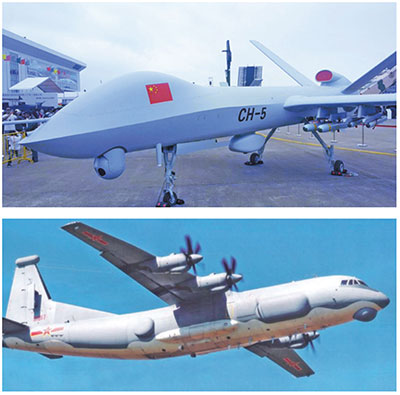
Top and Above: CH-5 MALE UAV; Shaanxi Y-9G ECM Platform
Since 1986, China has occupied land in the Skakjung area in the Demchok-Kuyul sector in eastern Ladakh. China’s assertion in Ladakh has grown after it built infrastructure in its Ngari prefecture to develop Kailash-Manasarovar into a tourist complex over the past 20 years to attract affluent local and international tourists. Ngari’s rapid development was a precursor of things to come. China has thus been applying the Sino-India Guiding Principle of 2005 to consolidate its position, for it knows that only 0.6 per cent of the Ladakh region is inhabited. By 2011, it had moved to the Chip Chap area in northeastern Ladakh.
In Ladakh, India has since mid-1999 witnessed persistent PLA transgressions-in-strength at the Depsang Bulge, Chumar, Trig Heights, Hot Spring, Finger Area, Spanggur Gap and Chip Chap Valley. The PLA has also moved motorised forces into Charding Nalla since 2009 and these could eventually threaten the Manali-Leh route. During wartime, the PLA’s most probable intention would be to enter from the south of the Karakoram Range and cross the Shyok River from the east. China thus is estimated to want to push Indian control to the left of Shyok River in the north and left of the Indus River in the east, possibly to establish both rivers as natural boundaries. In Chushul, the aim is to reach Luking to take control of the entire Panggong Tso Lake.
This three-pronged strategy would make India defenceless both in the Indus Valley and the Nubra Valley. That would in turn impact the supply-lines and even India’s hold over the Siachen Glacier. It is also quite possible that China has been eyeing the waters of the Shyok and Chang Chenmo rivers, to divert them to the arid Aksai Chin soda-plains and its Ali region. Consequently, as of today, the issue for India is not reclaiming 38,000 sq km of Aksai Chin lost to China in 1962, but retaining the territory lying inside the Indian portion of the LAC.
Offensive Options
The terrain of Eastern Ladakh is unique and there is no other place like this in the world. Up to Leh and 150km beyond, the terrain is extremely rugged with narrow valleys and surrounding hill ranges varying from 15,000 feet to 23,000 feet. Beyond this the valleys become broader, the base height rises to 15,000 feet and the surrounding hills and ranges become more gradual and only 3,000 feet higher than the valleys. After reconnaissance, the hill features can be negotiated by wheeled vehicles and for tracked main battle tanks (MBT) and infantry combat vehicles (ICV) it is a cake-walk. The Chushul Sector is more compact and there, the Indian Army’s main defences are between 5km to 8km from the LAC. The LAC runs along the Kailash Range, which is not held either by the Indian Army or the PLA Army. Both sides, however, have plans to pre-empt the other from occupying the Kailash Range in the event of war.
If this entire area is to be manned like the LC, the Indian Army would require four additional Mountain Divisions, which is not cost-effective. However, mechanised forces with their mobility are tailor-made for the role of dominating the valleys of the Kailash Range. Back in the mid-Eighties, the PLA did not have the strategic airlift to land MBTs and ICVs in the vicinity of the LAC. The PLA formations were then located in Central Tibet, 1,000km away. This gave the Indian Army a window of opportunity to pre-emptively secure the areas on or across the LAC or conduct deeper offensive operations. Consequently, an operational strategy was put in place in Ladakh to pre-emptively seize the Kailash Range and areas across the Panggong Tso Lake.
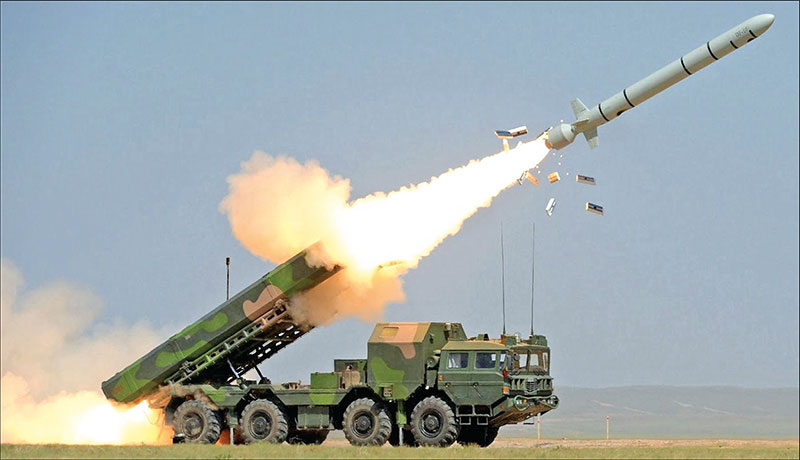
CJ-10 GLCM (Ground-Launched Land-Attack Cruise Missile)
The Indian Air Force (IAF) was on high alert and prepared for a limited war (as a consequence of OP Falcon that was underway at Wangdung in Arunachal Pradesh). It was in the last quarter of 1986 that the Indian Army, under OP Kartoos, temporarily had 14 41-tonne T-72M1 MBTs airlifted to Leh along with a Regiment of 15-tonne BMP-1/BMP-2 ICVs for deployment in Chushul, Finger Area and Spanggur Gap. Since then, the Indian Army’s Karu-based 3 ‘Trishul’ Division had until 2012 just one mechanised infantry regiment — 1 (Guards) Mechanised Infantry Regiment — with 52 BMP-2 ICVs and three armoured recovery vehicles (ARV). This Regiment used to carry out regular manoeuvre warfare exercises in the Wari La region in Panggong, which is located at an altitude of 16,600 feet. The IAF too had built a makeshift airstrip in Mud Village near Panggong-Tso.
In the Nineties, the Indian Army had deployed 30 T-72M1s in the Daulat Beg Oldie sector in eastern Ladakh, bordering China. The field commanders thought such MBTs were of no use in the mountains as the PLA was then not even patrolling the disputed LAC. Consequently, the MBTs were dismantled and moved to Leh, and then flown to the mainland by the IAF’s IL-76MD ‘Gajraj’ transport aircraft.
In mid-2009, however, a decision was taken to introduce six T-72CIA A-equipped Regiments (58 tanks per regiment, including reserves), equipped with 348 tanks. In addition, three new Mechanised Infantry Battalions with 180 BMP-2s were to be raised—all these functioning under a ‘Combat Command’ during wartime. Thus, the Ladakh-based XIV Corps was to be allocated an Armoured Brigade to cover the flat approaches from Tibet towards India’s crucial defences at Chushul. In 2014, the Indian Army’s HQ Northern Command started the hunt for a Brigade (formation with close to 4,000 troops) that could be deployed at altitudes higher than 15,000 feet. It soon realised that the 81 Brigade, aka the ‘Bakarwal’ Brigade, could be sent to the Daulat Beg Oldie sector with an Armoured Regiment. Combined, they could defend a possible armoured invasion by the PLA, launched through NH-219.
Next, IAF Boeing C-17A Globemaster-IIs took off with T-72CIAs from the Chandigarh air base. The Hindon-based C-17As, each of which can haul 77 tonnes of payload, were used to send the MBTs and ICVs to Leh, from where they were sent to Daulat Beg Oldie and other areas in eastern Ladakh. Around 100 T-72CIAs were sent for equipping the 85 Armoured Regiment at Nyoma and 4 Horse at Thangtse. With these in Daulat Beg Oldie and the Depsang Plain, the Indian Army can now cross the Demchok Funnel (where the Indus River enters India from Tibet) and intercept NH-219 in case of hostilities. 81 Brigade is presently headquartered at Durbuk—14,000 feet above sea level—near Daulat Beg Oldie and en route to the disputed Panggong Tso Lake.
Under 81 Brigade, three Infantry Battalions (with close to 900 troops each) have been deployed in the area. This is in addition to the 114 and 70 (Siachen) Brigades, which are part of the 3 Infantry Division. Thus, the Indian Army had to wait for another 28 years before the induction of a Combat Command in 2016 to get the enhanced capability. Though the ideal eventual requirement is for two Combat Commands and two Motorised Infantry Divisions! Such a force would give India the ‘retributive capability’ that a major power should have.
Ladakh thus remains India’s best bet for offensive operations as it is an extension of the Tibetan Plateau. The role of mechanised forces in offensive operations is, as part of overall offensive plans, to pre-emptively capture the tactical features/ passes on or across the LAC. Also, as per the strategic situation in conjunction with special operations forces/ air-mobile forces, the aim is to capture areas dominating the strategic Xinjiang-Tibet Highway (NH-219), which runs parallel to the LAC, 100km to the east. This is all based on the strategic situation as prevailing since 1988, and remains viable till today. More so, when the Indian Army now has much larger mechanised forces of up to a Combat Command (grouping based on an Armoured Brigade with one/ two Armoured Regiments and one/ two Mechanised Infantry Battalions).
In addition, India has much higher capability for heliborne/airborne operations. The role in defensive operations is to dominate the valleys ahead of and around the main defences, denying the PLA any freedom of action to deploy its field artillery assets and for logistics build-up. As a result, the PLA would be forced to the higher ridges on either side of the valleys. This is a classic covering-force action. Since the distances are vast, it is a pre-requisite for the enemy to seize tactical control of the valleys. Securing the tactical feature on and across the LAC is part of this role. Even the PLA’s mechanised forces spearheading its ground offensive are at a disadvantage as the valley funnel makes them sitting ducks for the Indian Army’s armoured/mechanised forces and the IAF’s offensive tactical airpower.




 VIDEO
VIDEO