

The Choice is Clear
Let me start by making a dramatic statement which perhaps may come true. On 26 June 2018, the world lost the South China Sea to China when the Chinese President Xi Jinping told the US defence secretary James Mattis, “We will not lose one inch of territory passed down by our ancestors.”
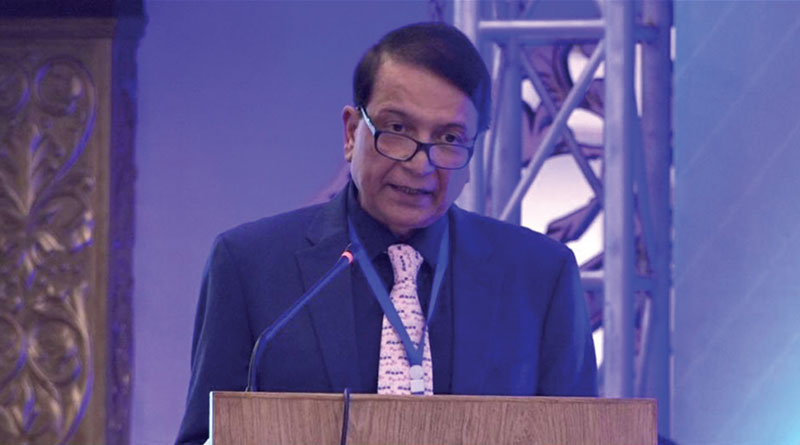
Editor, FORCE Magazine, Pravin Sawhney speaking at the “International Conference on Global Peace Amidst War and Conflict” in Islamabad
With no hopes of compelling China to de-militarise South China Sea, the US has doubled its efforts to safeguard the freedom of the Sea Lanes of Communications across the two Oceans – the Western Pacific and the Indian Ocean. Especially when the enviable war-shipbuilding capabilities of China has matched up to its Maritime Silk Road needs which interestingly follow the same maritime route as the global commercial Sea Lanes of Communications. Moreover, China has managed friendly sea-ports in the Indian Ocean, which analysts believe, could over time be converted into its naval logistics nodes if not naval bases with provision for ship repairs.
This explains why the US recently called India its ‘true strategic partner’. Making no bones about the centrality of India to preserve the maritime status quo, the US secretary of state, Mike Pompeo during the recent two-plus-two dialogue (between foreign and defence ministers) in Delhi on September 6 said: “Our relationship with India is very important to our success in our Indo-Pacific strategy.”
There was nothing new in Pompeo’s statement. The US has been nudging India since the Nineties to take responsibility as the maritime and naval pivot in the Indian Ocean region. To make this happen, India needed to buy US arms for commonality of equipment, sign the four US’ foundation agreements for sharing of logistics, communications and data, plan missions by sharing naval doctrines, procedures and drills, and train together. In other words, without being a NATO member or a US ally, Indian and the US naval forces should train together to fight together.
What was new in the two-plus-two joint statement was the US’ unsaid urgency to achieve naval interoperability with India. Without India’s wholehearted participation in the US’ Indo-Pacific strategy, the Quadrilateral mechanism or any other combination of nations meant to check China would end up as mere talking points.
Besides the US and China, Russia has emerged as a serious, though low-key, player in the Indo-Pacific region. While fixated on being a military power in the Pacific, it appears to have positioned itself as the alternate source of arms and energy needs for smaller nations like Vietnam, Indonesia and the Philippines in the Indo-Pacific who are wary of getting sucked into the US-China geopolitics. For India, Russia is not only its biggest arms supplier and the only nation which has given it restricted technologies. Russia is India’s proven strategic partner.
In such turbulent geopolitics, India faced a strategic dilemma: should it strengthen its strategic ties with the United States by developing naval interoperability which Washington desires? Or should it abide by the April 2018 Wuhan understanding reached between India and China as a consequence of the Doklam crisis? I will discuss this dilemma and then conclude that perhaps a better path, which has not been considered by India, should be pursued. Needless to add, all views expressed are my own.
I believe that India should have two serious reservations about aligning itself with the US in the Indo-Pacific region. One, the US has never given India, let alone, high-end and dual-use technologies, even medium-level defence, space and civil-nuclear technologies. India has been seeking these technologies from the US since December 1984 when Prime Minister Rajiv Gandhi signed the memorandum on technology during his US visit. India has got nothing worthwhile till date.
Subscribe To Force
Fuel Fearless Journalism with Your Yearly Subscription
SUBSCRIBE NOW
We don’t tell you how to do your job…
But we put the environment in which you do your job in perspective, so that when you step out you do so with the complete picture.



 VIDEO
VIDEO