The most important lesson of the Doklam crisis (June 18 to August 28, 2017) when Indian and Chinese forces were locked in a face-off in the Himalayas was: foreign policy without credible technological and military power is never taken seriously. Worried about an escalation, Prime Minister Narendra Modi sought the Wuhan summit with President Xi Jinping in April 2018 for peace on the disputed border, quickly followed by the Sochi summit with President Vladimir Putin as, perhaps, the guarantor of that peace.
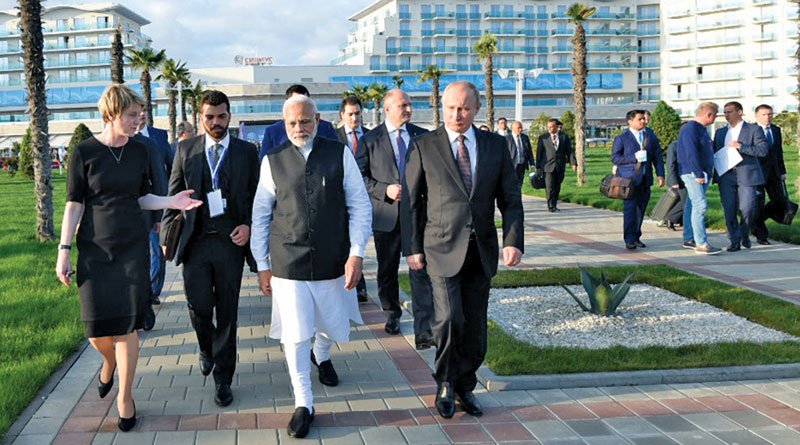
PM Narendra Modi with President Vladimir Putin in Russia
There were two fallouts of these summits: Speaking at the Shangri La dialogue on 1 June 2018, Modi, discounting the assertive US narrative, sought good relations with China. And, despite the US’ strong objections, he endorsed the purchase of Russian S-400 system which Putin had earlier personally offered to him.
India’s foreign policy ‘reset’, as it was charitably called, opened up wider cooperation possibilities in the technology and military fields. Much to the US’ annoyance, the perceptibly neglected relations between India and Russia were dramatically elevated as special strategic partnership. A confident Russian ambassador in India, Nikolay R. Kudashev stated, “We know your (Indian) relationship with the US would not be anti Russian in nature.” As if to vindicate Moscow’s belief, Russia, in 2018, become the biggest exporter of defence arms to India.
Since the Modi government had linked arms buys with political heft, a trend likely to continue in the globally uncertain times by the next Indian government, the choices are between Russia and the US. To be sure, military power is about war readiness, the ability to fight the present war with an assured product support by indigenous defence industrial complex. Technology power, on the other hand, is about innovation driven preparedness for the future warfare.
Interestingly, the future warfare would be transformational. If the Revolution in Military Affairs (RMA), which the world witnessed during the 1990 Gulf War, was about stand-off capability and network centricity, the unfolding second RMA is about speed of operations across multi-domains in order to disrupt, disorient and destabilise the enemy’s sensor shooter loop. Algorithms driven Artificial Intelligence (generic term) or more precisely Deep Learning followed by explorations in quantum sciences are at the heart of the second RMA, which has an unprecedented peculiarity: it is commercially driven with the militaries around the world seeking to use them in the new wave of military technologies like hypersonic missiles, lasers, microwave, directed energy, cyber weapons and so on.





 VIDEO
VIDEO