

The Anatomy of an Insurgency
The manner in which the last of the United States’ troops withdrew from Bagram air base some days ago suggests that the Americans were not sure of what was likely to happen if the withdrawal were done openly. The Afghan National Army detachments based with the US troops discovered in the morning that they were now alone.
It is difficult to understand the actions of both. Were the American detachments so small in number that they could leave without raising any suspicion and also that the Afghans did not have sentries at night who would have watched the Americans leave and they did not inform their commanders? It defies logic to understand what really happened, and also the fact the Americans were concerned about being interfered with as they left, never to return?
Just recently, the British Prime Minister also said that most of their troops had already withdrawn and for security purposes he could not disclose their departure plans. This curious manner of withdrawal from an area one had dominated until recently, reminded me of how I withdrew my Brigade from our operational area where we had fought for two years. It was on the east coast of northern Sri Lanka from the district town of Mullaitivu where we withdrew from in December 1989. The IPKF withdrawal was well publicised and our adversaries the LTTE who we had been fighting in this period knew exactly when our convoys would return to Vavuniya and from there to Trincomalee to return by sea. While there had been no understanding with the LTTE, they knew that any interference would prolong our presence, and in the end, they were relieved to see our backs.
That none, the IPKF in Sri Lanka or the Americans in Afghanistan, had achieved the aims of their intervention only serves to underscore the moral authority which the withdrawing forces had established against their respective adversaries. The fact that the most powerful nation in the world should fight for 20 years and return with their aims unfulfilled and in the manner that it did points to the precarious nature of what is likely to follow in Afghanistan. There are many lessons to be drawn from the US’ intervention and subsequent withdrawal; no doubt reams of paper and many books will be written on this episode. The similarities with the IPKF experience in Sri Lanka are striking, but it is not the purpose of this article to compare the two except in the most general of terms. However, this was not the first time the Americans had intervened with force in Afghanistan, or any other country and it so happens that in most cases the use of armed force abroad has not achieved the desired result.
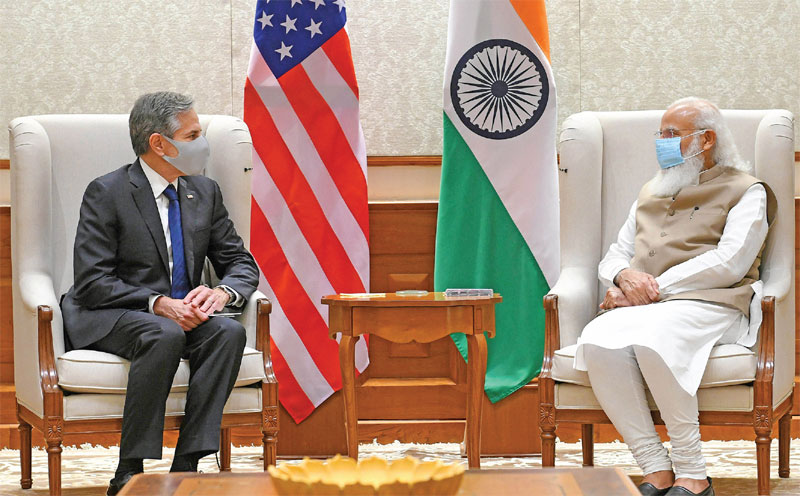
US secretary of state Antony Blinken with Indian Prime Minister Narendra Modi
The point we need to look at is whether it is possible to defeat a homegrown insurgency in another country; the pitfalls of doing so and whether such interventions have the seeds of failure built into them. This is a vast subject because since time immemorial there have been armed uprisings against invaders or unpopular regimes, some of which have been successful, and some have not. Limiting the scope of the present article, I have chosen to restrict it to the period of the 20th Century post the First World War and also limit its geographical spread to the regions of West and South Asia. This is an arbitrary choice mainly to highlight the contradictions inherent in such operations and the lessons that may be drawn from them.
Types of Insurgencies
In general, the types of insurgencies can be divided into two: differing mainly in their aims rather than their methods because violence against the established order remains a common factor to both. Before describing these, it is necessary to recollect the types of armed threats a state faces to its sovereignty. These can be external or internal and both types could be externally or internally abetted.
Subscribe To Force
Fuel Fearless Journalism with Your Yearly Subscription
SUBSCRIBE NOW
We don’t tell you how to do your job…
But we put the environment in which you do your job in perspective, so that when you step out you do so with the complete picture.



 VIDEO
VIDEO