

Taming the Seas
Much water has flowed under the bridge since the Bharatiya Janata Party (BJP)-led NDA government, now in its seventh year in office, came to power in May 2014. National security was one of the central pillars of its election manifesto and brought coalition politics to an end. The country, bitterly disillusioned by rampant corruption and an indecisive coalition government, looked forward to a period of good, fair and firm governance. The presentation of the budget for 2014-15 by the new finance minister, the late Arun Jaitley just 45 days after assuming office, offered no quick fix solutions and none were expected either. The defence budget remained at approximately USD38 billion with the navy’s share at about 17 per cent which, although less than its long-standing requirement for 20 per cent, was adequate given the country’s economic circumstances. It did, however, provide the reassurance that things were going to get better with national security a priority area.
Six years later, India is facing a major challenge to its territorial integrity despite the government’s reluctance to acknowledge its gravity. Countering this threat effectively and restoring the status quo on the Line of Actual Control (LAC) with China is an immediate concern but this prolonged stand-off which is part of our adversary’s larger strategic design, will definitely have medium to long-term implications for India’s national security in the maritime domain as well.
China is a revisionist power with an expansionist and well-defined time-bound agenda of regional and global domination and has adopted a ‘Mahanian’ approach of achieving this through maritime superiority. If present estimates, as brought out in the recently concluded 5th Plenum of the CCP are any indication, it is well on target to achieve these. For India, the issues on the land border notwithstanding, it will be the maritime domain where the real challenge will manifest itself. Competition is therefore imminent, confrontation is very probable and conflict is a distinct possibility. To effectively counter this, a sustained enhancement of India’s maritime capacity and capability is an inescapable imperative. There is, of course, no reason to believe that this government, in its seventh year at the helm, has not understood the complexity of this threat but there is some reason to doubt that it is doing enough to mitigate it.
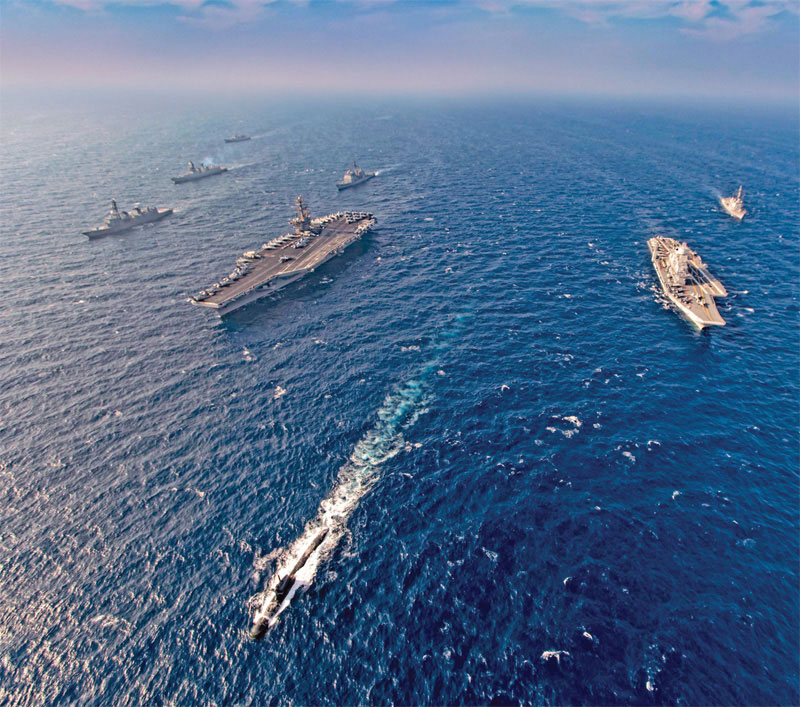
Ships of India, the US, Japan and Australia sailing in the IOR during Malabar exercise
Soon after taking over, Jaitley, who concurrently held the finance and defence portfolios, had stated that maritime security is the government’s top priority. On 14 June 2014, Prime Minister Narendra Modi, just over three weeks in office and on his first outstation trip embarked the aircraft carrier INS Vikramaditya and spent a day at sea witnessing the Western Fleet being put through its paces. In August 2014 he commissioned INS Kolkata, a Project 15A destroyer and a showpiece of India’s indigenous warship building capability. In 2015, a multi-crore port-led sustainable maritime infrastructure programme called Sagarmala was launched by the Government. Also, in 2015, during his visit to Mauritius, the Prime Minister articulated the concept of SAGAR, an acronym for ‘Security and Growth for All in the Region’ aimed at capacity and capability building in India’s strategic neighbourhood. In February 2016 India hosted an International Fleet Review at Visakhapatnam in which over 50 navies participated. Two months later a Global Maritime Summit was held in Mumbai which focussed on the non-military aspects of maritime power. This focus on the maritime domain was encouraging and not unexpected. However, in the six years since, the outcomes have fallen far short of the intent.
India’s Maritime Credentials
India is essentially a maritime nation. Its peninsular tip jutting almost a thousand miles into the Indian Ocean gives it a pivotal and strategic location overlooking some of the most critical sea lanes in the world. The maritime domain is critical for India’s security and economic well-being. Over 90 per cent of its trade by volume and 77 per cent by value transits over the sea and is serviced by 13 major ports and about 190 non-major ports. More than 80 per cent of India’s energy requirements are met from the sea, with a major portion transiting on tankers from other parts of the world. India’s largest export is refined petroleum products which travel more or less entirely over the sea thus further underlining the importance of the maritime domain for the country’s energy security.
Subscribe To Force
Fuel Fearless Journalism with Your Yearly Subscription
SUBSCRIBE NOW
We don’t tell you how to do your job…
But we put the environment in which you do your job in perspective, so that when you step out you do so with the complete picture.






 VIDEO
VIDEO