India was the world’s fastest growing domestic aviation market for the third straight year in 2017, according to global airlines’ body International Air Transport Association (IATA), which represents around 280 airlines comprising 83 per cent of the world’s air traffic. Simultaneously, Director General, IATA, Alexandre de Juniac, in his keynote address at the Singapore Air Show Aviation Leadership Summit (SAALS) 2018, called for urgent attention to address infrastructure challenges to secure the future of the aviation sector.
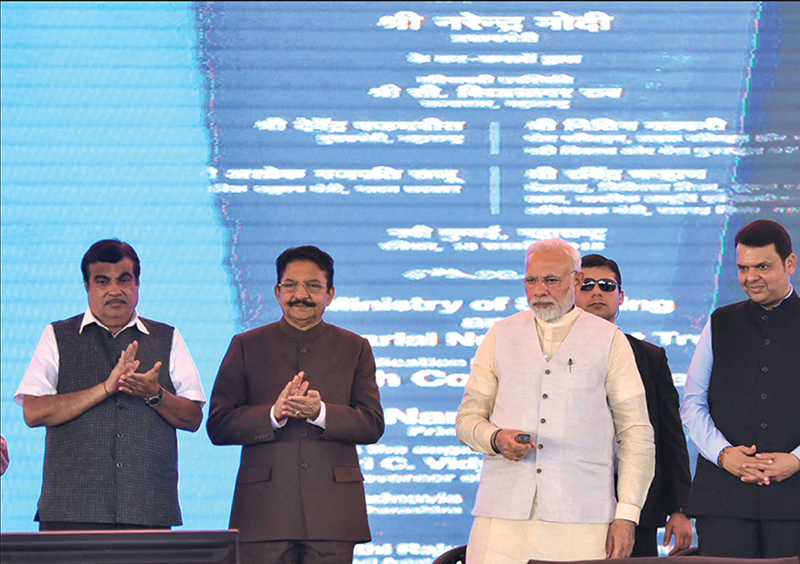
Prime Minister Narendra Modi laid the foundation stone of the New Mumbai International Airport
which was planned in 1997 on 18 February 2018
The supply and demand gap for aviation infrastructure has increased, primarily for airports, which not only aid airlines but also contribute to the local economy of the region. Acknowledging this, the Union Budget 2018 focussed on the expansion of airport infrastructure. Finance minister Arun Jaitley outlined the broad contours of the government’s massive airport building and modernisation plan, NABH (Next Gen Airports for Bharat) Nirman, in his budget address.
NABH Nirman aims to develop 100 new airports in the next 10 years for the country to handle one billion air trips per year. It also attempts to ease regulations and raise funds through Airports Authority of India (AAI). While India is looking to complete the project by 2027, China plans to build 73 new airports by 2020. Air traffic surge has already choked airports in Delhi and Mumbai over the last three to four years as nearly a third of the flights at Mumbai airport were delayed due to congestion in 2017.
There is talk to revise the regulatory framework for airports under NABH Nirman as well as look at developing multiple aerodromes in metro cities as part of long-term efforts to boost capacity. Revising regulatory framework for airports, strengthening AAI, forging partnerships with states, having multiple airports in metros and boosting air navigation system to manage the crowded airspace should be the key aspects of the yet to be drafted framework. A Request for Proposal (RFP) has been issued for a detailed study to understand the demand and capital requirements for NABH Nirman.








 VIDEO
VIDEO