Crowd control is a very important aspect of policing and an extremely complex domain when it comes to a country like India. Crowd management by armed forces is dictated by a number of factors, including variations owing to aspects like socio-political situations, demographics, inter-community issues, extremism, crowd psychology, hostility levels, cause of violence, police strength, and a host of other issues.
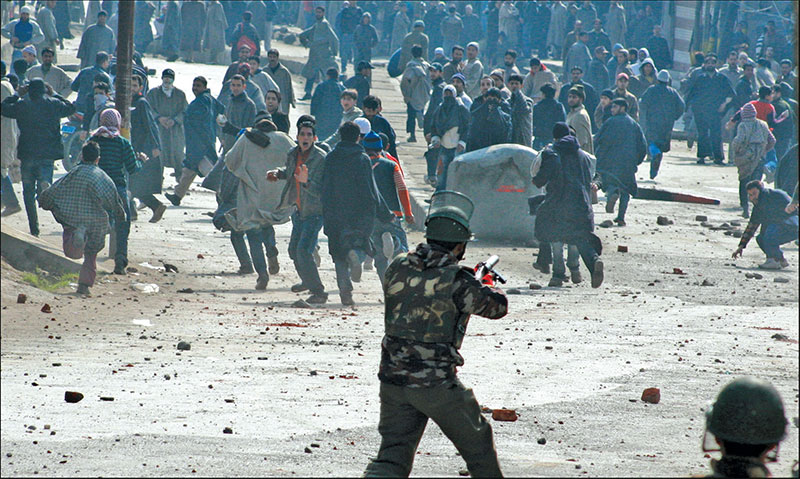
Security forces confronting protestors in Kashmir
Despite the phenomenal increase in the incidences of violence, the state police personnel lack adequate modern-day less lethal weaponry. Even the Central Armed Police Forces (CAPFs) lack effective and non-lethal weaponry to disperse unruly crowds. The availability of relevant and acceptable less lethal weapons to be used in crowd control operations has seen a gap primarily because of intense media scrutiny and public resistance to tolerate high-handedness, besides human rights considerations.
Adding to the mismanagement, the Indian armed forces lack proper training in controlling crowds. Crowd control drills are still the same as used in the colonial era. Most of the equipment by and large also hasn’t changed much in several decades.
The government had to look for non-lethal options after coming under fire for grievous injuries caused to civilians in Jammu and Kashmir by pellet guns, which according to the Central Reserve Police Force (CRPF) are highly effective in controlling agitated crowds. Consequently, the home ministry had set up a panel to examine the option of using non-lethal alternative to the pellets to control riots.
Kashmir witnessed the worst protests in 2010 when around 110 protesters died of bullet injuries after being fired at by security forces. It was after that incident that the Union home ministry sent the 12-gauge pump-action shotguns to Kashmir to control the growing mobs. The pellets were considered a less lethal option as they lodged into human tissue without killing, but what followed was contrary to government claims.






 VIDEO
VIDEO